If you have followed along, you know we’re building AirGradient Go in public. That means not just sharing the polished end result, but also the messy middle - the trade-offs, the dead ends, and the tiny mechanical details that can make or break a product.
With that in mind, today I want to discuss how we came up with the enclosure. I don't just want to share the pretty render at the end, but rather, the real journey: what we saw missing in other portable monitors, what we wanted to get right from day one, and why a “simple box” turned into one of the most constrained engineering puzzles of the whole device.
Before we designed anything, we used a bunch of portable monitors and paid attention to where they fell short in real life. A few gaps kept showing up.
1) No display - no independence
Some devices are technically capable, but without a display you’re basically forced into using your phone for every interaction. The Atmotube and AirBeam are good examples of this pattern - functional, but not autonomous.
We wanted AirGradient Go to be useful even if your phone is in your pocket, out of battery, or you’re simply not in the mood to open an app. That meant:
- a built-in display
- built-in navigation buttons
- on-device interactions like tagging pollution spots
2) Not weatherproof - not truly portable
A portable device that can’t handle humidity, rain, or being clipped to a bag is portable only in theory. Some products are not designed for harsh conditions.
We wanted Go to handle real-world use. If it’s on your backpack during a ride, it should survive.
3) Too dependent on a companion app
Building on point #1, some competitors lean heavily on the smartphone for core features outside of the display. We deliberately aimed for a complete feature set without the phone:
- built-in storage
- built-in GPS
- built-in display
- built-in navigation controls to tag spots and interact with the device
This was a key philosophical choice - and it had immediate mechanical consequences. More features means more components, more PCB area, more openings in the enclosure, and more design work to keep things robust and weather resistant.
And yes - the PCB got tight. Very tight.
Portability is not one use case
A common pattern in “portable” devices is designing for exactly one form factor: hand-held, pocketable, maybe clipped somewhere.
We wanted something more versatile. In practice, people use monitors in different ways depending on the day. So we designed the enclosure to support multiple modes:
- hang it on a backpack
- put it into a sleeve
- mount it on a wall (stationary monitoring)
- put it on a desk
This sounds simple, but each mode pulls the design in different directions. Backpack mounting demands strength. Wall mounting wants clean geometry and stable orientation. A sleeve wants smooth edges and nothing that snags. Desk use wants stability and readability.
The enclosure had to be “portable” and “stationary” without being compromised at both.
Size constraints - sensors decide the geometry
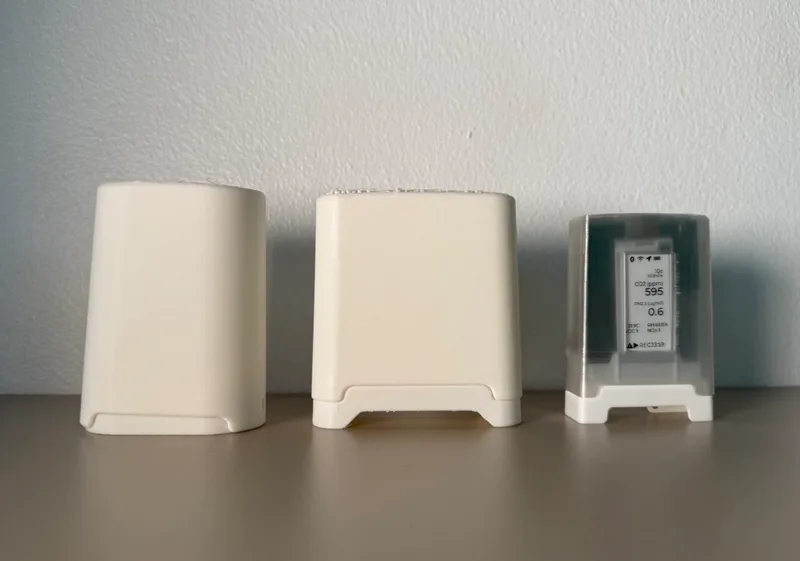
You can’t design the enclosure first and then “fit the sensors in later” - the sensors are the enclosure.
For particulate matter, we wanted a sensor class that has proven performance over time. That means a certain minimum physical size. We looked at very small sensing concepts like Bosch BMV080, but for us, it felt too risky at this stage because it relies on optical field-of-view constraints and airflow assumptions that are hard to guarantee in a compact, weatherproof enclosure.
In other words: exciting technology, but too many unknowns for a device we want people to trust.
So we designed around more established options - think Sensirion SPS30 or Plantower-class modules. Those sensors need space, airflow planning, and careful placement.
We also wanted the option to fit an NDIR CO2 sensor. There are smaller alternatives (SCD40, STCC4, etc.), but true NDIR sensors still come with a size and power cost that affects the enclosure design early.
And the battery...
At the beginning, I was quite focused on using a standard 18650 battery (or even two). From a “maker perspective” that’s appealing - standardized, user-replaceable, widely available.
But after trying hard to make it work, I had to admit something: in the form factor we wanted, cylindrical cells just weren’t ideal. They force a round-ish geometry or waste space, and the enclosure becomes larger than it needs to be. So we moved to a standard pouch battery.
Once you choose the PM sensor, the next biggest physical driver is the battery. Beyond a certain point, battery volume becomes the main determinant of enclosure size.
The real trade-off matrix
Enclosure design is never “make it small.” It’s always competing objectives.
For Go, the big tensions were:
- size vs runtime
- weatherproofing vs airflow requirements
- compact design vs accurate temperature measurements
One example: if you make the enclosure too sealed, you can create heat buildup. Heat influences sensor readings, especially temperature and humidity, and it can affect PM readings indirectly via airflow patterns. On the other hand, if you add too many openings, you compromise weather resistance and durability.
There is no perfect solution - only a set of compromises that you can justify, test, and improve.
Small things that matter more than you’d think
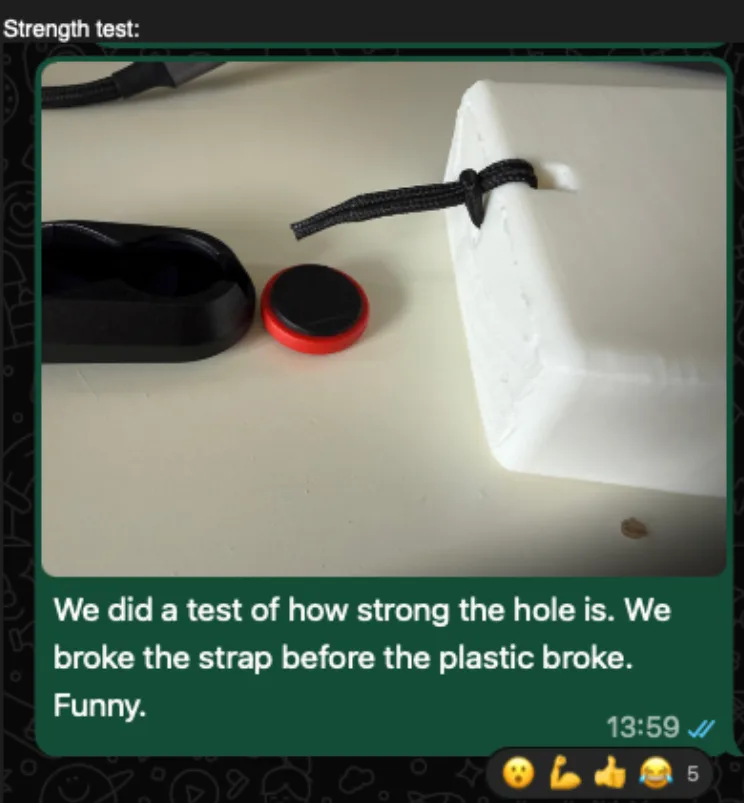
I always underestimate how much time the “small stuff” takes. Then I build hardware again and remember.
Here are a few details that became surprisingly important:
- USB clearance: not every USB-C plug is the same size. If you don’t leave enough space, some cables will not fit.
- Strength around the hanging hole: a backpack mount point needs to survive real stress, not just look good in CAD. The material thickness and reinforcement around that hole matters.
- Temperature accuracy: we’re planning an external temperature probe so temperature is less affected by the device’s internal heat. This is one of those decisions where you trade mechanical simplicity for better data integrity.
Where we landed (for now)
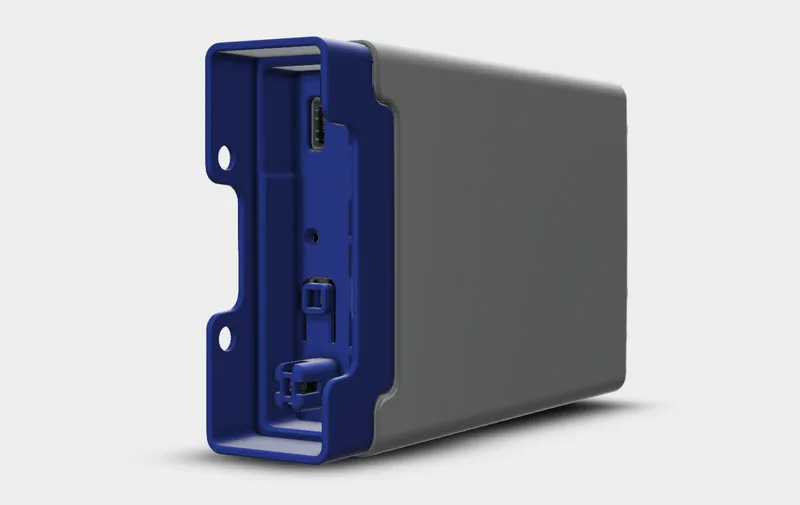
The enclosure we’re building and that is currently with the mold maker is the product of dozens of micro-decisions, each with a reason behind it.
It’s weatherproof because it has to be used outside. It’s autonomous because we want the device to stand on its own. It’s multi-mode because “portable” is not one lifestyle. And it’s the size it is because physics - and reliable sensing - demands it.
In around a months time we expect the first samples from the mold maker, and at the same time we test and improve our circuit boards and will decide on the final selection of sensors.
Stay tuned for more blog posts!
Also, if you like to be informed about this development and potentially when we start a pre-order, sign up here.