Open and Accurate Air Quality Monitors
We design professional, accurate and long-lasting air quality monitors that are open-source and open-hardware so that you have full control on how you want to use the monitor.
Learn MoreAir pollution is often reduced to averages and indices - a single number that’s meant to summarise an entire city or country. But that’s not how people experience it. For residents in Almaty, pollution shows up as smog that blocks the mountains, a smell that lingers in winter, irritated eyes and throats, and the slow accumulation of exposure over the years. To understand air quality properly, measurements need to reflect those lived conditions, street by street, not just city-wide averages.
That gap between official measurements, daily experience and action is what led to the creation of the Almaty Air Initiative (AAI).
While spending the winter in Almaty, AAI co-founder Arsen Tomsky was struck not only by how dense the smog could become, but by how normalised it seemed. Pollution was everywhere, yet largely invisible in public discussion. This wasn’t because it wasn’t severe, but because there wasn’t enough data in the places people actually live. This observation quickly became something more concrete with the realisation that air quality in a city like Almaty is not just an environmental issue, but a data and management problem.
This observation evolved into a concrete mission with the realization that air quality in a city like Almaty is not just an environmental issue, but a complex data and management problem. To address this, Arsen teamed up with visionary technologist Kairat Akhmetov to co-found the initiative. Together, they set out to build an organization capable of driving systemic change – one grounded in rigorous measurement, careful analysis, and a commitment to "playing the long game”.
While Almaty was the first focus, the aim was not to create a one-off project for the city, but a practical, repeatable model that could be applied in other cities facing similar challenges.
In June of 2025, I had the pleasure of visiting and spending a few months in Almaty. During this time, I visited Ravkat and the Almaty Air Initiative team a few times to help with the deployment of their AirGradient network. It was instantly apparent just how dedicated and motivated the AAI team is, and - as you’ll soon learn - the network they’ve set up is truly impressive. Walking through the streets of Almaty, I came across an air quality monitor every few blocks. I hope this can help set an example for other organisations hoping to set up dense air quality monitoring networks.
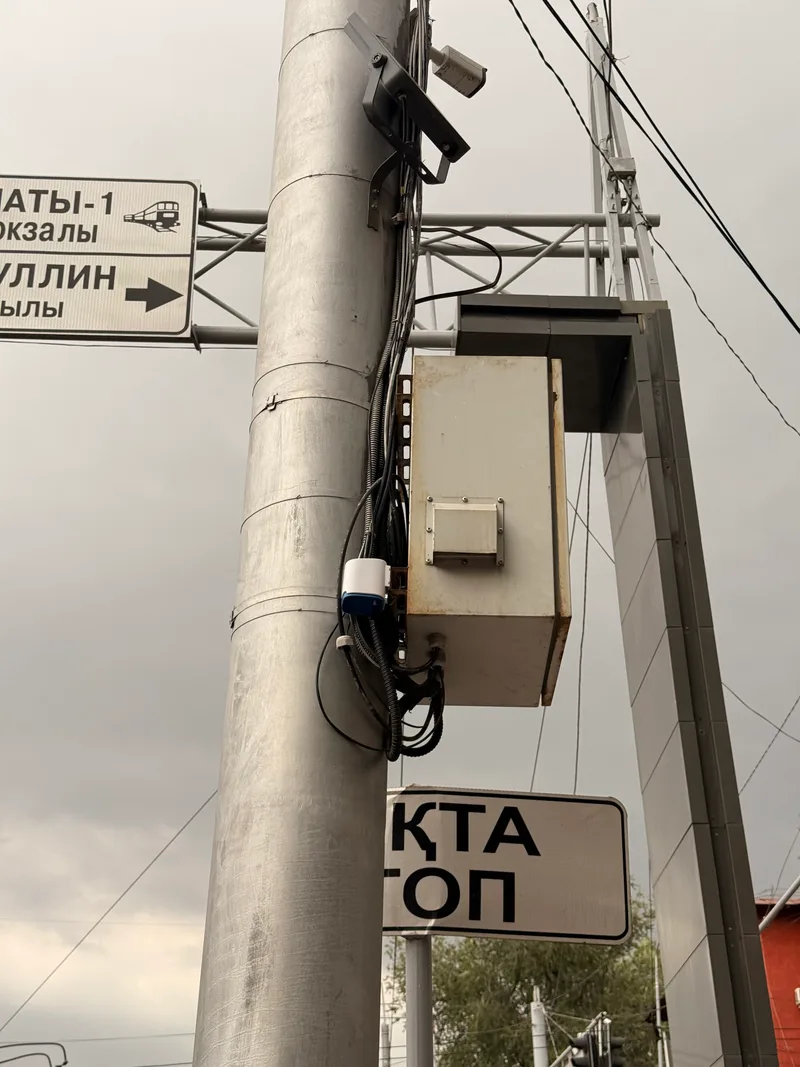
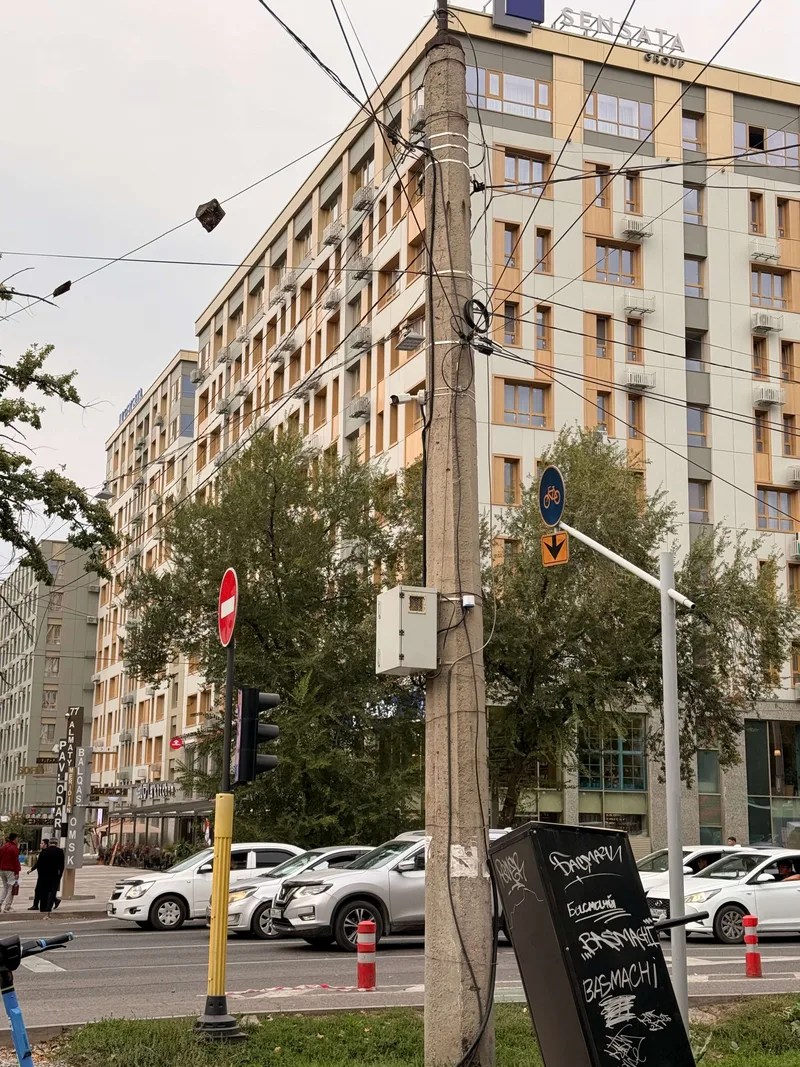
After over a year of hard work, in September 2025, Almaty Air Initiative’s planning led to the deployment of 170 air quality monitors across the city, creating what is currently the largest sensor network installed by a single organisation in Asia. The monitors were placed deliberately around the city, with some in residential neighbourhoods, near schools and hospitals, and some across industrial and mixed-use areas. Every monitor was placed with the aim of capturing how pollution actually varies across the city.
A dense, low-cost sensor network fills in the gaps, increasing spatial resolution and making pollution patterns visible where people live, commute, and spend their time.
All measurements are published openly on AAI’s public dashboard, the AirGradient Map, and other large platforms such as OpenAQ, ensuring the data remains accessible and transparent.
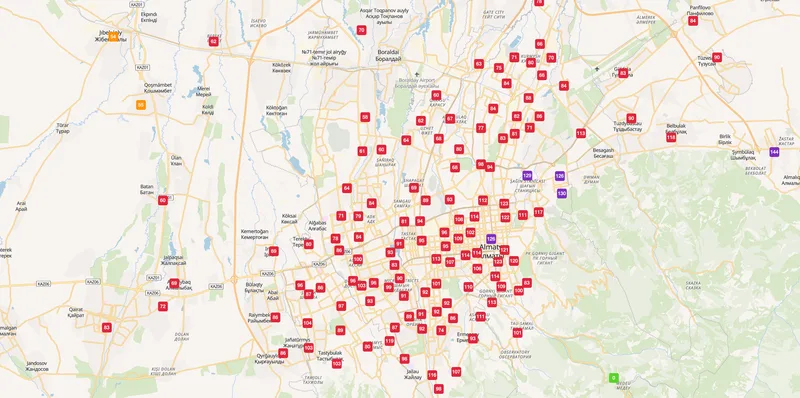
Almaty’s air-quality challenges are shaped by a combination of factors: its geography, seasonal heating demand, and emissions from transport and solid fuel use. These influences do not affect the city evenly. Pollution levels can vary significantly depending on location, time of day, and weather conditions - sometimes over distances of just a few streets.
City-wide averages smooth out those differences, but they also conceal them. Dense monitoring does the opposite. It reveals where pollution concentrates, how it moves, and when it worsens. That level of detail is essential for meaningful analysis, credible modelling, and evaluating whether policies are actually delivering results.
Just as importantly, it makes pollution visible. When air quality can be seen on a neighbourhood map rather than inferred from a distant station, it becomes harder to ignore and easier to discuss in concrete terms.
Hardware choice matters when deploying at scale. For this network, AAI partnered with AirGradient, largely because our approach aligned closely with the Initiative’s values.
Transparency was a key factor - open data, open methodologies, and sensors designed to be examined rather than treated as black boxes. Practical considerations mattered too. Being based in Asia, AirGradient has experience with high-pollution environments and the logistical realities that come with them. Just as importantly, the absence of mandatory subscriptions keeps long-term costs predictable, allowing resources to be directed towards analysis, public engagement, and advocacy rather than ongoing platform fees.
For a public-interest project, sustainability isn’t just about hardware longevity - it’s about keeping the data accessible over time.

One of the first findings from the expanded network was that pollution levels in northern parts of Almaty may have been consistently underestimated in the past. These areas previously had very limited monitoring coverage, meaning local conditions were largely absent from official datasets.
With the new sensors in place, differences between districts became much clearer. Early data suggests that residential coal use, small-scale combustion sources such as bathhouses, and the influence of nearby thermal power plants may play a larger role in northern neighbourhoods - areas that are home to a large share of the city’s population.
Rather than pointing to a single source, these observations highlight that without sufficient spatial coverage, important pollution patterns can remain invisible.
Once the network went live, something interesting happened. Residents began checking the data - not only occasionally, but regularly. Screenshots of the sensor map started appearing on social media, with people comparing neighbourhoods, tracking daily changes, and discussing what they were seeing.
This is one of the strongest arguments for dense, open monitoring. When data is local and easy to access, air quality stops being an abstract environmental issue and becomes part of everyday decision-making - when to open windows, when to go outside, and when conditions are improving or deteriorating.
Despite the impact so far, deploying 170 monitors across Almaty is not an endpoint. It is the foundation.
With high-resolution, neighbourhood-level data now available, the city has the tools needed for deeper analysis, stronger modelling, and more informed discussion - not just among experts, but between residents, researchers, and decision-makers.
For large cities facing complex air-pollution challenges, access to local, real-time data is often the turning point. It is when air quality shifts from something that feels unavoidable to something that can be measured, understood, and addressed through evidence-based action.
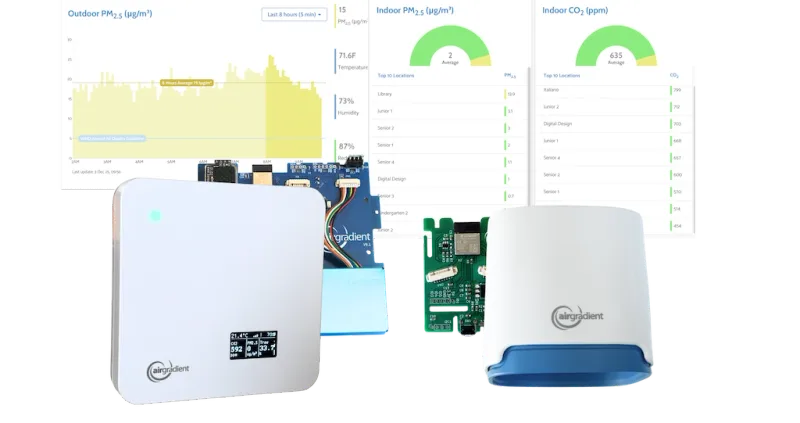
We design professional, accurate and long-lasting air quality monitors that are open-source and open-hardware so that you have full control on how you want to use the monitor.
Learn MoreCurious about upcoming webinars, company updates, and the latest air quality trends? Sign up for our weekly newsletter and get the inside scoop delivered straight to your inbox.
Join our Newsletter