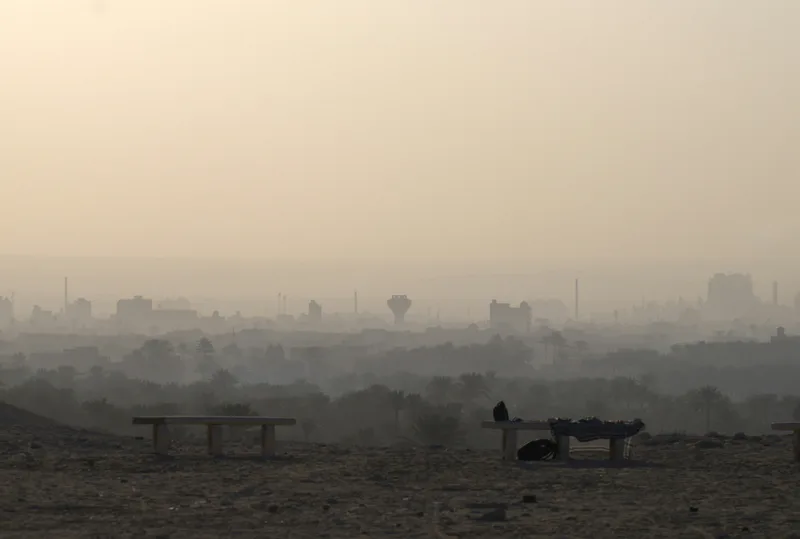
Pai is often framed as a mountain escape with clean air and beautiful scenery. But right now, this isn’t the case. Air pollution levels in Pai have reached extreme levels. During the burning season, this kind of pollution is often described as “haze,” which makes it sound like a surface-level visibility problem. But that framing misses what is actually happening. What Pai is experiencing is a severe PM2.5 event, and the available numbers clearly show this.
Thai PBS reported 24-hour average PM2.5 concentrations in northern Thailand reaching as high as 318.6 µg/m³, with Pai among the worst-hit locations. Other Thai local reports placed Pai at 232.5 µg/m³ in one case, while international coverage described some monitors in Pai recording PM2.5 of over 900 µg/m³.
Those numbers do not all come from the same system, and they should not be treated as interchangeable. Different monitors, averaging windows, and reporting methods matter, but that uncertainty does not weaken the main conclusion. The WHO 24-hour guideline for PM2.5 is 15 µg/m³. Once reported concentrations are in the hundreds, the only serious question left is not whether the air is unhealthy, but how extreme the exposure has become and how long it will last.
This is where the usual language around northern Thailand fails. The term “haze” sounds mild, temporary, and more like an inconvenience. But PM2.5 is not a visibility metric. It is a particulate exposure metric. These particles are small enough to penetrate deep into the lungs, and some fraction can enter the bloodstream. At the levels being reported in Pai, this has less to do with unpleasant scenery and more to do with breathing air that is plainly dangerous.
Pai also shows why local air quality monitoring matters more than generic summaries. As mentioned earlier, a mountain town is not automatically a clean-air refuge. In smoke season, the opposite can be true. Valleys and basins trap pollution, weak ventilation slows clearing, and particulate matter accumulates when wildfire smoke, agricultural burning, and regional transport smoke combine. These conditions make Pai exactly the kind of place where a single distant station or broad provincial average is not enough.
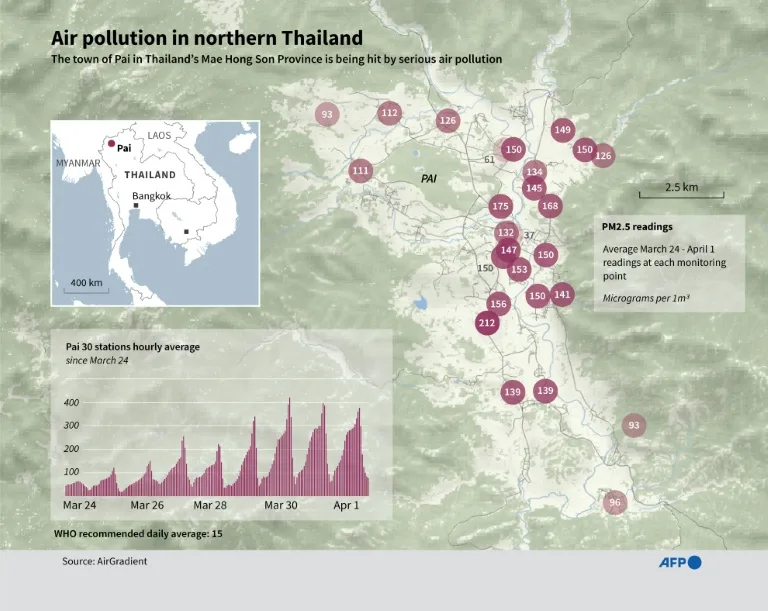
People need measurements that reflect the air quality where they actually live, work, and are constantly exposed to. If the data is too sparse, delayed, or abstract, then the people most affected are left with the least useful information.
The lived reality in northern Thailand matches what the numbers suggest. AFP quoted Pon Doikam, a 36-year-old coconut seller, saying, “It’s suffocating.” She added, “It feels like you’re trapped in the smoke constantly.” Volunteer firefighter Maitree Nuanja described the scene in similarly direct terms: “Everyone can see how serious it is now. It’s so dark and hazy you can’t see a thing, and it’s gone on for far too long.”
Those are not dramatic embellishments. They are exactly what severe PM2.5 episodes look like when translated into daily life. Burning eyes, difficult breathing, days of persistent smoke, limited visibility, and the sense that the crisis is being normalized because it happens every year.
Thai-language reporting adds another important detail: public frustration. One Khaosod headline focused on the fact that pollution had exceeded standards for seven straight days while residents in Pai were publicly asking when authorities would declare a disaster zone. That matters – as it shows us that once people can see the severity for themselves, track it on monitors, and feel it physically, vague official language starts to look less like caution and more like denial.
Our view is simple. Pai should not be discussed as a beautiful destination temporarily obscured by smoke. It should be discussed as a place experiencing repeated episodes of severe particulate pollution. And if we are serious about protecting public health, then we need to stop using soft language for hard exposure.
That means better local monitoring, more honest communication, cleaner indoor refuges, and much less tolerance for the idea that extreme smoke is just part of life in the north. Seasonal repetition does not make a public health problem normal – it makes it chronic.
Pai is a good example of why open, accurate, and affordable monitoring networks matter. When pollution becomes this severe, people need evidence, local context, and the ability to act on real data.
Sources
AFP. (2026, April 3). ‘It’s suffocating’: Why Chiang Mai’s air is among the world’s worst right now. Malay Mail. https://www.malaymail.com/news/world/2026/04/04/its-suffocating-why-chiang-mais-air-is-among-the-worlds-worst-right-now/214957
Bangkok Business News. (2026, April 2). ยกระดับสู้ “ไฟป่าแม่ฮ่องสอน” ฮ.ทส. ระดมทิ้งน้ํา 3 หมื่นลิตร สกัดฝุ่น PM2.5. Bangkokbiznews. https://www.bangkokbiznews.com/news/news-update/1227985
Khaosod. (2026, April 2). ค่าฝุ่นพิษ เกินมาตรฐาน 7วันแล้ว คนเมืองปาย โพสต์ถาม จะประกาศเขตภัยพิบัติกี่โมง. Khaosod. https://www.khaosod.co.th/around-thailand/news\_10195832
Rramida. (2026, April 1). ปายยังมืดทึบจากหมอกควัน. Chiang Mai News. https://www.chiangmainews.co.th/social/3909415/
Siamrath. (2026, March 30). ไฟป่าแม่ฮ่องสอนหนัก! ค่าฝุ่น PM2.5 อ.ปายพุ่ง 232.5 ไมโครกรัม เสี่ยงต่อสุขภาพ. สยามรัฐ. https://siamrath.co.th/regional/news/138094
Thai PBS. (2026, April 7). ภาคเหนือจมฝุ่น PM 2.5 อ.ปาย จ.แม่ฮ่องสอน หนักสุด พุ่ง 318 มคก./ลบ.ม. Thai PBS. https://www.thaipbs.or.th/news/content/504256
Malay Mail / AFP: It’s suffocating: Why Chiang Mai’s air is among the world’s worst right now - https://www.malaymail.com/news/world/2026/04/04/its-suffocating-why-chiang-mais-air-is-among-the-worlds-worst-right-now/214957