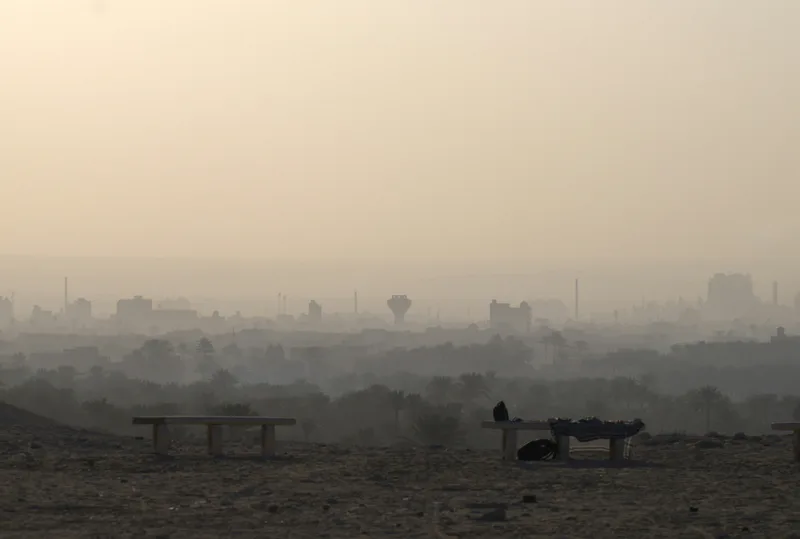
I recently came back from a holiday in the French Alps, where I go almost every year, and the last thing on my mind was the possibility that the fresh winter air I was breathing was unhealthy. After all, being surrounded by mountains, pine trees, and blue skies must mean clean air, right?
Unfortunately, the reality is quite the opposite.
The Arve Valley, situated at the foot of the Mont-Blanc mountain range and home to world-renowned ski villages such as Chamonix and Megève, is also one of the most polluted places in France. In fact, just last week, authorities placed parts of the valley under an orange alert for elevated atmospheric pollution due to fine particles. This corresponds to a 24-hour average PM10 concentration above 50 µg/m³.
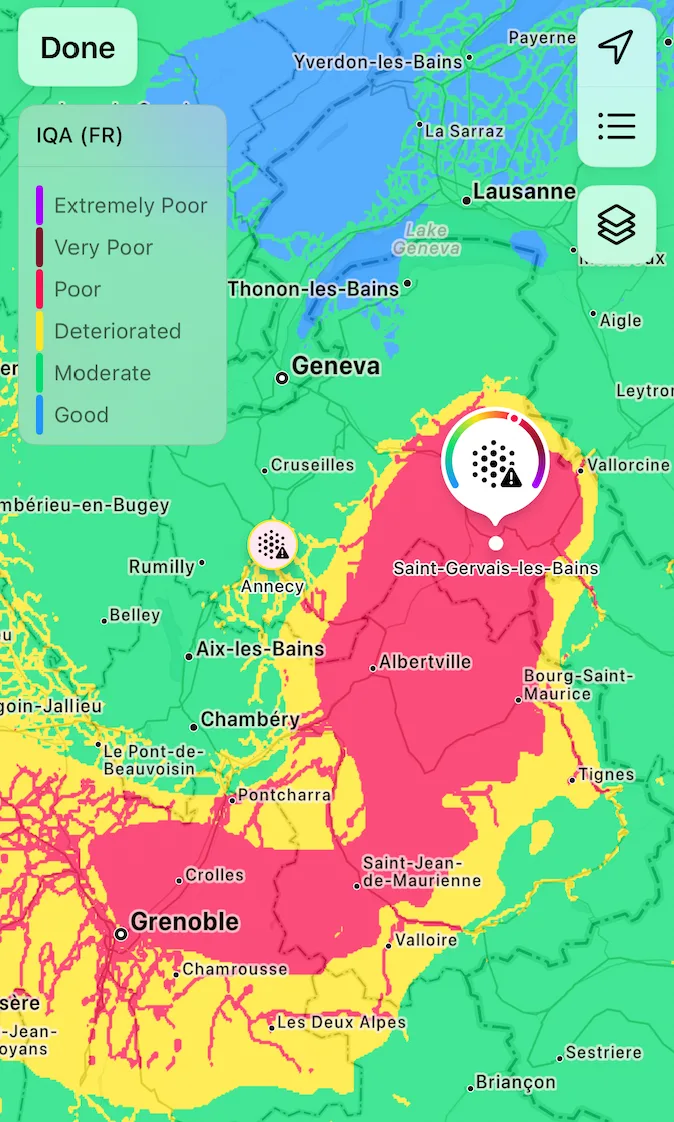
What makes these episodes disorienting is how normal they can look; there isn’t always a thick smog hovering over the landscape. In fact, locals sometimes call it a ‘tempête de ciel bleu’ (a ‘storm of blue sky’): bright sun, perfect visibility, and a buildup of fine particles at the same time.
That’s because the calm, clear weather that feels ‘fresh’ can be exactly what locks pollution in place. In winter, high-pressure systems often bring stable air and very little wind. Cold air sinks into the valley while warmer air sits above it, creating what the director of the region’s air quality observatory calls a ‘lid’ effect. Emissions from heating, traffic, and everyday activity don’t disperse upward, and instead linger and accumulate near the ground. The valley’s shape worsens this, concentrating homes and roads into a narrow corridor where the air doesn’t move much.
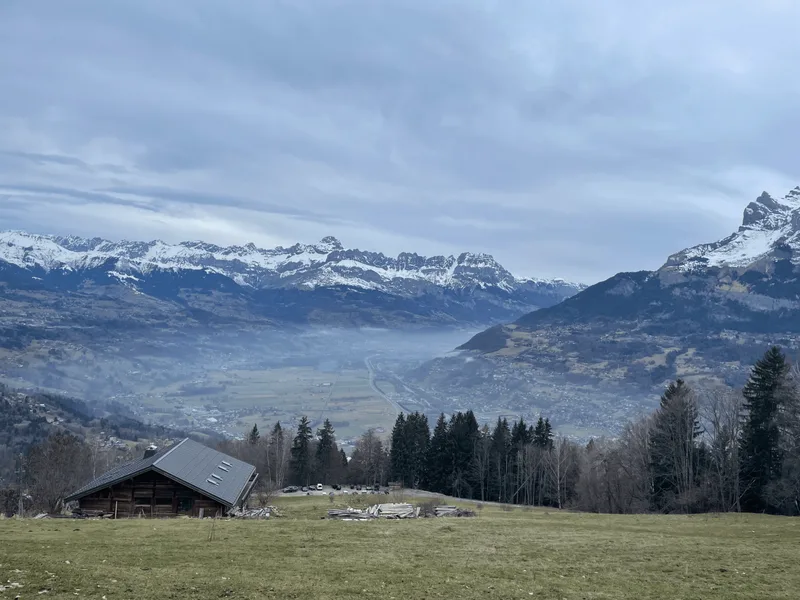
In theory, you can escape the worst of it if you stay above the ‘lid’ layer; however, the exact altitude at which it forms can vary day-to-day, sometimes trapping higher-altitude villages within it. Furthermore, it’s unfeasible to completely avoid it, as all the main activity centres such as large supermarkets, train stations, and gas stations require a trip down into the valley. For those living there, this is where most workplaces and schools are located, making it a near-daily hazard.
An invisible problem with real consequences
During these alert periods, authorities advise to reduce intense outdoor activity, which is quite a bummer for the many tourists who come all the way here to ski and hike. But the deeper issue is that long-term exposure matters too, and repeated winter episodes can add up, which is not good news for habituals vacationers of the area like myself.
In the Arve Valley, air pollution is responsible for 8.8% of deaths, which represents around 93 premature deaths per year attributable to PM2.5 and 9 months of life expectancy loss by the age of 30. If we include nitrogen dioxide (NO2) pollution – primarily caused by fuel combustion from vehicles – this burden adds up to 12.6%, with an estimate of 133 deaths per year. These values are relatively similar to those of medium-sized urban areas, but still remain smaller than those of big cities. Prolonged exposure over several years is linked to the development of chronic cardiovascular, respiratory, and neurological conditions, as well as cancers. This is without factoring in the additional risk for vulnerable populations, such as children, older adults, and those with asthma or heart and lung conditions.
The local sources of pollution
As mentioned earlier, the Arve Valley’s topography is in part responsible for its high pollution. However, these pollutants don’t appear out of thin air; there are three main sources contributing to their accumulation, especially during the winter season.
1. Heating: residential wood burning
Whether you’re familiar with the Alps or not, you can surely picture a stereotypical alpine village with people living in snow-covered wooden houses called ‘chalets’, enjoying a hot drink around a cosy fireplace.
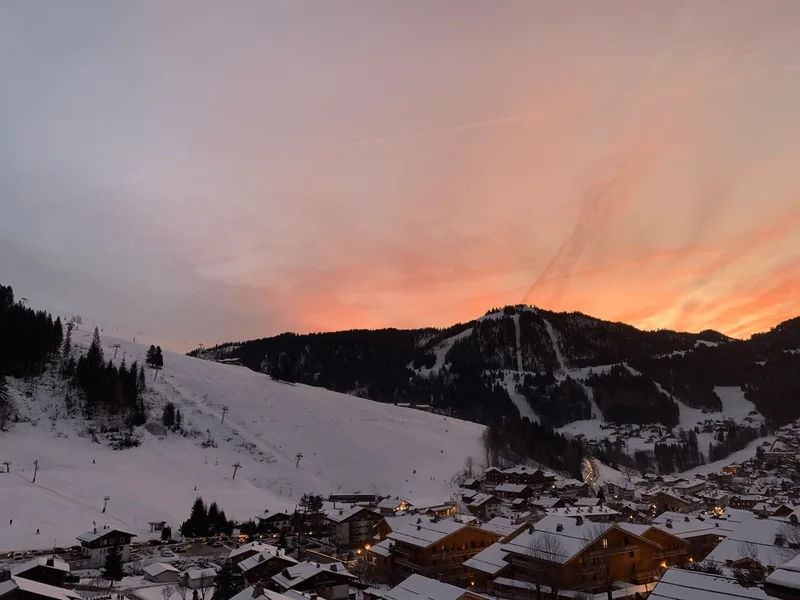
Well, in this case, the stereotype is very accurate. Around most chalets, you can spot stacks of wood ready to be used throughout the season. Beyond being a heating method, wood burning is also a cultural practice, used for traditional cooking and social events.
However, it turns out that residential wood burning is the biggest driver of this pollution. According to the French regional environment authority, old or inefficient wood-burning methods as a means of heating accounts for about 60% of the average yearly PM10 emissions in the Arve Valley, and around 80% in the winter. This includes open fireplaces and old wood stoves.
And not all wood heating is equal. Open fireplaces are particularly bad – a traditional open hearth can emit up to 30 times more particles than a high-performance modern appliance with closed and controlled combustion.
2. Traffic: the Mont Blanc tunnel
Despite its rustic mountain charm, the valley gives way to the Mont Blanc tunnel – a major transport route for trucks from all over Europe passing into Italy. In 2024, the tunnel saw an average of over 1,300 heavy goods vehicles per day, and around 4,000 light vehicles per day. As I witnessed firsthand, this massive daily traffic creates long queues starting kilometres before the tunnel’s entrance, where traffic is slowed down for customs checks and safety purposes.
This heavy-duty diesel traffic is a double hit for air quality: it contributes directly to particles and also to nitrogen dioxide (NO₂), which has its own harmful health effects as well as contributing to secondary particle formation.
3. Industry: less significant but still present
The valley also hosts industrial activity, notably a major ‘bar turning’ industry, which is the precision machinery of small parts made for watchmaking, vehicles, and electronics. However, this is more relevant for industrial air pollutants (especially VOCs) and for localized emissions near activity clusters. As of 2024, industry only makes up 10% of PM2.5 emissions.
The atmospheric protection plan
In response to this issue, France developed an atmospheric protection plan ‘Plan de Protection de l’Atmosphère’ (PPA) for the Arve Valley in 2012. Revised numerous times since then, here are some of the regulations it has put forward:
Open fireplaces have been banned since January 1st 2022 across the PPA perimeter (comprising of 41 communes)
Each winter (from 1 November to 31 March), speed limits are reduced on key roads in the valley (for example, motorway sections shift from 130 to 110 km/h)
When pollution intensifies, prefectural measures reported in local news can include restrictions on heavy goods vehicles based on their Crit’Air category (which assigns a number to vehicles based on their polluting level), with the most polluting vehicles temporarily barred or limited
During alerts, there can also be bans on practices like burning green waste and setting off fireworks
A good lesson
Personally, I’ll be thinking twice next time I go on a hike or cross-country skiing. This is a prime example of the importance of regularly checking a reliable local air quality monitoring source, wherever you are. This is true in the Arve Valley, but it’s also true in plenty of other ‘outdoorsy’ places where topography, winter weather, and pollutant sources can create the same trap. Unfortunately, regardless of how bucolic a place may be, rurality and nature are not reliable measurements of clean air.
Sources:
Atmo Auvergne-Rhône-Alpes. (2024, October). Évaluation du PPA de la vallée de l’Arve : Évaluation quantitative du PPA de la vallée de l’Arve [Evaluation of the Arve Valley PPA: quantitative evaluation of the Arve Valley PPA]. https://www.auvergne-rhone-alpes.developpement-durable.gouv.fr/IMG/pdf/2024_rapport_evaluation_ppa_arve.pdf
Autoroutes et Tunnel du Mont Blanc (ATMB). (n.d.). Le suivi du trafic routier au Tunnel du Mont Blanc, sur l’Autoroute A40 et sur la Route Blanche RN205 [Road traffic monitoring at the Mont Blanc Tunnel, on the A40 motorway and Route Blanche RN205]. https://www.atmb.com/actualites-et-presse/suivi-trafic-routier-tunnel-du-mont-blanc-autoroute-a40/
Direction régionale de l’environnement, de l’aménagement et du logement (DREAL) Auvergne-Rhône-Alpes. (2021, December 7). Vallée de l’Arve, interdiction des foyers ouverts, une mesure forte pour la protection l’atmosphère [Arve Valley: ban on open fireplaces, a strong measure to protect the atmosphere]. https://www.auvergne-rhone-alpes.developpement-durable.gouv.fr/vallee-de-l-arve-interdiction-des-foyers-ouverts-a20781.html?lang=fr
Direction régionale de l’environnement, de l’aménagement et du logement (DREAL) Auvergne-Rhône-Alpes. (2025, November 6). PPA de la vallée de l’Arve [Atmosphere protection plan (PPA) for the Arve Valley]. https://www.auvergne-rhone-alpes.developpement-durable.gouv.fr/ppa-de-la-vallee-de-l-arve-r5082.html?lang=fr
Franceinfo. (2015, February 15). Haute-Savoie : la vallée de l’Arve est la plus polluée de France [Haute-Savoie: the Arve Valley is the most polluted in France]. https://www.franceinfo.fr/france/haute-savoie-la-vallee-de-l-arve-est-la-plus-polluee-de-france_825737.html
France 3 Régions. (2025, December 29). Pollution de l’air en Haute-Savoie : la vallée de l’Arve placée en vigilance orange, plusieurs restrictions en vigueur [Air pollution in Haute-Savoie: the Arve Valley placed on orange alert; several restrictions in effect]. https://france3-regions.franceinfo.fr/auvergne-rhone-alpes/haute-savoie/chamonix/pollution-de-l-air-en-haute-savoie-la-vallee-de-l-arve-placee-en-vigilance-orange-plusieurs-restrictions-en-vigueur-3273665.html
Le Dauphiné Libéré. (2026, January 6). Haute-Savoie. L’alerte pollution de l’air pour la vallée de l’Arve et la Faucigny sera levée ce mercredi [Haute-Savoie: the air-pollution alert for the Arve Valley and Faucigny will be lifted this Wednesday]. https://www.ledauphine.com/environnement/2026/01/04/la-vallee-de-l-arve-et-le-faucigny-passe-en-vigilance-orange-pollution-ce-lundi-5-janvier
Préfecture de la Haute-Savoie. (n.d.). Gestion des épisodes de pollution [Management of pollution episodes]. https://www.haute-savoie.gouv.fr/Actions-de-l-Etat/Prevenir-le-risque-et-se-proteger/Air/Gestion-des-episodes-de-pollution#seuils
Sheikh, A. (2026, January 6). Explaining VOCs, TVOC and the VOC Index. AirGradient. https://www.airgradient.com/blog/explaining-voc-tvoc-and-voc-index/
TF1 Info. (2024, December 30). “On a l’impression d’étouffer” : pourquoi la vallée de l’Arve est l’un des endroits les plus pollués de France [“It feels like we’re suffocating”: why the Arve Valley is one of the most polluted places in France]. https://www.tf1info.fr/environnement-ecologie/video-reportage-alerte-aux-particules-fines-en-haute-savoie-on-a-l-impression-d-etouffer-pourquoi-la-vallee-de-l-arve-est-l-un-des-endroits-les-plus-pollues-de-france-2342100.html
Yvon, J.-M., & Pascal, M. (2017, September). Impacts sanitaires de la pollution atmosphérique dans la vallée de l’Arve. Exposition chronique aux particules fines et mortalité 2012-2013 – Synthèse [Health impacts of air pollution in the Arve Valley: chronic exposure to fine particles and mortality (2012–2013) – Summary]. Santé publique France. https://www.santepubliquefrance.fr/content/download/183096/2308912?version=1
Yvon, J.-M., & Yvroud, M. (2021, October). Évaluation quantitative d’impact sur la santé (EQIS) de la pollution de l’air ambiant en région Auvergne-Rhône-Alpes, période 2016-2018 [Quantitative health impact assessment (HIA) of ambient air pollution in the Auvergne-Rhône-Alpes region, 2016–2018]. Santé publique France. https://static1.squarespace.com/static/52248eb5e4b01cea4fd7ef13/t/616d21791106fb6090be0857/1634542061678/EQIS+AURA+2021+SPF.pdf