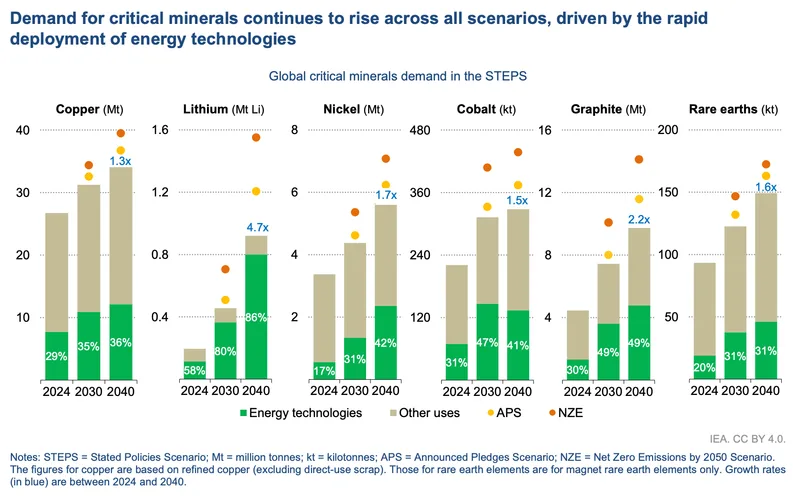
Every phone, laptop, battery, and solar panel contains a hidden material story. Copper, iron, cobalt, nickel, graphite, lithium, and rare earth elements make modern life possible, and they are also central to the energy transition. The International Energy Agency projects rapid growth in demand for many of these minerals as the world moves toward cleaner energy systems (International Energy Agency). But before these materials become part of a sleek device or a clean technology, they are mined, crushed, transported, processed, and refined - often near communities that have little access to reliable air quality data. This is the uncomfortable contradiction: some of the materials we need for a lower-carbon future can pollute the air breathed by the very people living closest to their extraction.
Our glittery phones and colourful screens, that keep us entertained, are silent testament to the suffering of millions of people who either work in mines or have the misfortune of living close to mining operations and are constantly exposed to a multitude of harmful substances. Mining may have positive knock-on effects as a source of employment and national income, often creating urban centres with greater economic opportunities, but for the communities that live near them, the real cost is often paid for by their health.
How Mining Creates Air Pollution
Every step of the mineral extraction process involves substantial volumes to be displaced. Whether by underground shafts or by open pit blasting, which removes large areas of land and surface rock to reveal ore, mining requires the removal of vast quantities of rock, soil, and water from the ground.
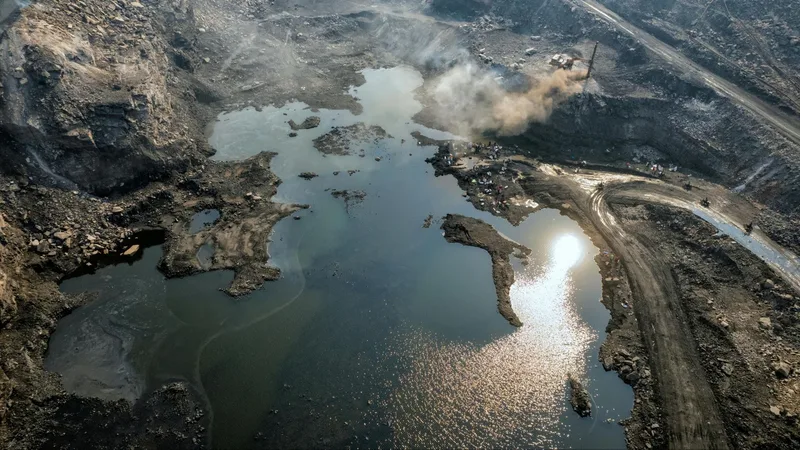
Due to lower operating costs, mining companies are increasingly choosing open-pit techniques over underground shafts. The resulting pits which are the size of large craters, and the enormous piles of abandoned debris, are major sources of dust in the air. Fine particulate matter, PM2.5 and PM10, is added to the air by explosions, continuous movement of heavy vehicle traffic on unpaved roads, and whipped up wind blowing across material depots.
Since most of the deposits that yield a high percentage of minerals and metals have been depleted, we have shifted our focus to lower grade ore deposits, which has resulted in an increase in waste production per unit of recovered product.
It is estimated that just 0.00001 percent of the ore extracted during gold mining is converted to gold.
Copper, nickel, and aluminum are processed in smelters, where the ore is heated and toxic chemicals are added. These smelters release sulfur dioxide, nitrogen oxides, and heavy metals including lead, arsenic, and cadmium. Gold ore is sprayed with cyanide in the recovery process. All unusable crushes that do not contain the desired product are dumped as tailings: a sludge of crushed rock, residual chemicals, and toxic metals that is pumped into vast reservoirs. When these tailings dry out, they become a source of airborne particles that can travel large distances. Tailings often contain heavy metals that, over time, can cause chronic illnesses.
In northern Chile, research found that copper mining activities, particularly dry material from the Talabre tailings dam, have transported toxic elements including arsenic, antimony, and cadmium up to 50 kilometers away, depositing them on the rooftops and windowsills of indigenous communities (Zanetta-Colombo et al. 2022).
In Chañaral, a coastal city in northern Chile that received 200 megatons of unregulated copper mine waste between 1938 and 1975, studies have found that residents in the northern part of town, in the path of wind-borne tailings dust, have urinary levels of arsenic, nickel, and mercury exceeding both Chilean and international benchmarks (Cortes et al. 2016).
The Health Toll
The particulate matter generated by mining is not just ordinary dust, it carries with it whatever toxic metals, minerals, and chemicals are found in the ore recovery process. Communities living in close proximity to active or closed mines are constantly exposed to serious health risks due to pollution generated by the mining process. Research conducted near gold mine waste dumps in Johannesburg found that residents living within 500 meters of a mine dump had significantly elevated rates of upper respiratory symptoms, asthma, and COPD compared to those living more than 15 kilometers away (lyaloo et al. 2022). Health risk assessments of the eMbalenhle community in South Africa, located near the tailings dump of gold mines, have shown that older adults face a one-in-ten lifetime risk of developing cancer from exposure to PM2.5. Even toddlers in that community showed cancer risk probabilities exceeding critical levels (Thabete et al. 2025).
The PM10 Problem
Beyond the unbelievable environmental damage and waste that mining operations generate, there is a vast amount of air pollution floating around these sites, which is not made publicly available.
I reached out to Paolo from Communities Against Pollution (CAP), based in South Africa, to see how our AirGradient monitors were being used in mining towns and facilities. He pointed out that many affected impoverished South African Communities cannot afford to place PM10 specific monitors.
In Africa, we are always trying to get the most bang for our buck, so we use low-cost air quality sensors that use optical scattering to measure PM2.5 and estimate PM10 values. We chose AirGradient over much more expensive monitors, so we opted for more coverage rather than specific data.
He went on to say in South Africa, the government has only deployed 132 reference-grade monitors throughout the country, less than one monitor per 450,000 people, and in 2023 reported that less than 27% are giving actionable data. With rampant corruption and criminality, many government officials are being exposed to having interests in mining companies and downstream businesses, which may explain why they have been less inclined to monitor the environmental damage caused by these businesses.
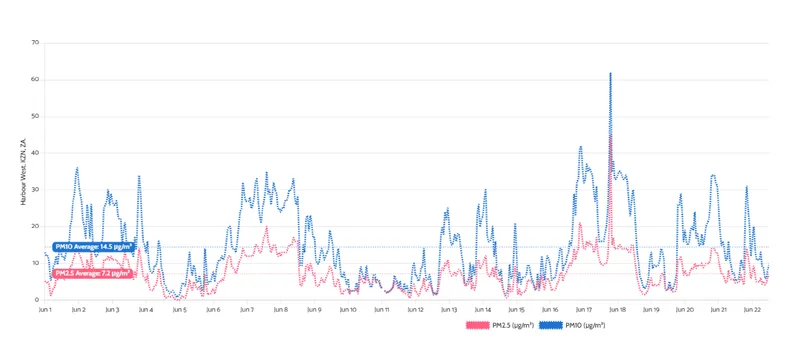
During our Zoom call, we looked at readings from an AirGradient monitor CAP placed at the harbor in Richard's Bay, South Africa. The Richards Bay Coal Terminal is one of the world's largest coal terminals capable of exporting 91 million tons per annum. The coal dust from the depot is most definitely contributing to large amounts of PM10 in the air, and Paolo said that trucks transporting coal can queue for kilometers on roads leading into the harbor, adding more PM2.5 to the already polluted air through their exhaust. The graph below shows that the PM10 levels largely mirrored the PM2.5 levels, as would be expected from a monitor designed to measure PM2.5 and estimate PM10. He went on to say:
"We are looking forward to a PM10 specific version of the AirGradient monitor in the future which can be placed to monitor dust from mining and other sources."
Something is better than nothing
Even though PM10 may account for a significant portion of the air pollution caused by mining activities, it is still worthwhile to measure PM2.5 levels surrounding the mines, particularly when the hazardous tailings dust is carried by the wind and travels many kilometers to neighbouring communities. We are donating monitors to the city of Chañaral in Chile, to help them shed some light on how air pollution from mining is a real air pollution problem for many communities. Hopefully, our monitors there will help the public access critical information about PM2.5 and PM10 levels in the air and help determine the true impact of the mining facilities around them.
Air pollution does not stop at the fence line of a mine, a smelter, a tailings dam, or a coal terminal. It moves with the wind, settles on rooftops, enters homes, and becomes part of daily life for communities that rarely see these costs reflected on a corporate balance sheet. Measuring that pollution will not solve the problem by itself, but it is often the first step toward making the invisible visible. When communities can document what they are breathing, they are in a stronger position to demand protection, accountability, and change. That is why open, affordable air quality monitoring matters - especially in the places where the need is greatest and official data is scarce.
Sources
Cortes, S., Lagos, L. D. C. M., Burgos, S., Adaros, H., & Ferreccio, C. (2016). Urinary Metal Levels in a Chilean Community 31 Years After the Dumping of Mine Tailings. Journal of Health and Pollution, 6(10), 19-27. https://doi.org/10.5696/2156-9614-6-10.19
International Energy Agency. Overview of outlook for key minerals. https://iea.blob.core.windows.net/assets/ef5e9b70-3374-4caa-ba9d-19c72253bfc4/Globa1CriticaIMinerals0utlook2025.pdf
lyaloo, S., Kootbodien, T., Naicker, N., Kgalamono, S., Wilson, K. S., & Rees, D. (2020). Respiratory Health in a Community Living in Close Proximity to Gold Mine Waste Dumps, Johannesburg, South Africa. International Journal of Environmental Research and Public Health, 17(7), 2240. https://doi.org/10.3390/ijeroh17072240
Pieters, J. N., Ndaba, N. S., & Ngcobo, S. (2025). Exploring prioritization of wellbeing and health impacts for mining communities during the mining life cycle within the sub-Saharan Africa context: A systematic review. BMC Public Health, 25(1), 1432.
https://doi.ora/10.1186/s12889-025-22691-7
Thabethe, N. D. L., Makonese, T., Masekameni, D., & Brouwer, D. (2025). Probabilistic human health risk assessment of PM2.5 exposure in communities affected by local sources and gold mine tailings. Frontiers in Public Health, 13, 1515009. https://doi.ora/10.3389/fpubh.2025.1515009
Zanetta-Colombo, N. C., Fleming, Z. L., Gayo, E. M., Manzano, C. A, Panagi, M., Valdes, J., & Siegmund, A (2022). Impact of mining on the metal content of dust in indigenous villages of northern Chile. Environment International, 169, 107490. https://doi.org/10.1016/j.envint.2022.107490