At AirGradient, we know that our presence on traditional social media platforms is less than stellar. Although we are active on LinkedIn and our website blogs like this one, we don’t spend as much time on X, Instagram, or Facebook. We’ve wanted to improve this for some time now, but then we thought more deeply: are we doing this because we’re expected to have a presence on social media? And will churning out social media content really further our mission – supporting communities and lifting their voices? Perhaps it was time for another one of our “irrational” choices, an approach that was outside the box.
Our guiding question was: How can we, as AirGradient, help communities that already engage in communication campaigns achieve more impact? We want to leverage our resources and tools to amplify communities in their own communication campaigns, rather than curate a polished corporate feed that we control from start to finish. And as you all know from our open-source mindset, control is not something we are really interested in.
So last week, we started the first step of this new social media strategy: gathering information. We organised two workshops in different time zones for the communities we work with and asked them about their successes, goals, and also struggles related to social media outreach. Our discussions surprised us.
A Globalised World Still Has Local Needs
One of the first and most common topics brought up was the need for localisation of the communication content that organisations disseminate. Information about air pollution needs to be available in more languages, especially in linguistically diverse countries such as Nigeria, with 520+ spoken languages. Communities need to be able to understand this information easily, and the current translation efforts are no longer cutting it. At AirGradient, we have our app available in many languages, but we realised we could add considerably more, and are planning to do so.
Another important localisation issue is that certain cultural contexts used in many communication campaigns do not “translate” well into different countries. A participant brought up that portraying air pollution as the amount of cigarettes smoked per day does not have a shock effect for villagers in rural Lao PDR, because smoking isn’t considered unhealthy. Symbols and animals used in campaigns around air pollution, such as the chameleon, are considered evil in some countries, whilst harmless in others. All of these localisation aspects must be considered carefully, and our first group conclusion was that providing already finished content and dispersing it across several countries might not have the expected effects.
A Resource Bank and Cross-Cutting Synergies in the Making
The discussion around localising content for organisations’ awareness work quickly bled into a conversation about how content could also be shared between all of us. As AirGradient, we could provide more scientific content and utilise our design team to create templates and infographics for content that each organisation can then localise for their own community. A resource bank where organisations share their strategies and collaborate on communication campaigns would be highly valuable. Perhaps one day, a global campaign across all of these different organisations could be possible…
A Challenge to Our Assumptions
And lastly, our workshop challenged our assumptions about how communication still works. We organisers have to admit that we thought social media was the most common form of information sharing at this point, much to the chagrin of newspapers, magazines, and the radio. But is this true for the entire world?
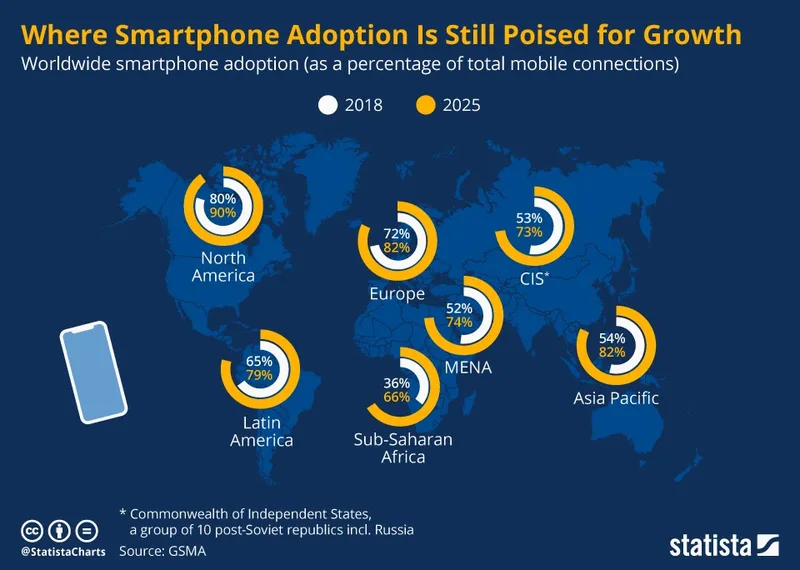
Organisations in Kenya, Nigeria and other African countries were quick to remind us that, especially in rural areas of the continent, where there is no stable power grid or internet connection, social media is not the main form of communication. There, smartphone and social media access is still more limited than in the Global North or even in lower-income parts of the Global South. When we asked our employees living in LMICs, they agreed that in Thailand or the Philippines, even very impoverished communities use smartphones, but this is not the case in Sub-Saharan African countries. As the diagram below shows, Sub-Saharan Africa has the lowest rate of smartphone adoption at just 66%, whereas the Asia Pacific is at 82% and Latin America at 79%. So, whereas even the poorest communities in Southeast Asia might use social media for information, this doesn’t ring true globally.
Instead, more traditional forms of communication, such as the radio or announcing information at local social gatherings, are common. At a time when radio stations are being sequentially shut down in Germany or Switzerland due to a lack of listeners, in Kenya the radio is still a reliable and far-reaching tool for reaching all citizens.
How Do We Reach Everyone – Really Everyone?
Thus, our social media workshops became a discussion of how we can accelerate community outreach in general, online or offline. One of the ideas of how we could accomplish that turned out to be the creation and sharing of printed materials, such as brochures or even stickers. We went from a strategy of resharing posts to brainstorming best practices for widespread dissemination of information, to everyone in the community, rather than only those with access to our platforms.
We were very happy with this workshop as it not only widened our horizons, but also helped to connect our partners so that they can collaborate and support each other in the future. We are planning to repeat these workshops to keep on developing solutions and improvements to community outreach, and hope to also create a network of support that exists independently of us hosting these workshops. If you work on air quality-related communication and are interested in joining, please reach out!