Sometime ago, we shared how different types of particles, even at the same PM2.5 concentration, can behave very differently inside air quality monitors. Now, we’ve taken that investigation one step further.
The goal this time was simple: to see whether our monitors, when exposed to real-world ambient air, behave as consistently as they do under controlled laboratory conditions (with incense as particle emission source).
The Setup
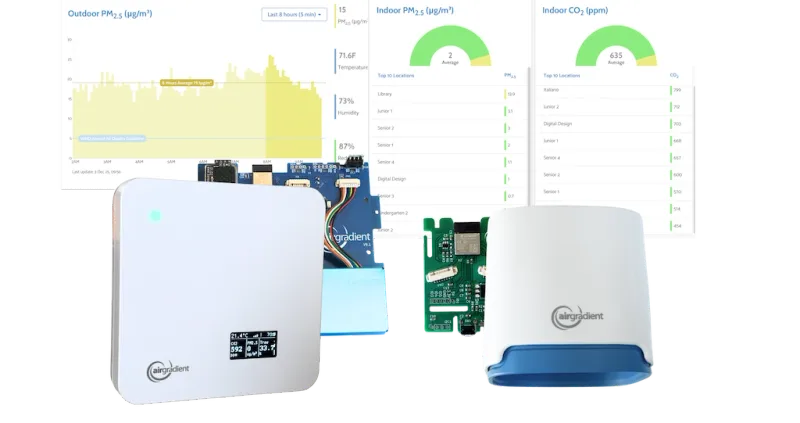
We compared nine AirGradient monitors:
3 Open Air Max units (with Plantower PMS5003-20240518 sensors)
3 Open Air Max units (with PMS5003T-20240826 sensors)
3 Open Air units (all with PMS5003T-20240518 sensor)
Batch numbers in bold.
This allowed us to not only assess reproducibility between individual monitors but also to see whether there was any measurable difference between the PMS5003 and PMS5003T sensor versions, between the Open Air and Open Air Max designs and across different Plantower sensor batches as well.
Furthermore, some customers expressed the concern that the PM2.5 measurements from the OpenAir Max might be different from those of the Open Air monitors. So we added this aspect to our experiment as well.
1. Test Chamber: Controlled and Repeatable
Inside our test chamber, all units showed excellent reproducibility:

Despite being from different batches and configurations, the raw PM2.5 concentrations across all nine monitors aligned closely throughout the entire concentration range. The standard deviation (SD) is a measure for the differences across the sensors. The value is very low here, indicating an excellent agreement between the sensors. Note that the exposure to clean air (0 µg/m³) in the test chamber between the test runs might drive the SD value lower than you would expect in an ambient environment.
We didn’t observe any systematic difference between the PMS5003 and PMS5003T sensor versions, neither between the Open Air and Open Air Max designs or across different Plantower sensor batches. This is good news as it means that these factors don’t affect the consistency of AirGradient PM2.5 measurements.
2. Rooftop: Real-World Ambient Air
The true test, however, happens outside.
When we deployed the same nine monitors side-by-side in ambient conditions, exposed to the complex, constantly changing mix of urban aerosols in Thailand, the results held steady.

Across several days of measurements, we found no significant deviation across the raw PM2.5 readings from the 9 monitors. We expected and found a slightly higher SD value when the sensors are exposed to more natural air pollution patterns instead of long time periods of clean air. An SD value of 2.5 µg/m³ still indicates high agreement between the sensors (the EPA target value is < 5 µg/m³ with hourly data).
In other words: the sensor type and enclosure design had also no measurable influence on the readings in ambient air.
3. Improved Agreement after Calibration
After calibrating all units using incense smoke under our new Test Report v2 protocol, reproducibility improved even further.


In both the test chamber and ambient air, the units showed tighter alignment (i.e. a better consistency across the sensors) across the entire concentration range after calibration.
Incense remains a valuable calibration aerosol because of its stability and repeatability, even if, as we discussed in our earlier article, it doesn’t fully replicate real ambient aerosol composition.
This consistency confirms that our internal calibration and assembly processes are working as intended: any AirGradient monitor you pick up will deliver data that matches other AirGradient monitors when exposed to the same air.
What This Means
These results confirm that AirGradient monitors maintain high reproducibility across both controlled and outdoor environments.
They also show that PMS5003 and PMS5003T sensors perform equivalently, which is a reassuring outcome for researchers and community users who may deploy mixed fleets of monitors.
Looking Ahead
This experiment strengthens one of our core beliefs: accuracy starts with reproducibility.
By ensuring all monitors read consistently under any condition, we make field calibration and large-scale data comparison far more reliable.
It’s another step toward our ongoing goal: building open, transparent, and scientifically grounded air quality monitors that you can trust.
Have thoughts or want to discuss our calibration methods? Join the conversation in our Community Forum – we’d love to hear your insights.