There are more indoor air quality monitors on the market today than ever before, and the data they generate has become increasingly detailed and reliable. The gap that remains, however, is not in the sensors, but whether the information they produce reaches people in a way that is easy to understand and interpret. This is the challenge that the Global Open Indoor Air Quality Standards (GO IAQS) Score was built to address.
The GO IAQS Score
Developed by GO AQS, the GO IAQS Score is a measurement system that translates complex air pollution data into a single, easy-to-read number. It consolidates readings across multiple pollutants, including particulate matter (PM2.5), carbon dioxide, ozone, carbon monoxide, formaldehyde, nitrogen dioxide, and radon, into one score ranging from 10 to 0.
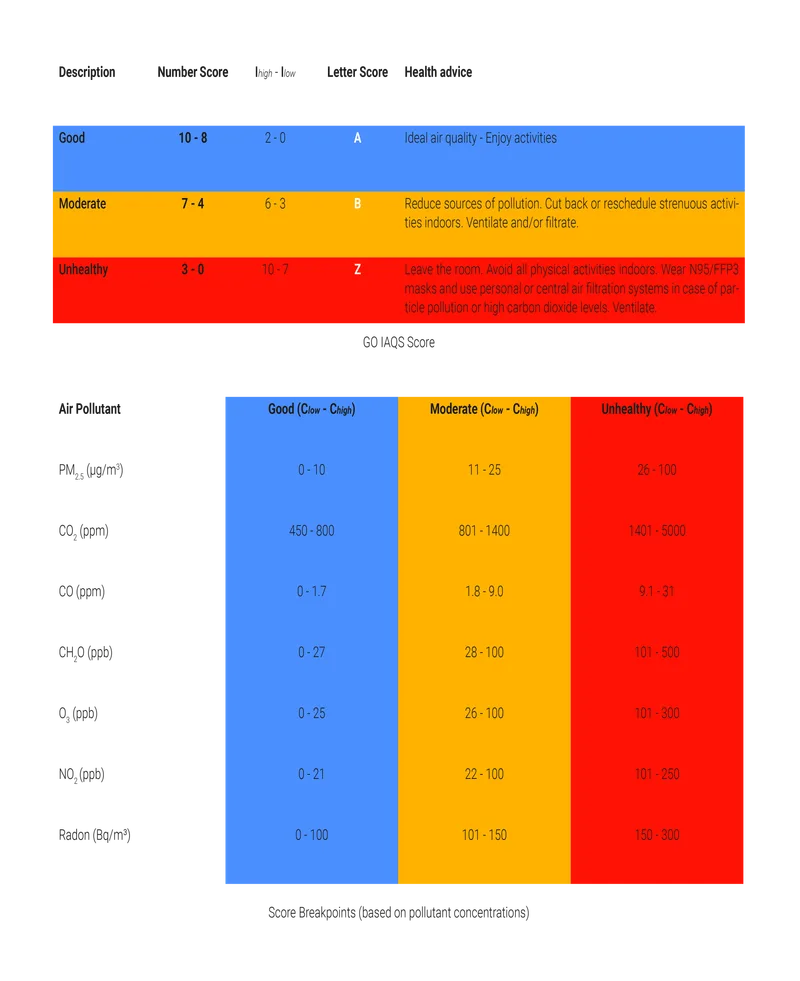
The system uses three categories: Good (scores 10 to 8), Moderate (7 to 4), and Unhealthy (3 to 0). Each category also carries a corresponding letter grade, A, B, or Z, so that anyone can communicate indoor air quality in a simple manner.
Designing towards a “common language”
When GO AQS, founded by Sotirios Papathanasiou, developed the GO IAQS Score, there was a strong commitment to universal accessibility and creating a “common language” for the air we breathe, which many existing air quality indices struggle with. As Sotirios puts it, “I created this framework after years of fielding the same question from specialists, researchers and academics: 'Which standard should we follow?' I felt it was time to move past regional inconsistencies and point everyone toward a single, science-based direction. After all, the biological need for clean air doesn't change based on where you live.”
Many systems use colour schemes that are difficult to interpret for people with colour vision deficiencies, rely on culturally specific design conventions, or use technical language that creates barriers for general audiences. The GO IAQS Score was designed with these limitations in mind. For starters, its colour palette was specifically chosen after simulating how it would appear across different types of colour vision deficiency, landing on a blue, amber, and red scheme that remains distinguishable regardless of how someone perceives colour.
Beyond visual accessibility, the score is also built on open standards, which matters enormously in practice. Indoor environments are monitored using a wide variety of hardware and software from different manufacturers. When each of those systems uses its own proprietary scoring method, comparing data across devices or locations can become frustrating. The GO IAQS Score gives different tools a shared language. This means that a school, hospital, and home office can all use different hardware and still arrive at a score that means the same thing and carries the same health implications.
Another factor worth noting is the scientific rigour behind the system, particularly in how pollutants are weighted. Rather than assigning different weights to individual pollutants, the GO IAQS Score takes a different approach: when several pollutants are simultaneously elevated to the same level, the overall score is pulled down to reflect that combined burden. In other words, breathing air where CO2, PM2.5, and CO are all moderately bad at the same time is treated as worse than any one of them would suggest on its own.
What drew us to the GO IAQS Score
We have worked with a few mainstream indoor air quality standards in the past – which served their purpose at the time – but when we looked closely at where their priorities lie, we often felt that health was left behind.
Many widely used indoor air quality certifications operate on a pay-to-certify model. The more buildings a certification body approves, the more revenue it generates, which creates an obvious tension when it comes to maintaining rigorous health-based standards. It also means that a certification badge does not necessarily confirm that a building is genuinely healthy to occupy.
Beyond the financial incentives embedded in those models, mainstream indices often were not built with indoor environments in mind. Outdoor air quality standards track long-term averages across continuous exposure, but indoor spaces have their own dynamics. Pollution can spike drastically during cooking, cleaning, or when a room fills with people, and those peaks matter even if they are short-lived. The GO IAQS Score was designed with real-time, continuous measurement in mind, making it better suited for the actual way people experience indoor air.
But beyond technical fit, it also aligns closely with how we think about air quality more broadly. AirGradient's philosophy has always been grounded in open-source hardware and software. With this in mind, the GO IAQS Score fits naturally within that approach. There is no proprietary ownership, certification fee, and financial incentive distorting the health guidance it provides.
The fact that AirGradient has adopted the methodology we have developed, and has opened the ability for other manufacturers to do the same through their technical expertise, has made us at GO AQS very hopeful. A common language for air quality is no longer just a dream, but a reality that many people will now have the chance to embrace
Implementing the GO IAQS Score
The GO IAQS Score is currently integrated into our system in a few different ways.
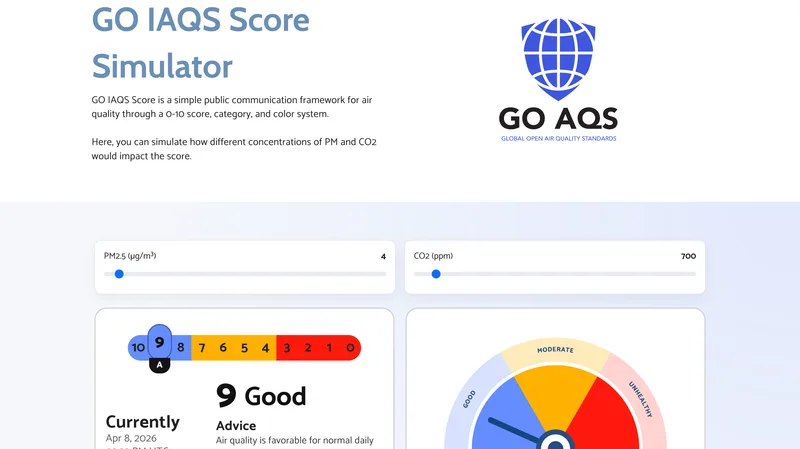
In order for users to gain a better understanding of how the scoring system actually works, we’ve developed the GO IAQS Score Simulator, which can be accessed through the AirGradient website. The simulator currently focuses on PM2.5 and CO2, allowing users to input readings and see how the scoring logic responds. It is a straightforward way to get a feel for how the system works before committing to a full integration.
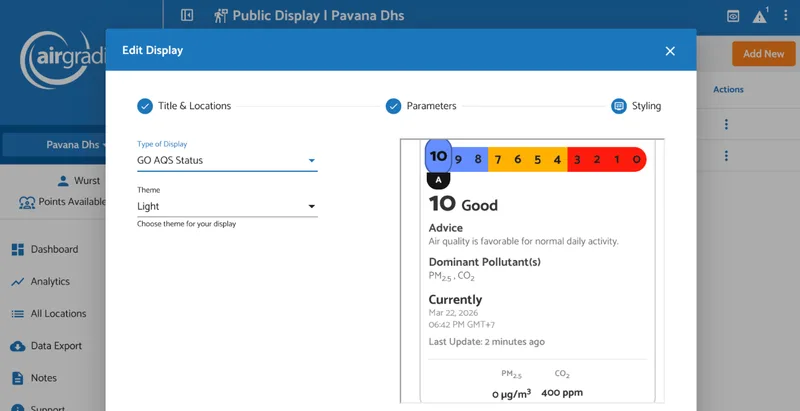
For those already using AirGradient monitors, the GO IAQS Score is also available directly through the dashboard as a live widget. Because it pulls from real-time sensor measurements, the score updates continuously, reflecting actual conditions in the space rather than a static snapshot.
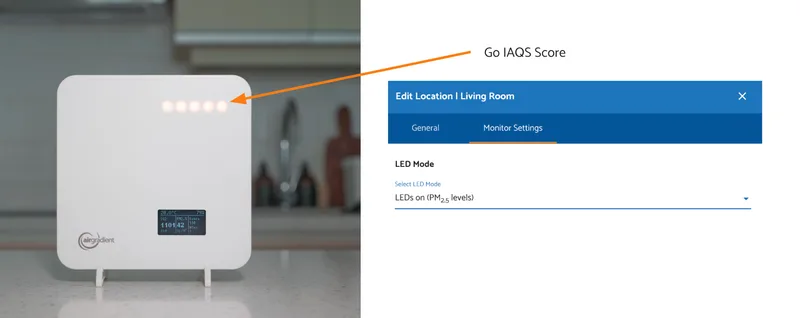
Lastly, we are in the process of implementing the score into the AirGradient ONE LED Bar. Right now, the monitor displays LED signals based on either PM2.5 or CO2. Integrating the GO IAQS Score allows these readings to be combined into a single, more intuitive output.
As mentioned earlier, air quality standards are only meaningful if they are built around the right priorities. The GO IAQS Score is one of the few that started from the right question: not what is easiest to measure or certify, but what actually helps people understand the air around them. That is the kind of standard worth backing, and it is why we intend to keep doing so.
To learn more about the GO IAQS Score and how it’s been implemented in the AirGradient ecosystem, you can watch our recent forum here.