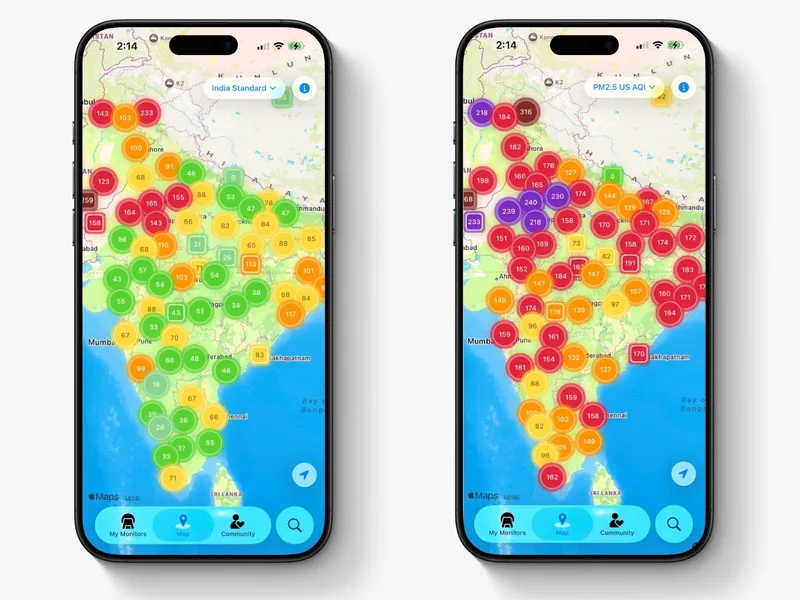
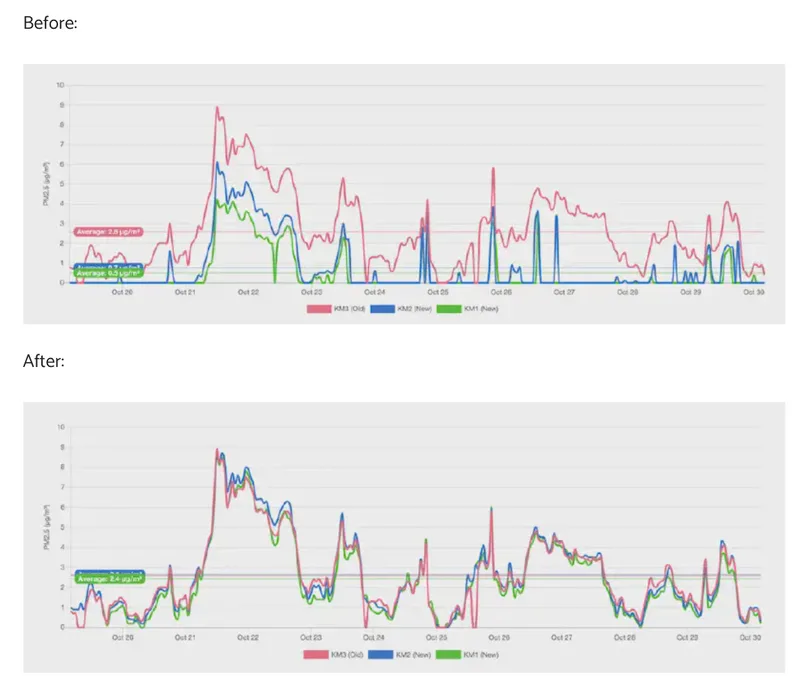
When we first uncovered changes in newer batches of the Plantower PMS5003, most of the attention naturally went to the obvious issue - the unrealistically low readings at the bottom end of the range. These newer sensors often sat at zero in concentrations where older PMS5003 modules would still register low but meaningful values. After a lot of testing in our lab, we confirmed that this behaviour came from a shift in Plantower’s own calibration method rather than faulty hardware. Since then, we’ve been using our own calibrations based on the 0.3 µm particle count, which brought the newer batches back in line with the older, “classic” ones.
Recently, one of our academic and research customers asked a follow-up question regarding our calibrations. Their concern wasn’t about the initial calibration itself, but whether these newer Plantower units showed any calibration drift after months of operation. Because this was something we also wondered when the issue first appeared, we decided to run a quick check.
We have looked at drift in the past and discovered that this isn’t an issue with the Plantower sensors we use. However, that earlier testing wasn’t tied to the Plantower calibrations, as it didn’t involve the sensors we recently corrected (instead we were looking at the 'classic' sensors). It was simply something we felt we needed to understand because drift can quietly undermine a sensor’s accuracy if you’re not paying attention to it and accounting for it.
Method
With this background in mind, Anika, our chief scientist, pulled data from two AirGradient monitors that had been running in our test chamber since the middle of the year. One contained one of the newer low-reading Plantower modules, and the other used an older ‘classic’ PMS5003 with the usual behaviour we had come to expect from these sensors. Both had been calibrated in July against our Palas reference instrument, so we had a clean baseline for comparison when she checked them again in early November.
To understand whether anything drifted, Anika compared two periods:
- July (right after calibration)
- November 6th (several months later)
For each monitor she looked at:
- the raw Plantower PM2.5 values
- the calibrated PM2.5 values using the same July parameters
- how both compared to the Palas reference
She then calculated the RMSE for July and November. The point wasn’t to adjust the calibration or optimise anything, but rather simply to see whether the July calibration still held up months later.
Results
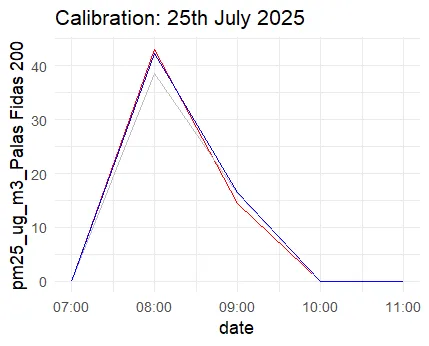
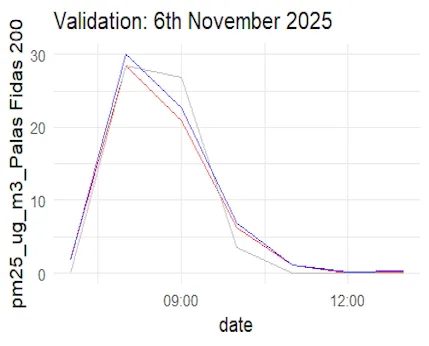
The newer Plantower module held up almost exactly as the older, classic PMS5003. When Anika compared the July calibration to the November data, the RMSE values barely changed for the calibrated output.
Newer Plantower batch
- Raw PM2.5 (July): RMSE = 2.2 µg/m³
- Calibrated (July): RMSE = 0.9 µg/m³
- Raw PM2.5 (November): RMSE = 2.7 µg/m³
- Calibrated (November): RMSE = 0.9 µg/m³
The raw values differed slightly, which is expected with any low-cost sensor, but the calibrated values were identical in July and November.
Older ‘Classic’ PMS5003
- Raw PM2.5 (July): RMSE = 3.0 µg/m³
- Calibrated (July): RMSE = 1.4 µg/m³
- Raw PM2.5 (November): RMSE = 4.0 µg/m³
- Calibrated (November): RMSE = 1.4 µg/m³
Here again, the raw values moved slightly over time, while the calibrated values remained exactly the same.
Across both sensors, the graphs looked nearly identical between July and November. The July calibration continued to match the Palas reference in November without any loss in accuracy, and there was no widening of the gap between the Plantower output and the Palas.
Conclusion
This was only a quick comparison using two monitors, but the results are already meaningful. The newer Plantower batches did not show any sign of calibration drift over several months of continuous operation. The same was true for the classic PMS5003 module. In both cases, the raw values shifted a little, which is normal for this type of sensor, but the calibrated values held their accuracy from July through November.
For us, this is encouraging. These units were calibrated months earlier using the 0.3 µm particle count, and those same calibration parameters continued to line up well with the Palas reference without any adjustment. While this was a small sample, it suggests that our custom calibration approach remains stable over time.
We’ll continue monitoring this as more long-running units accumulate data, but the initial findings are promising.