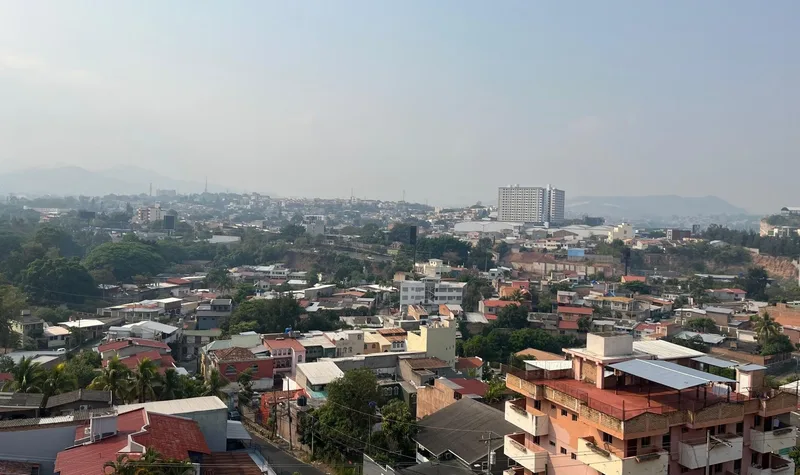
This article was contributed by Jeffrey Albertson-Kwok, Aidan Farrow, Andrew Murchie, and Rita Pelicano from Greenpeace. The article details how human-ignited fires in the Amazon are causing severe air pollution across the region, and how Greenpeace Brazil is using monitors in Porto Velho and the Caititu Indigenous Territory to measure and document the impact on local communities.
Some of the worst air in Brazil can be found in ... the Amazon region?
Yes, it may go against intuition that the air quality in swaths of the Amazon region can be worse than Brazil's biggest cities and industrial zones. However, poor air quality is the reality for millions of Brazilians who live in the Amazon region. Communities across the region, quite physically, live within an air pollution crisis.
Every year between July and November, almost like clockwork, fine particulate matter levels peak across much of the Amazon. Meteorologically speaking, this period is the Amazonian dry season. However, it is no longer low rainfall but the presence of fire that has come to define this period, and today, the terms ‘fire season’ and ‘dry season’ have become synonymous.
During these months, farmers set their cattle pastures ablaze to clear new growth and remnant vegetation. Since large-scale fire monitoring in Brazil began in 1985, at least a million hectares of cattle pastures have been burned every year (1). In this guise and hidden by the expansiveness of the Amazon region, some farmers also burn forest edges to pave way for more pastures, causing irreversible harm to virgin forests. Fires do not naturally occur in the Amazon: all Amazon fires are human-ignited.
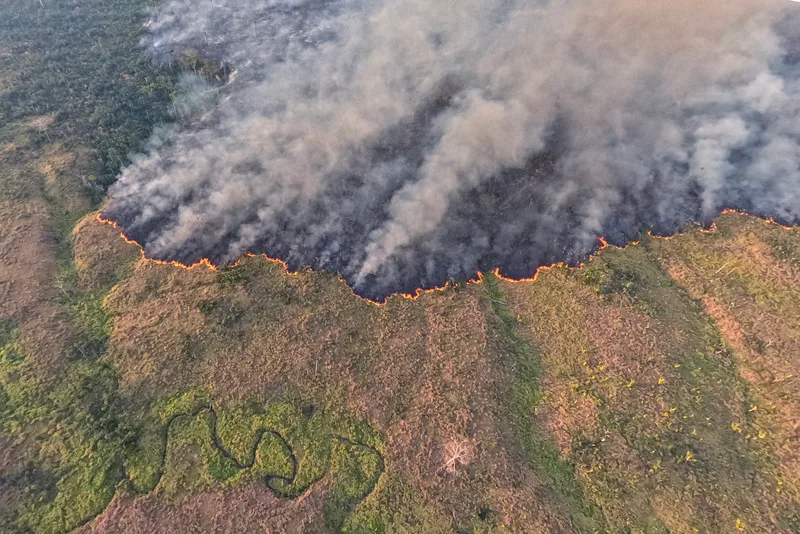
Burning pastures and forests is unsustainable and degrades the environment. Brazilian legislations outlaw these uses of fire, but they nonetheless persist, and they are fuelled by a growing global appetite for meat.
Smoke from these human-ignited fires inundates Amazon communities, causing the Amazon region to become one of the most polluted places in Brazil to breathe. In August 2024, at the height of the 2024 fire season, the 24-hr average PM2.5 concentration in Porto Velho city, the state capital of Rondonia state with more than 450,000 inhabitants, reached 56.5 µg/m³ (2). This is more than 3 times higher than WHO’s recommended limit (3). In a literal sense, fires tied to meat production have Amazon communities in a chokehold.
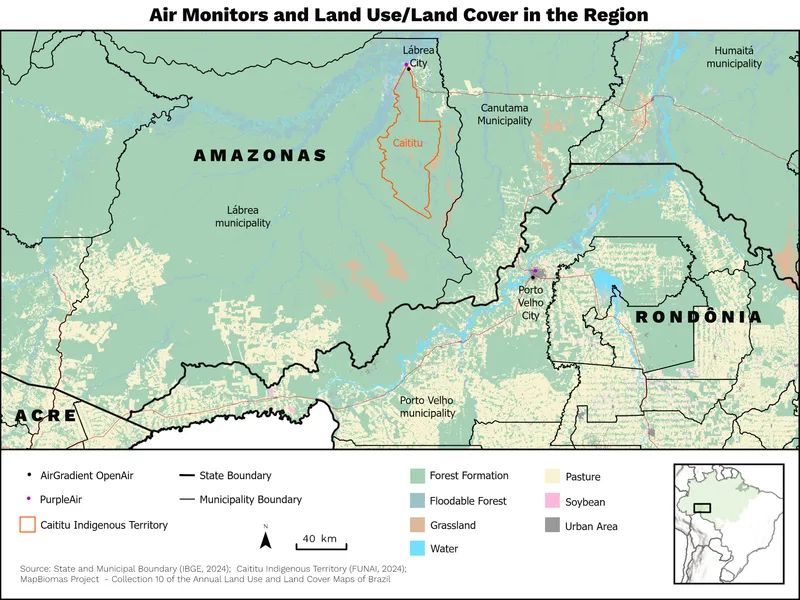
In response to the decades-long environmental and health crisis in the making, Greenpeace Brazil embarked on a new initiative to campaign for clean air in the Amazon. The project’s latest phase installed two AirGradient monitors. One was installed in Porto Velho, the regional capital flanked by cattle pastures. The other was installed in a part of Caititu Indigenous Territory (a forested territory of the Indigenous Apurinã people) that is approximately 2.5 km (1.5 mi) from the rural town Lábrea. The monitors were installed during the 2025 fire season.
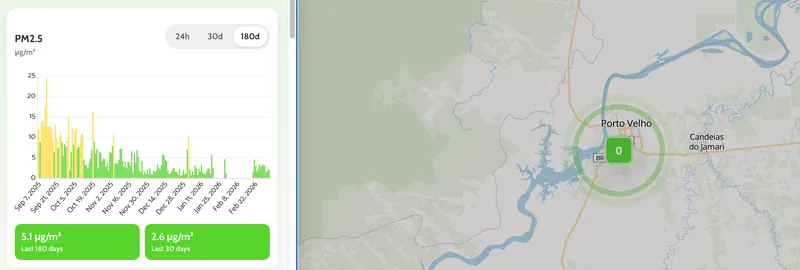
There are two main reasons why Greenpeace Brazil chose to deploy air quality monitors. First, providing accessible air quality data can catalyze positive change towards clean air. Data have the ability to empower those affected to make informed, evidence-based decisions, advocate for their rights, and hold culprits and institutions accountable. Also, building capacity for empirical data collection in this fire-plagued region allows clean air advocates to more confidently describe the fire events and discuss their public health impacts to civil society and policymakers, through an evidence-led lens.
The first batch of data for September 2025 was presented in the Greenpeace report ‘Toxic Skies: How Agribusiness is Choking the Amazon’. The monitors measured PM2.5 levels in the study location that exceeded the WHO health guideline, in keeping with recordings from air quality monitoring networks operating in the Amazon region.
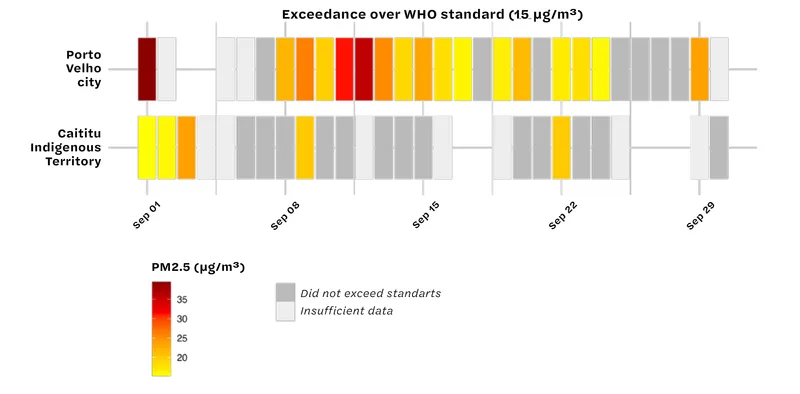
The AirGradient monitors allowed us to track daily and hourly average PM2.5 levels. Daily averages can be compared to the WHO’s health guideline (15 µg/m³ over a 24-hr averaging period), while hourly averages show the dynamic changes and extreme highs in air pollution level over a relatively short period of time. Together, these two metrics provide a wide angle view of the health implications. Long-term exposure to health-damaging PM2.5 levels can contribute to chronic respiratory or cardiovascular conditions, while short-term spikes are known to trigger asthmatic episodes and eyes-nose-throat (ENT) irritation.
| Top 3 hourly readings | Porto Velho city | Caititu Indigenous Territory (2.5 km from Lábrea city) | ||
|---|---|---|---|---|
| PM2.5 (µg/m³) | Date / time (UTC-4) | PM2.5 (µg/m³) | Date / time (UTC-4) | |
| 1st | 99 | 2025-09-29 16:00:00 | 250 | 2025-09-03 18:00:00 |
| 2nd | 93 | 2025-09-12 23:00:00 | 50 | 2025-09-09 17:00:00 |
| 3rd | 76 | 2025-09-29 15:00:00 | 49 | 2025-09-03 19:00:00 |
Table 1: The 3 highest hourly PM2.5 readings in Porto Velho city and Caititu Indigenous Territory in September 2025.
To safeguard air quality in the Amazon, we must take steps to protect pastures and forests from being intentionally set ablaze. Fire use linked to meat production for the global market has created an acute, yet preventable public health crisis, but it is not too late to act. We must ensure that fire use restrictions are complied by. In turn, we will hopefully see clearer skies and healthier air in the Amazon. And perhaps, smoke and haze will no longer define the Amazon dry season and in time, the term ‘fire season’ will be relegated to history.
References
(1) MapBiomas Project – Collection 4 of MapBiomas Fire, accessed on October 11 2025 through the link: https://plataforma.brasil.mapbiomas.org/en/
(2) World Health Organization. (2021). WHO global air quality guidelines: Particulate matter (PM2.5 and PM10), ozone, nitrogen dioxide, sulfur dioxide and carbon monoxide (ISBN 978-92-4-003443-3). https://iris. who.int/handle/10665/345329
(3) Agence France-Presse. (2024, August 21). Brazilians ‘struggling to breathe’ as Amazon burns. Le Monde. https://www.lemonde.fr/en/international/article/2024/08/21/brazilians-struggling-to-breathe-as-amazonburns\_6719069\_4.html