< Back to blog

Updates

Short news from AirGradient.

Achim Haug

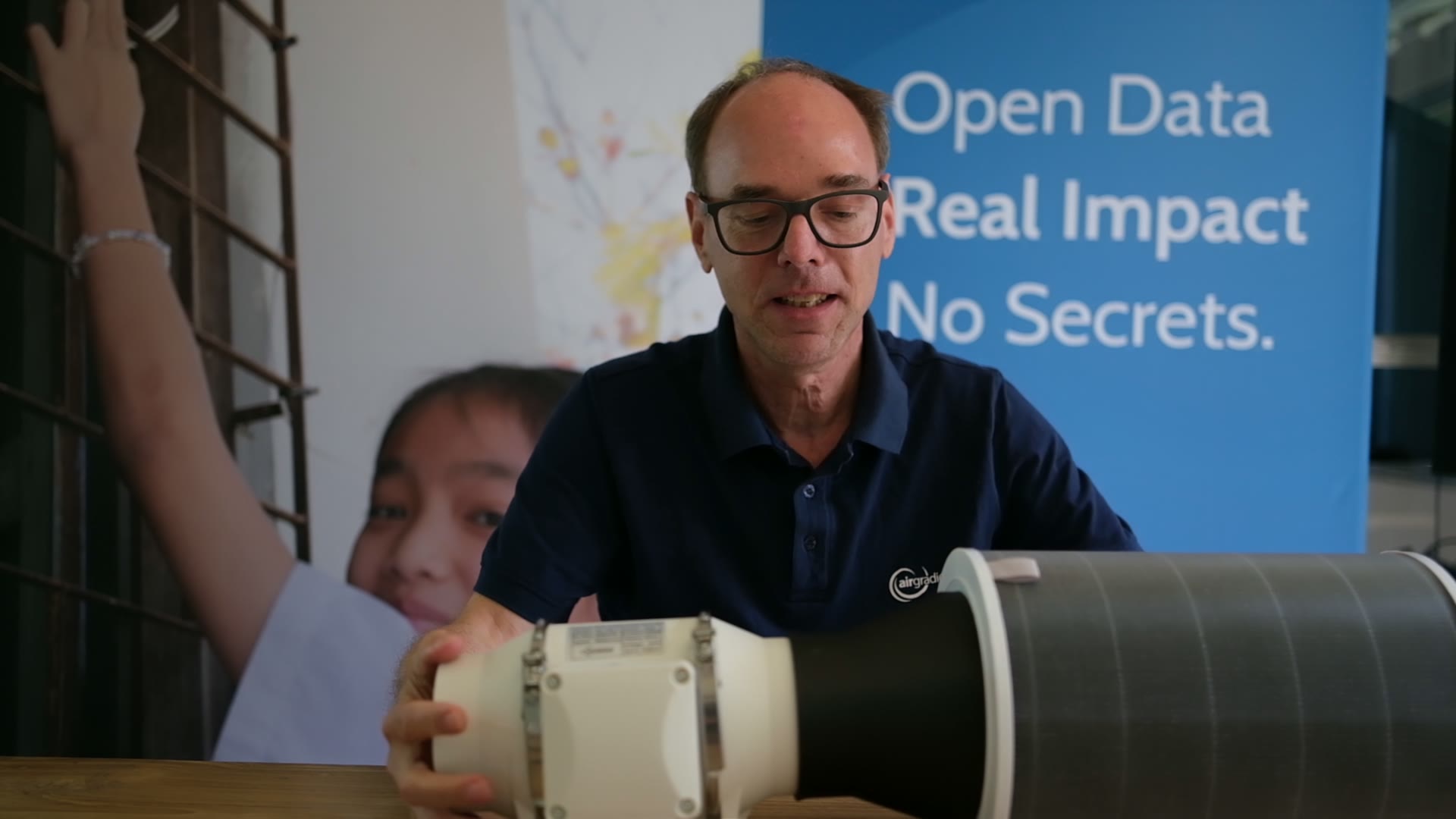
I wanted to see how simple I could make a positive-pressure fresh-air system. I believe this is about the simplest PPS design possible: a popular cylindrical replacement filter, a standard four-inch duct fan and one small 3D-printed adapter. Both the filter and fan are readily available. Unlike a recirculating air purifier, this setup does not filter the air already inside the room. Instead, it pushes filtered outdoor air in, flushing dirty indoor air out. With sufficient airflow and a suitable installation, the resulting positive pressure also helps reduce unfiltered outdoor air leaking in. This fresh-air exchange can also lower the CO2 that builds up in occupied rooms, something a particle filter alone cannot do. The fan and filter come to roughly US$50–60 at the prices quoted in the demonstration, before printing, ducting and installation. In my initial check with an AirGradient Go, the PM2.5 reading fell from around 17 µg/m³ outdoors to approximately 0.5–0.6 µg/m³ in the filtered outlet air stream. We will publish the video and full blog post soon, showing the parts, assembly and initial checks.

Open update

Achim Haug

I’m currently testing new firmware for the AirGradient Go aimed at substantially extending its battery runtime. The early results are looking very promising. My trick for speeding up the real-world test: use a much smaller battery. That way, I don’t have to wait for the normal-sized battery to run down before seeing how the firmware performs. After 36 hours, taking a measurement every five minutes, the Go still has around 50% battery remaining on the small battery. Based on these early results, we’re likely looking at more than a week of runtime with the standard battery at the same measurement interval. That’s still an estimate until the full test is complete, but it’s an encouraging start!

Open update

Achim Haug

This Saturday morning I connected the AirGradient Go, my iPhone and my Mac to investigate why some Bluetooth Low Energy (BLE) broadcasts weren’t being received. The cool thing is that my AI agent now runs the test loop autonomously. It tries different BLE settings, compiles and flashes the firmware, then reads the logs to compare what the Go sent with what the phone and Mac actually received. It uses those results to decide what to test next, and repeats the cycle. The BLE work is still in progress. But I can go for lunch while the agent works through the next round of tests.

Open update

Achim

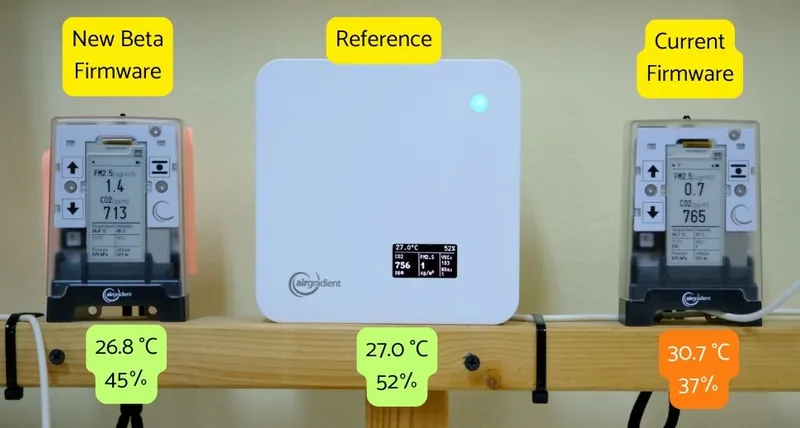
We are experimenting with a new firmware version for the AirGradient Go that runs a lot more power efficient and as a result also produces much less internal heat. So the temperature and humidity readings are much closer to the AirGradient One (which is basically on ambient levels). Currently BLE and TVOCs are disabled and we are now looking to re-enable these but still keep power and temperature accuracy. Great side-effect is that this will also tremendously improve the battery life. We expect at least one week but possibly a lot more. Stay tuned.

Open update

Your are being redirected to AirGradient Dashboard...