Most low-cost CO₂ sensors were made with indoor air in mind. They usually live in offices, classrooms, and bedrooms, flagging when a room has gone stuffy and it's time to open a window. That's a job that modern CO₂ sensors do well, and it's a job that's been picked apart in study after study.
Urban environments are another place these sensors have earned their keep. Networks of them have tracked the air quality in cities around the world for years, mapping how it shifts across neighbourhoods and helping work out where the emissions come from. However, rural CO₂ monitoring with low-cost sensors is still a young area, which is unusual given how much of the carbon story is dependent on land use.
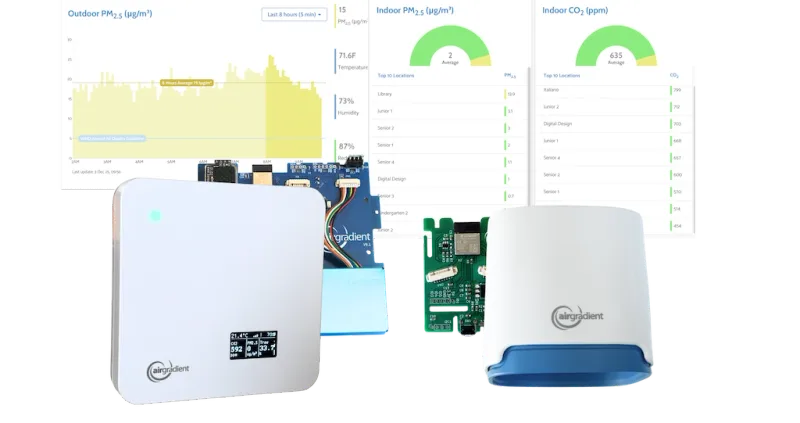
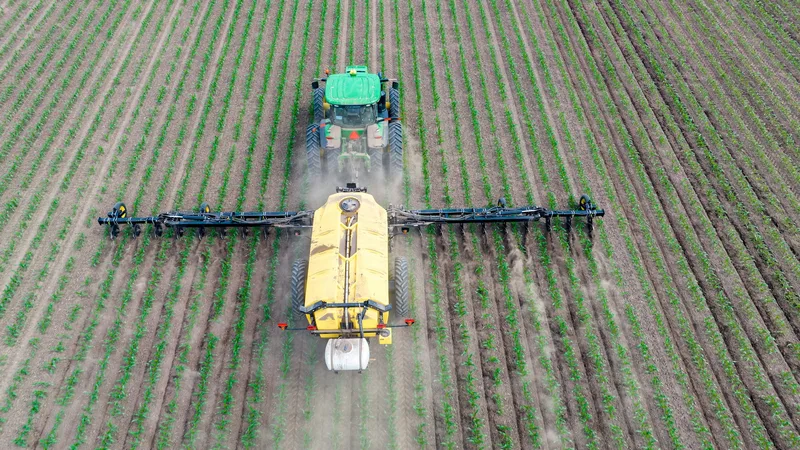
That’s now changing, though, as a recent preprint from a group at the University of Cambridge takes the outdoor question head on. Olalekan Popoola and his colleagues deployed bespoke ‘Magic Box’ monitors alongside AirGradient Open Airs equipped with NDIR CO₂ sensors at a working arable farm near the city of Ely and ran them against a research-grade reference instrument, while also doing the same on a city rooftop in Cambridge about 16 km away (shown in the banner image). The intention was to find out whether an LCS (low-cost sensor) can produce numbers you can actually trust out in the countryside.
The sensors doing the work
The sensors used in this study are NDIR modules, which are currently considered the ‘gold standard’ for low-cost CO₂ monitoring. NDIR stands for non-dispersive infrared, and these sensors work by shining an infrared source through a small pocket of air and detecting two wavelengths. One sits near 4.26 µm, where CO₂ soaks up light strongly, so more CO₂ means a weaker signal on that channel. The other sits around 3.9 to 4.0 µm, where CO₂ barely absorbs at all, giving a reference to compare against. The difference between the two signals is a measure of the CO₂ concentration.
Importantly, these sensors are now relatively cheap to build and run. No consumables, low power draw, and small enough to place inside a weatherproof box. The study leaned on three Senseair parts across its deployments: the K33, the S8, and the Sunrise. Two of these sat inside AirGradient's Open Air outdoor monitor, and everything got checked against a LI-COR LI-7815, a laser-based analyser with 100 ppb resolution.
The setup
Two locations were monitored for this study. The rural site was an arable farm at Stretham (7 kilometres away from Ely, which is north of Cambridge), with the low-cost nodes mounted at 1.5 m next to a rural reference monitor. The urban site was the rooftop of the Yusuf Hamied Department of Chemistry at Cambridge University, roughly 22 m up. Because a LI-COR reference was co-located at both sites, the team could compare the affordable sensors against a trusted baseline.
What makes the dataset particularly useful, however, is the sheer length of it. One AirGradient unit with the S8 ran from May 2023 all the way to February 2025, so the sensor had to cope with two winters, two summers, and everything in between. Shorter, seasonal collocation tests can often hide issues that only arise under specific conditions, but a stretch approaching two years accounts for these seasonal changes and differences. Reference data were averaged to 5-minute resolution to match the low-cost nodes.
Why a sensor that behaves indoors drifts outside
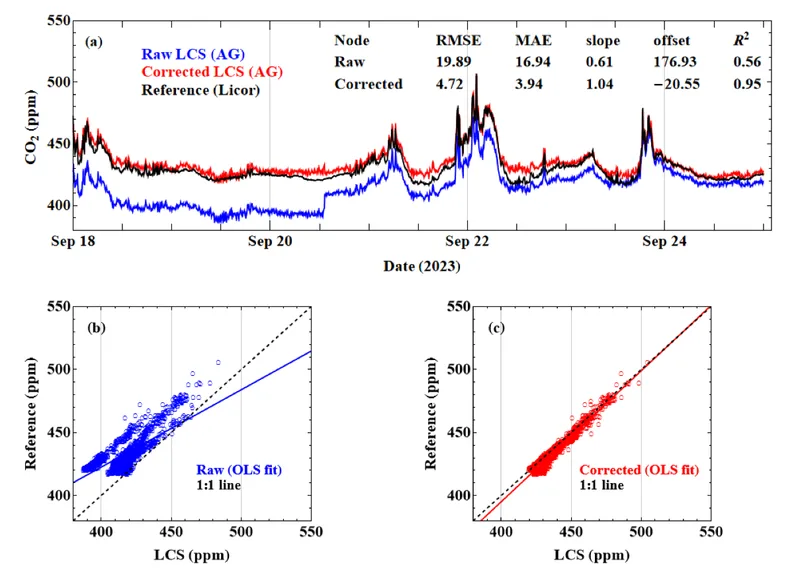
Indoors, temperature holds fairly steady, humidity rarely gets extreme, and pressure is less impactful due to the higher CO₂ concentrations often seen - in other words, it’s a best case for an NDIR sensor. This paper instead pulls apart the specific ways an outdoor deployment trips the sensor up.
The first culprit is Automatic Baseline Calibration, or ABC. Essentially, over a window of about eight days, the sensor assumes the lowest CO₂ it has seen is roughly the ambient concentration, around 400 ppm (400 ppm is still regularly used as the baseline for many sensors, even if ambient concentrations now normally sit closer to 430 ppm), and gradually adjusts its baseline to match. In a classroom that empties overnight and returns to near ambient air, that assumption makes sense. Out on a farm it doesn't. A real dip driven by weather can look, to the algorithm, like sensor drift, so the sensor "corrects" a reading that was true all along. As the authors put it, "the automatic correction may introduce errors into the actual CO₂ measurements."
Pressure is the second problem, and it's quite a subtle one. The sensor is calibrated at a fixed laboratory pressure and reports a mixing ratio in ppm. But the number density of gas molecules in a given volume shifts with ambient pressure, so when a weather system rolls through and pressure drops from around 1020 mBar down to 960, the reading moves with it even though the true CO₂ hasn't budged. Over the winter stretch, the team recorded that pressure swing was the single biggest source of error.
Temperature can also cause issues. NDIR is a spectroscopic measurement, and heat affects the detector and the light path. The effect showed up strongly in summer, when the low-cost signal overshot during the warmest hours. The daytime overestimation, the paper notes, "coincides with daytime temperatures well above 10 °C." So pressure rules the cold months and the long timescales, temperature bites hardest on hot summer afternoons.
Finally, there's water. Vapour absorbs weakly in the same infrared region CO₂ uses, which can nudge readings up, and if humidity gets high enough to condense on the optical mirrors, the readings go properly haywire.
The fix
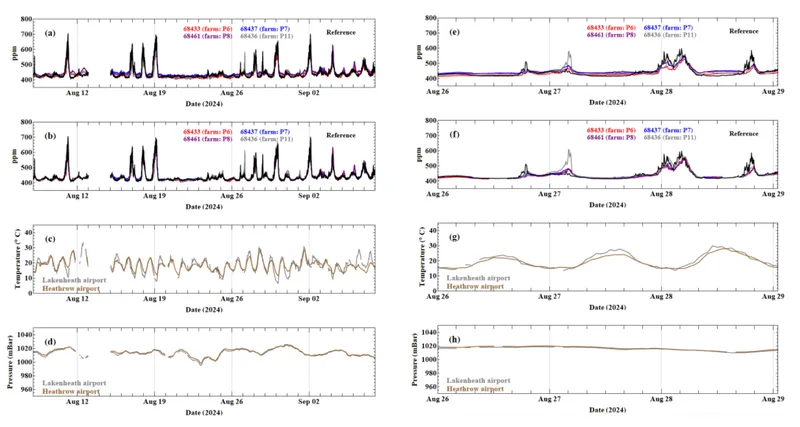
Popoola's team created a system for dealing with these issues by tackling the ABC step first, either by turning the feature off or by correcting the jumps it introduces. Next, they applied a pressure correction followed by a temperature one. Since the AirGradient Open Air lacks a pressure sensor, the team pulled hourly surface pressure from two nearby airports, Heathrow and Lakenheath. Pressure varies on a large scale, so those two stations, 125 km apart, tracked each other closely, which meant a remote reading was good enough to correct a sensor sitting between them.
The numbers make the case for these fixes. In winter, root mean square error against the reference fell from about 10 ppm to 4 ppm, and R² climbed from 0.85 to 0.98. Summer showed a similar lift, with RMSE going from 5 ppm to 4 ppm and R² from 0.86 to 0.97. For comparison, the simple linear scaling most people reach for barely helped at all. It kept underestimating CO₂ through the winter months at both sites, because scaling can't undo errors that change with the weather.
What the corrected data showed
Rural CO₂ doesn't stay comparatively steady the way city CO₂ tends to. The farm saw daily swings of up to 50 ppm, more than three times the roughly 15 ppm you'd see in the urban data. At night during the growing season, with photosynthesis switched off and the planetary boundary layer collapsing closer to the ground, CO₂ piled up. The corrected sensors caught "above background CO₂ ranging periodically in excess of 200 ppm" for 5-minute averages, and they reproduced both the seasonal shape and the daily cycle well enough to match the reference.
Final lessons
The humidity problem deserves its own warning, because it behaves differently from other factors. When the team ran a poorly ventilated enclosure, the "Magic Box", at the damp rural site over winter, the results fell apart. RMSE landed somewhere between 35 and 61 ppm, and the unit only tracked the reference for the first three or four days before internal humidity climbed past 75% and stayed there. The AirGradient housing, with mesh openings that let air move through the enclosure, kept its internal humidity lower and held up far better.
The catch is that you can't correct this after the fact. Pressure and temperature errors follow predictable physics, so you can model them and account for them. Humidity condensation doesn't. The effect "cannot be corrected empirically, as it is inherently non-systematic", which means the fix has to happen in hardware. Ventilate the enclosure so air actually exchanges, or heat the sampled air where power allows.
None of this makes a few-hundred-dollar sensor research-grade. But if you sort out the baseline, account for pressure and temperature, and put the sensor in a box that breathes, a Senseair NDIR module can hold within a few ppm of a laser reference for the better part of two years, sitting in a field, through two British winters.
Source:
Popoola, O. A. M., Cicuta, P., Georgiou, R. H., Tom, L., Freshwater, R., Leet, K., and Giorio, C.: Evaluating low-cost NDIR CO₂ for atmospheric observation in rural settings, EGUsphere [preprint], https://doi.org/10.5194/egusphere-2026-2702, 2026. Preprint — under open discussion, not yet peer-reviewed. Figures reproduced with the authors' permission under CC BY 4.0.