This article is part of a series, where we explore the hidden complexities of PM2.5 — tiny airborne particles that impact air quality and health. We will uncover the ambiguities behind its measurement, the challenges in assessing health risks, and the surprising insights that emerge. Each article will tackle a different aspect of PM2.5, shedding light on its hidden dilemmas and unanswered questions. Today’s article discusses air pollution in the context of dementia and other brain diseases.
What is dementia?
Dementia is an umbrella term for a group of conditions that cause a progressive decline in cognitive function, including memory, language, reasoning, and problem-solving. The most diagnosed cause of dementia is Alzheimer’s disease.
What is the cause of Alzheimer’s?
The cause of Alzheimer’s is not known. Instead, it appears to develop through a combination of ageing-related changes in the brain, genetics, and long-term biological processes that are still being actively studied. Understanding why these changes begin in some people but not others is one of the most important questions in medicine today.
Alzheimer’s is characterised by specific changes in the brain. Two proteins called amyloid-beta and tau, which are normally present in healthy brains, are involved.
In a healthy brain, these proteins exist in a soluble form. In Alzheimer’s disease, however, they can gradually change shape and begin to accumulate. Over time, amyloid-beta forms plaques outside brain cells, while tau forms tangles inside brain cells (see Figure 1).
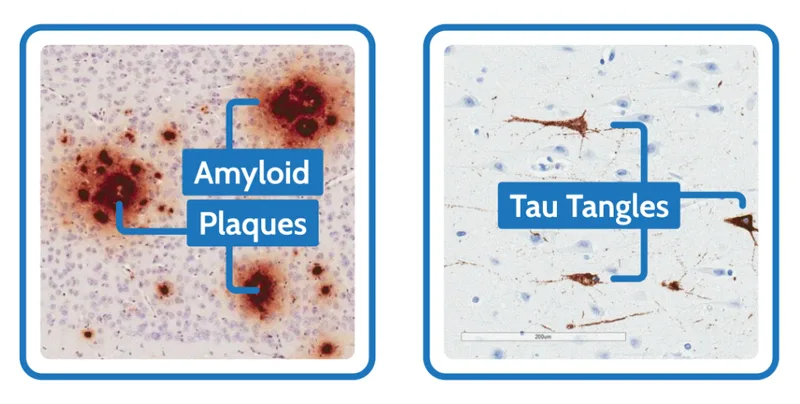
Many researchers think that these proteins play an important role in the development of Alzheimer’s disease, especially in the early stages. Based on this idea, several drugs have been developed that target amyloid-beta and aim to reduce plaque buildup. While they do reduce amyloid buildup in the brain, their effects on slowing cognitive decline appear modest, and experts continue to discuss how large their benefit is in practice.
Current state of the science in a nutshell:
Amyloid plaques and tau tangles are closely linked to the loss of brain cells seen in Alzheimer’s disease. However, it is not known whether they cause the disease, whether they are a result of it, or whether they may even reflect a protective response against the disease.
Does air pollution cause dementia?
Whether air pollution causes dementia is unknown. However, researchers from several different fields have found observations that are consistent with such a link.
Evidence 1: Airborne particles can reach the brain
Airborne particles can be inhaled and reach the lungs. From there, some of them can enter the bloodstream.
This raises an important question: can they also reach the brain?
The brain is well protected. It is enclosed in the skull. It is also shielded by a very selective barrier called the blood–brain barrier.
For a long time, this barrier was thought to prevent particles from entering the brain. Today, we know this protection is strong, but not absolute.
Some studies report finding very small particles in human brain tissue. For example, Maher et al. (2016) reported iron-rich particles with diameters smaller than 0.2 microns in human brain samples. These particles were similar in composition and shape to those produced by high-temperature processes outside the body.
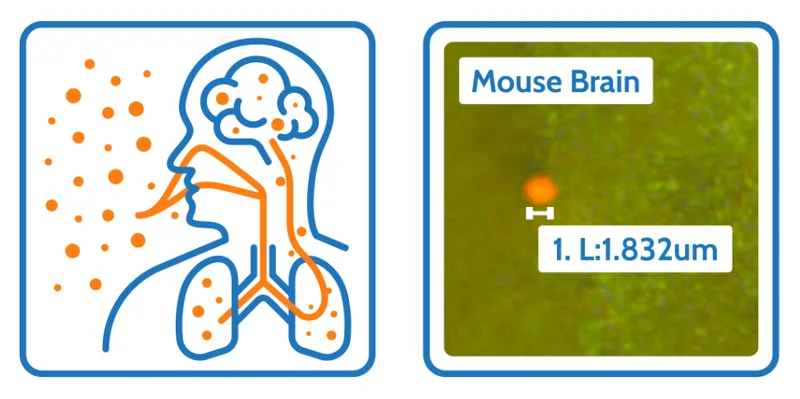
Based on their chemical properties and shape, the authors suggested that the particles likely originated from air pollution. Because many of the particles were found in frontal brain regions, they also proposed that they may have entered the brain directly via the nose, bypassing the blood-brain barrier (Figure 2, left).
Other animal studies show that particles can reach the brain after exposure. For example, mice exposed to 2-micron plastic particles had the same particles found in their brain tissue (Figure 2, right).
These findings show that particles can reach the brain. However, this does not tell us:
- How much this happens in real life
- How fast this happens
- What these particles do in the brain
- Or whether this is enough to affect brain health
Different types of particles may also behave very differently in the brain. Overall, these studies suggest that particles can reach the brain. However, the methods used are not without limitations, and contamination during sample collection and analysis cannot be completely ruled out.
Evidence 2: Particles can have effects on the brain
Evidence 1 shows that particles can reach the brain which leads to the question: what do these particles do in the brain? This is not known.
However, more and more studies are providing more and more pieces of evidence. Many of them expose mice or rats to air pollution particles and then study their behaviour, especially memory and learning.
For example, Lee et al. (2022) exposed mice to polystyrene particles in drinking water (that’s the study from above). They found signs of brain inflammation and changes in learning and memory. It is unclear how these findings translate to humans.
This question is also part of my PhD research outside of AirGradient.
We study what happens when airborne particles, such as iron-rich particles from car brakes, come into contact with brain-related proteins like tau.
These are very simple laboratory experiments. We do not use brains or animals. This means the system is highly simplified and therefore uncertain.
Because of this, we cannot directly say how relevant the results are for human health. But we can observe what happens at a basic level:
- Do the proteins change?
- Do they start forming structures similar to those seen in Alzheimer’s disease?
- Or do we see no effect at all?
We are still at an early stage of this research. We do see effects in some experiments, but their real-world meaning is not clear at all.
One reason is that laboratory experiments often use higher concentrations than real life. This is done to see effects in a short time, because these experiments usually cannot run for more than a few days or weeks.
At the same time, real exposure happens at much lower levels, but over many years.
This is a general challenge in toxicology which we have written about here. It is difficult to reproduce long-term exposure in short experiments and therefore we should be very careful with our conclusions. As Paracelsus said: “The dose makes the poison.”
Evidence 3: Air pollution correlates with dementia
The previous section discussed laboratory experiments. There is another way to study air pollution and dementia: epidemiology.
Epidemiology looks for patterns in large populations. We have written about it here. For example, researchers compare where people live with how often they develop dementia. If people living in more polluted areas are diagnosed with dementia more often, then it indicates a correlation between air pollution and dementia.
Over the past decades, more and more studies have reported such correlations. A large review by Best Rogowski et al. (2025) analysed the available evidence. It found that long-term exposure to PM2.5 and nitrogen dioxide was associated with a higher risk of dementia, while no clear association was found for PM10 or ozone.
The authors concluded:
“This analysis adds to the body of evidence that outdoor air pollutants are risk factors for dementia, indicating that reduced exposure to pollution could reduce dementia rates and stricter air quality standards would likely provide substantial health, social, and economic benefits.”
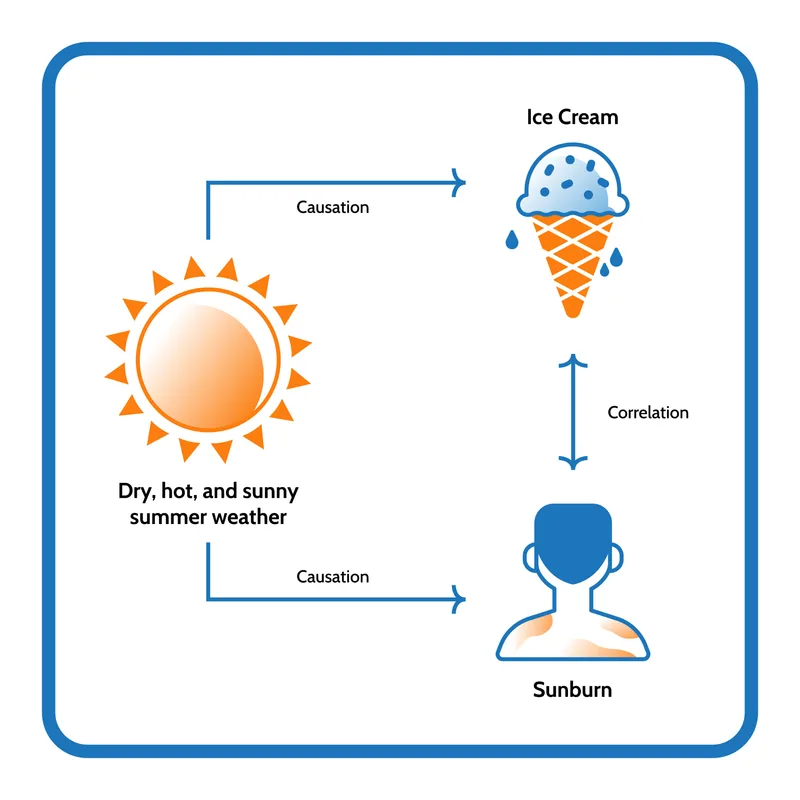
However, a correlation does not prove that one thing causes the other. People living in more polluted areas may also differ in many other ways, such as age, income, diet, healthcare, traffic noise, or lifestyle. Researchers try to account for these factors, but it comes with limitations.
This is why the authors wrote that reducing air pollution “could” reduce dementia rates, rather than saying it “will” reduce dementia rates. That single word reflects an important scientific distinction between correlation and causation. The difference between the two is shown in Figure 3.
So, does air pollution cause dementia?
The honest answer is that we do not know.
The evidence presented in this article does not prove that air pollution causes dementia. However, it also does not rule it out. Figure 4 summarises the 3 lines of evidence.
| 1. Brain entry evidence | 2. Biological effects | 3. Population studies |
|---|---|---|
| • Air particles in lungs → bloodstream • Some particles found in brain • Nose → brain (olfactory) |
• Inflammation • Oxidative stress • Memory changes in animals • Protein effects (tau / amyloid) |
• Epidemiology • PM2.5 exposure linked to higher dementia risk • Large population datasets |
Possible link to dementia
(causation NOT proven)
Each of these findings has important limitations on its own. But together, they form a growing body of evidence that deserves attention.
This is how science often progresses. A single study rarely answers an important question. Instead, evidence slowly builds from different fields of research until a clearer picture emerges.
Whether air pollution contributes to dementia is one of those questions. At the moment, the evidence is suggestive, but not conclusive. More research is needed before we can confidently say whether air pollution is a cause of dementia, how large its contribution is, or which particles are responsible.
Until then, the most scientifically honest answer remains: we simply do not know.