When we talk about clean air in schools, the conversation often starts with air purifiers. This makes sense, because purifiers are easy to understand: air goes in, particles are removed by a filter, and cleaner air comes out. They're also easy to add to a classroom without much extra effort. But are they really the best solution for clean classroom air?
Positive pressure systems (PPS) are gaining more and more traction in heavily polluted areas, and there are good reasons for it.
Instead of only cleaning the air once it's already inside a classroom, a positive pressure system tries to control the direction in which air moves through the building. The goal is simple: when air leaks through gaps, cracks, doors, or ceiling spaces, it should leak from the classroom outward - not from the polluted outdoors inward.
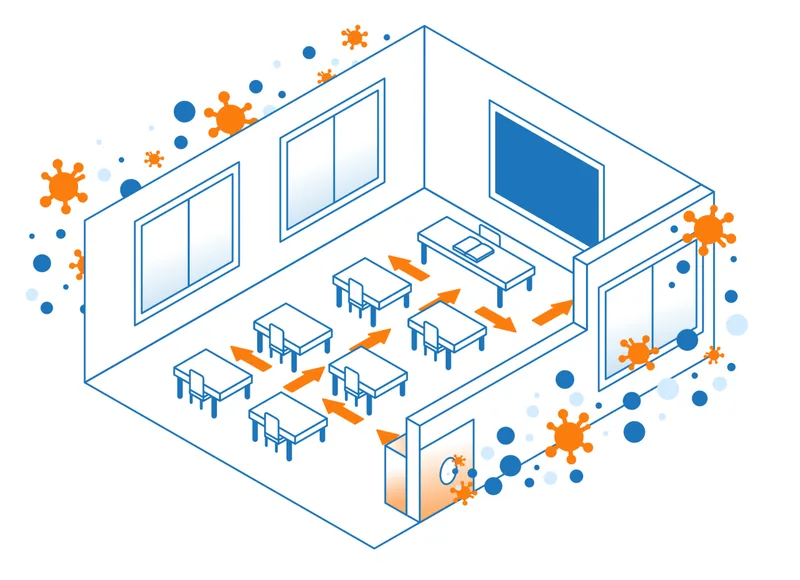
This is why positive pressure can be so powerful during high outdoor PM2.5 events. It is not only removing particles, but also reducing the amount of polluted air entering the room in the first place. A positive side effect is that CO2 levels in the classroom also remain low, which has been linked to better cognitive performance. Air purifiers do nothing to manage CO2 concentrations (since they're not introducing fresh air), making this a significant advantage over more traditional purification systems.
But positive pressure is also easy to misunderstand. It is not created by putting any fan into a room. It is not guaranteed by installing a filter box. And it does not work equally well in every type of classroom. When it comes to positive pressure systems, the physics matter.
The basic idea: pressure decides airflow direction
Air moves from higher pressure to lower pressure, and a positive pressure classroom is simply a classroom where the indoor air pressure is slightly higher than the pressure outside the room or in the adjacent corridor.
The pressure difference can be written as:
ΔP = P_inside - P_outside (difference in pressure = inside pressure - outside pressure)
If ΔP is positive, the room is positively pressurised.
If ΔP is zero, the room is neutral.
If ΔP is negative, the room is under negative pressure, and air from outside or adjacent spaces can leak in.
The pressure differences involved are usually small and are measured in pascals (Pa). For comparison, normal atmospheric pressure is around 101,325 Pa. A classroom positive pressure system may only need a few pascals of added pressure to change the direction of leakage. So, while the number is small, the effect can be substantial.
The important point is that positive pressure behaves almost like a binary state. The room is either positively pressurised relative to the surrounding space, or it is not. Once the room crosses that threshold, leakage direction changes. Below the threshold, polluted air can still enter. Above it, clean filtered air tends to escape. This is why we very often see near-zero particle concentrations in classrooms with positive pressure systems, even when outdoor levels are extremely high.
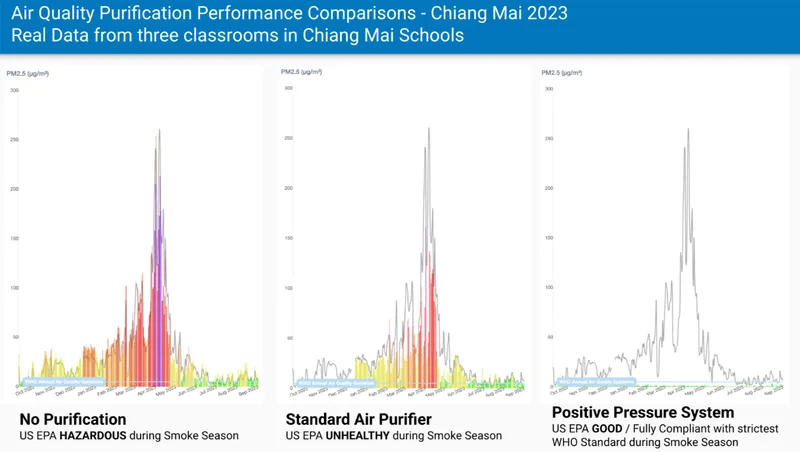
With that said, more pressure is not automatically better. Very high pressure can create noise, draughts, energy waste, and unnecessary strain on the system. The goal is not to inflate the room, but rather to maintain just enough positive pressure during real school operation.
Why the classroom envelope matters
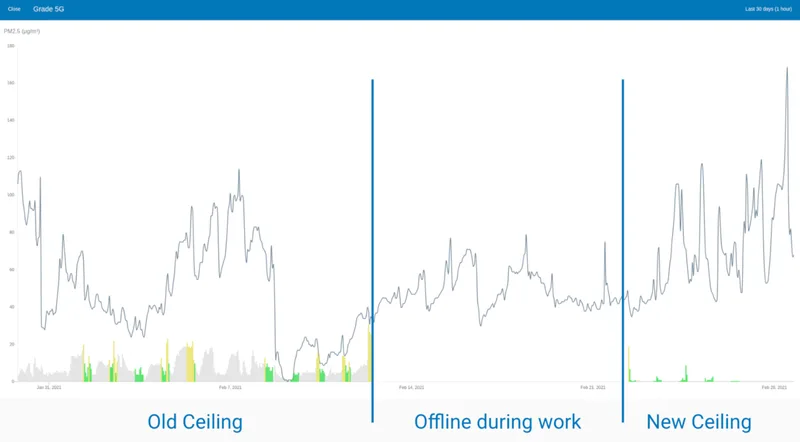
A positive pressure system only works if the classroom can behave like a pressure zone. That means the room does not need to be perfectly sealed, but it does need a reasonably airtight envelope.
Every classroom leaks. Air escapes through gaps under doors, window frames, ceiling joints, wall cracks, electrical penetrations, louvred openings, and ductwork. These leaks are not automatically a problem - whether they matter depends on the sum of the leakage area. In a positive pressure room, they become outward leakage paths. The difficulty arises when the leakage area is so large that the fan cannot build any meaningful pressure.
A simplified leakage relationship is:
Q_leak = C × (ΔP)^n
Where:
Q_leak is the airflow through leaks
C is the leakage coefficient of the room
ΔP is the pressure difference
n is a flow exponent, typically around 0.6 to 0.7 for building leakage (theoretically bounded between 0.5 for fully turbulent flow and 1.0 for fully laminar flow)
The practical meaning is straightforward: if the classroom is very leaky, C is large. If C is large, much more airflow is needed to reach the same pressure difference. At some point, the required airflow becomes unrealistic.
This is why sealing the room is absolutely critical to the system. A school can spend money on a good filter and fan, but if the room has permanently open windows, large roof gaps, or open corridors, the fan may simply move air without creating pressure. Often the work required to make the classroom envelope relatively airtight is greater than the work of installing the positive pressure system itself.
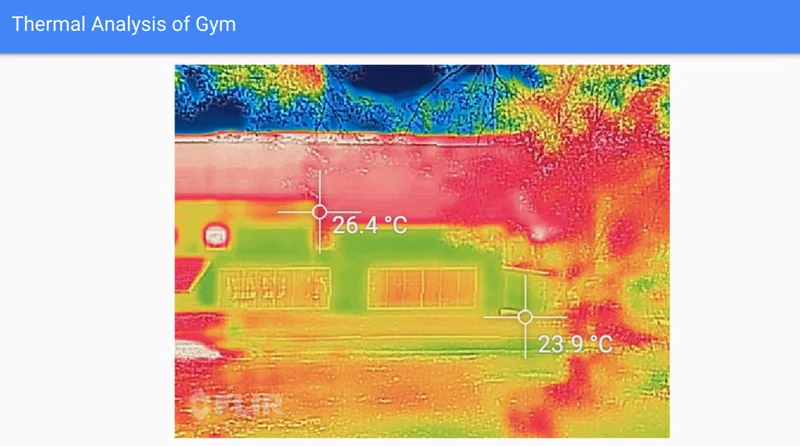
The good news is that these improvements are often low-cost. Door sweeps, sealed window gaps, closed louvres during pollution episodes, sealed ceiling penetrations, and controlled supply openings can reduce leakage enough for positive pressure to become feasible.
Open classrooms are a challenge
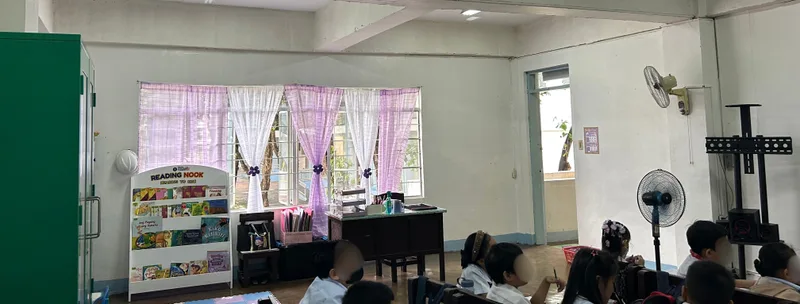
In low- and middle-income countries, however, this can become more challenging. Many classrooms are not designed as sealed, air-conditioned spaces and instead may be naturally ventilated, open-sided, or built with large openings for heat control. In many cases, there is no air conditioning, and keeping windows and doors open is part of normal operation.
An open classroom behaves less like a room and more like a semi-outdoor space. If one wall is open, or if there are large permanent openings near the roof, the leakage area is likely to be too large to pressurise the room. The fan would need to supply huge amounts of filtered air, which may be too costly, noisy, or energy-intensive.
This does not mean clean air is impossible in these settings, but a more nuanced approach is required. For very open classrooms, it may be better to focus on partial enclosure, or on dedicated clean-air shelters used during severe pollution episodes.
Positive pressure is most effective when the classroom can be made into a reasonably enclosed zone. Without that, the concept becomes much harder to apply.
Supply airflow must exceed uncontrolled outflow
Now we know that to create positive pressure, filtered supply airflow into the classroom must be greater than the air leaving through mechanical exhaust and return paths.
Here is a simplified way of expressing that:
Q_supply > Q_exhaust
The surplus - the difference between supply and mechanical exhaust - is what must find its way out through the envelope. It is that surplus, pushing outward through gaps and cracks, that creates and sustains the positive pressure. The room settles at whatever ΔP makes the outward leakage equal to the surplus.
This is why an ordinary split air conditioner does not normally create positive pressure. Most split AC units recirculate indoor air. They cool the room, but they do not supply fresh outdoor air. A room can have air conditioning and still be under negative pressure if exhaust fans, wind, or building effects pull air out.
A positive pressure system needs net filtered supply air. That means air from outside is pulled through a filter and pushed into the classroom. The air must be clean enough, and the volume must be high enough to overcome leakage and maintain a small positive pressure.
Also keep an eye on systems that create negative pressure and could work against your positive pressure system. Sometimes these systems are in adjacent rooms. Examples include kitchen hoods and bathroom exhaust fans.
The filter has only one pass
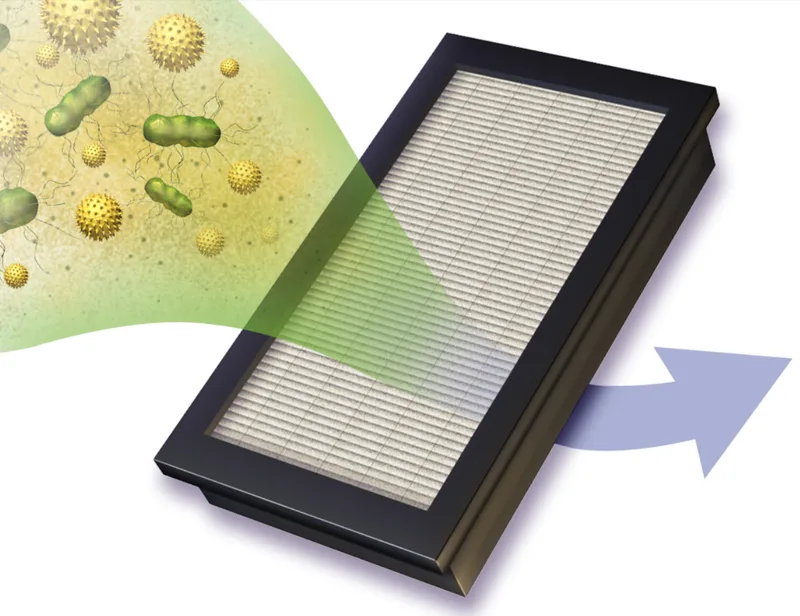
The filter in a positive pressure system has a harder job than the filter in many recirculating air purifiers.
A typical room air purifier cleans the same room air again and again. If some particles pass through the filter in one cycle, they may be captured in the next pass. This repeated circulation helps reduce particle concentration over time.
A positive pressure system is different, though, because it brings outdoor air into the room. That air passes through the filter only once before it reaches the classroom, meaning the filter must remove all relevant PM2.5 in a single pass. A weak filter is not good enough, because any particles that pass through are delivered directly into the protected space.
This is why positive pressure systems for polluted outdoor air need high-performance HEPA filters, and why the entire clean-air path must be airtight.
If the filter box leaks, polluted air can bypass the filter. If the ducting leaks on the suction side, unfiltered air can be pulled into the system. If the filter does not seal properly against its frame, particles can pass around the filter instead of through it. In all these cases, the system may still move air and may even pressurise the room, but it is pressurising the room with partially unfiltered air.
A well-designed system should ensure that all supply air passes through the filter, not around it. Gaskets, sealed filter frames, sealed duct joints, proper access panels, and careful installation determine whether the system actually delivers clean air.
Pressure drop
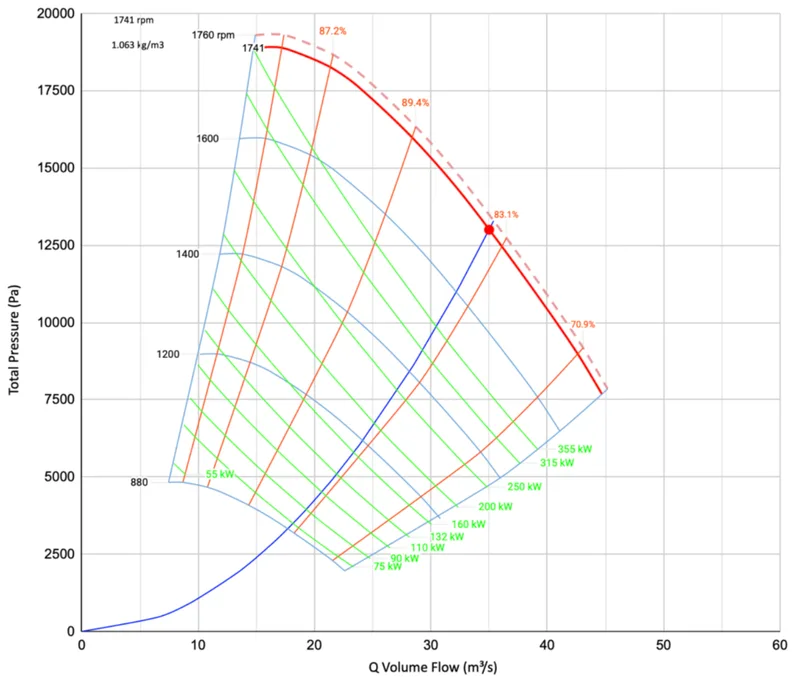
High-performance filters clean air, but they also resist airflow. This resistance is called pressure drop.
Pressure drop is one of the most important technical concepts in positive pressure systems. A fan may move a large amount of air when it is sitting in open space. But once it is connected to a HEPA filter, duct, bend, grille, insect screen, or damper, the airflow can drop dramatically.
The system pressure drop can be simplified as:
ΔP_total = ΔP_filter + ΔP_duct + ΔP_grille + ΔP_bends + ΔP_other
The fan must be able to overcome this total pressure drop while still delivering the target airflow.
This is where many simple designs fail. A fan advertised as 500 m³/h may only deliver that airflow in free air, with almost no resistance. Add a dense filter and the actual airflow might fall to a fraction of the advertised value.
For positive pressure, the relevant question is not "What is the maximum airflow of the fan?" but "How much airflow can this fan deliver at the expected pressure drop?"
As filters load with dust, the pressure drop increases. If the fan has no reserve capacity, airflow falls over time. Once airflow falls too far, the classroom may lose positive pressure even though the system is still switched on. That is why filter maintenance is so important.
Many classroom systems are undersized
One of the most common problems with positive pressure systems is that they are too small for the room they are supposed to protect.
This is especially common in classrooms. A classroom is not a small bedroom. It has many occupants, frequent door openings, a large floor area, and often a leaky envelope. The system must supply enough filtered air to maintain positive pressure under these real conditions. If the fan is too weak, the filter too small, or the ducting too restrictive, the room may never reach the pressure point where leakage direction reverses.
Undersizing can happen in several ways.
The filter may be too small. A small filter has a higher face velocity, which usually means a higher pressure drop. It also loads with dust more quickly. As the filter clogs, airflow falls, and the system may lose positive pressure. A larger filter area reduces pressure drop, extends filter life, and makes it easier for the fan to maintain airflow.
The fan may not be able to produce enough static pressure. Many fans look powerful when rated in free air, but their airflow collapses once they are connected to a high-performance filter, ducting, bends, and grilles. For positive pressure, the fan must be selected for airflow at pressure, not just maximum airflow under ideal conditions. More on this below.
The system may also be too small for the leakage area of the classroom. A relatively airtight room may only need moderate airflow to become pressurised. A leaky classroom may need much more. If the supplied clean air is not enough to exceed leakage and uncontrolled outflow, the classroom will remain neutral or negative.
This is why small positive pressure units should be used with caution in classrooms. A compact system may work well for a small office or bedroom, but not for a full classroom during school operation. If only smaller PPS units are available, several systems may need to be installed in the same classroom to provide enough filtered supply air and to distribute it properly.
A practical rule is to avoid asking one small device to solve a large-room problem. Positive pressure is a room-level airflow strategy. The system size must match the classroom volume, leakage, filter resistance, door-opening frequency, and target indoor PM2.5 level.
The key question is not whether a PPS unit is installed. The question is whether the total installed system is large enough to keep the classroom positively pressurised while maintaining very low PM2.5 during real use.
Fan types matter
Not all fans are suitable for positive pressure systems. The fan must move air through resistance. This makes fan selection critical.
Axial fans
Axial fans move air in a straight line, like a propeller. They are common in wall fans, exhaust fans, computer fans, and simple ventilation systems.
They can move a lot of air when resistance is low. But many axial fans perform poorly against high static pressure. If connected to a high-performance filter or restrictive duct, their airflow can collapse.
Axial fans may be useful for low-cost prototypes, very large filter areas, short airflow paths, or low-resistance systems. But for serious classroom positive pressure systems, they need to be selected carefully.
Centrifugal fans
Centrifugal fans, also called blower fans, pull air into the centre of the fan wheel and push it outward. They are widely used in HVAC systems, air handlers, and many air purifiers.
They are generally much better than simple axial fans at maintaining airflow against resistance. This makes them highly useful for positive pressure systems, especially when high-performance filters, ducts, bends, and grilles are involved.
A well-selected centrifugal fan can provide stable airflow even as the filter becomes more loaded. The trade-offs are cost, noise, size, and the need for proper housing.
EC fans
EC fans are not a separate fan shape. They use electronically commutated motors and can be axial, centrifugal, or mixed-flow. Their advantage is efficiency and controllability.
For schools, EC fans are especially attractive because they make the positive pressure system dynamic. Instead of running the fan at one fixed speed, the system can adjust airflow based on sensor feedback.
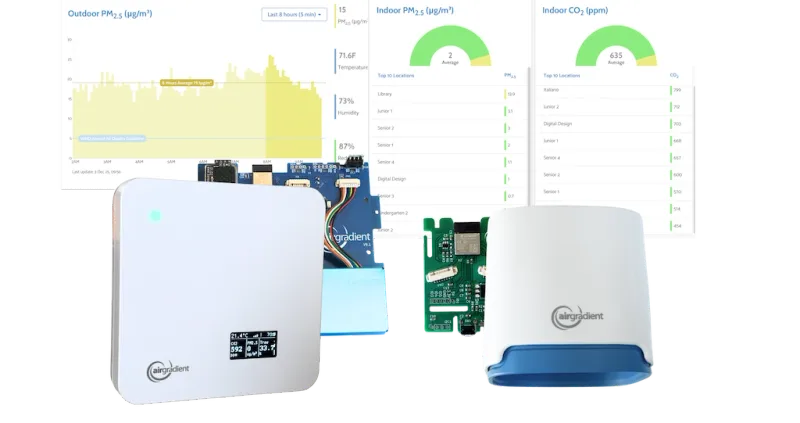
In a more advanced setup, the indoor air quality monitor can be coupled directly to the EC fan controller. The fan speed can then increase or decrease automatically to find the right operating point: enough airflow to maintain positive pressure and keep PM2.5 as low as possible, but not more airflow than needed.
This turns the positive pressure system from a static installation into a feedback-controlled clean-air system. The monitor is no longer only a reporting device. It becomes part of the control loop.
The key lesson is simple: fan curves matter, but control matters too. A fan should be selected based on the airflow it can deliver at the expected static pressure, and advanced systems should be able to adjust that airflow as classroom conditions change.
How to check whether a room is pressurised
The best way to verify positive pressure is with a differential pressure sensor or manometer. This directly measures the pressure difference between the classroom and the adjacent space.
But there are also simple visual tests that help explain the concept.
One easy demonstration is to check airflow direction at a known leakage gap, such as the gap under a door. Place a thin strip of tissue paper, a light ribbon, or a smoke source near the gap. If the room is positively pressurised, the tissue or smoke should move away from the classroom, showing that air is leaking outward.
A small candle flame can also show airflow direction, but it should only be used with great care. Never use a flame near filters, curtains, paper, children, or combustible materials. A tissue strip or smoke pencil is safer.
These indicators are especially valuable because positive pressure systems can fail silently. A clogged filter, open window, leaking duct, poorly sealed filter frame, broken fan, blocked intake, or changed operating condition can remove the pressure or filtration advantage without anyone noticing.
Monitoring turns the system into evidence - and control
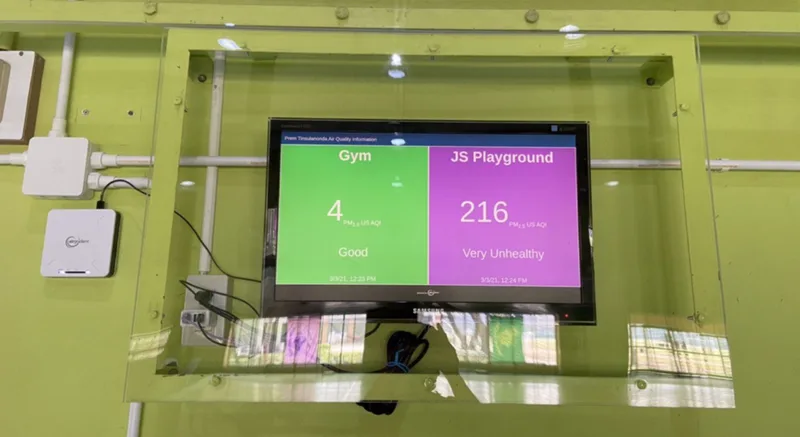
Without monitoring, a positive pressure system is mostly a promise. With monitoring, it becomes a verifiable clean-air strategy. With control, it can become adaptive.
At a minimum, schools should compare indoor and outdoor PM2.5. This shows whether the classroom is protected during high outdoor pollution. If outdoor PM2.5 rises but indoor PM2.5 stays close to zero, the system is doing what it should do.
In more advanced systems, the indoor air quality monitor can also help control the system. An indoor monitor connected to an EC fan can automatically adjust fan speed to maintain the desired operating point. If indoor PM2.5 starts to rise, the fan can increase airflow. If CO2 rises during a full classroom period, the fan can supply more fresh filtered air. If the room is already clean and lightly occupied, the fan can reduce speed to save energy and noise.
This allows the system to maintain targets rather than simply run at a fixed setting. The ideal target for PM2.5 is as close to zero as practically possible during pollution episodes. At the same time, the system can help keep CO2 low by supplying enough filtered outdoor air during occupied hours.
The physics decides whether it works
Positive pressure can be one of the most effective ways to protect classrooms from outdoor PM2.5. But it only works when the system is designed around the physics of airflow.
- The classroom must be enclosed enough to hold a small pressure difference.
- The fan must deliver enough filtered air at the required pressure.
- The filter must remove particles in a single pass.
- The filter must also be large enough to avoid excessive pressure drop and rapid clogging.
- The total PPS capacity must match the classroom size and leakage, and smaller units may need to be installed in multiples.
- The PPS enclosure and ducting must be airtight enough to prevent unfiltered bypass.
- The system must keep working as filters load, doors open, outdoor pollution changes, and classrooms fill with students.
For advanced systems, the best setup is not fixed-speed operation but feedback control. A monitor connected to an EC fan can dynamically adjust airflow to maintain the pressure point, keep PM2.5 as close to zero as possible, and help keep CO2 low during occupied periods.