Provinces in Kalimantan and Sumatra, Indonesia have been battling forest fires for many months now. The Indonesian Ministry of Forestry reported that the total area of forest and land fires burned about 202,000 hectares from January to July 2026, while Reuters reported that nearly 95,000 hectares of land burned in July alone.
The smoke coming from the wildfires has drifted beyond Indonesia, affecting its neighbouring countries.
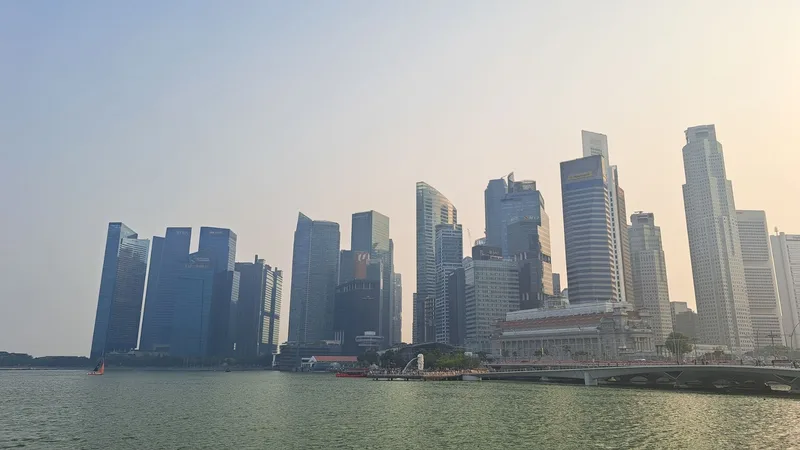
Singapore has been among the most persistently affected, with its air quality fluctuating mostly between moderate and unhealthy since September 4. CNA stated that on September 15, all its five regions recorded unhealthy levels for the first time since 2019. On October 14, the 24-hour Pollutant Standards Index (PSI) reached the “very unhealthy” range, with the hourly PM2.5 reading climbing to 288 in the west.
Earlier in September, Malaysia declared an emergency in Sarawak’s Serian district after the Air Pollutant Index (API) passed the critical level of 500 while Kuching, the state capital, reached a hazardous reading of 407.
| AIR POLLUTION AND HEALTH EFFECTS | ||
|---|---|---|
| Standard Index Range | Health Category | Health Effects (PSI / API) |
| 0 – 50 | Good | Little to no health risk; air quality is considered satisfactory. |
| 51 – 100 | Moderate | Few or no health symptoms expected for the general public. |
| 101 – 200 | Unhealthy | Moderate symptoms occur in sensitive groups (e.g., individuals with asthma, respiratory, or heart conditions); the general population may begin to experience mild discomfort or upper respiratory irritation. |
| 201 – 300 | Very Unhealthy | Significant symptoms and reduced physical endurance in high-risk groups (children, elderly, and those with underlying illness); the general population commonly experiences noticeable symptoms. |
| Above 300 | Hazardous | Significant health risks and potential trigger of early symptoms across the general public; vulnerable individuals may suffer severe health complications or aggravation of existing conditions. |
Brunei’s air hit unhealthy to very unhealthy levels in all four districts. Air quality in the Philippines has also been described as “acutely unhealthy” as smoke travelled across different regions, including Manila, Cebu, and Northern Mindanao. Meanwhile, Hat Yai and other southern parts of Thailand reached the red warning category as air quality continued to deteriorate. Countries use different national air quality indices, so some of these labels are not directly comparable with the PSI and API.
Facing a crisis of this scale, people turn to the same hope every haze season: that the rain will wash the haze away. Governments and communities have acted on this same hope, too.
In Palembang, South Sumatra, Indonesia, about 3,000 residents gathered for “Salat al-Istisqa,” a special Islamic prayer seeking rain. Malaysia has carried out cloud seeding operations over Kuala Lumpur and Putrajaya, and along its shared border with Indonesia to combat the spread of regional haze. Efforts to fight the fires directly are also under way. Indonesia has deployed more than 50 aircraft for water bombing, and Japan has also sent helicopters to aid in aerial firefighting efforts.
But can rain really wash haze away? To find out, we first need to understand the science behind haze.
What is haze and why does it keep coming back?
According to the Association of Southeast Asian Nations (ASEAN), haze consists of smoke carrying PM2.5, suspended fine particles that are small enough to enter the lungs and bloodstream when inhaled. ASEAN described haze as transboundary “if its density and extent is so great at source that it remains at measurable levels after crossing into another country’s air space.”
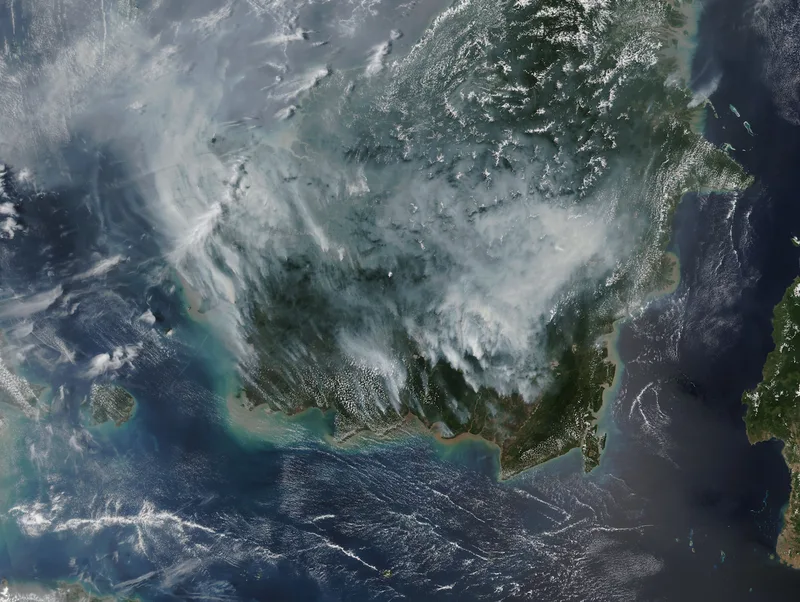
Wind acts as the primary transport mechanism that turns local fires into a crisis for neighbouring countries, with the Southwest Monsoon (also known as the Boreal Summer Monsoon) driving the transboundary haze in the dry season. But wind is not the culprit. It only carries smoke from fires that already exist.
Transboundary haze in Southeast Asia is not new. In fact, it has been a source of regional tension for decades now, with a haze outbreak documented in Singapore as early as 1972. The situation got worse in the 1980s and 1990s as slash-and-burn agricultural techniques, palm oil farming, and peatland drainage became more common and widespread in Indonesia, which is home to 36% of the world’s tropical peatlands. Peatlands are especially vulnerable to fire because dry conditions and drainage make their rich organic matter ignite more easily and smoulder deep underground where rain and surface water struggle to reach.
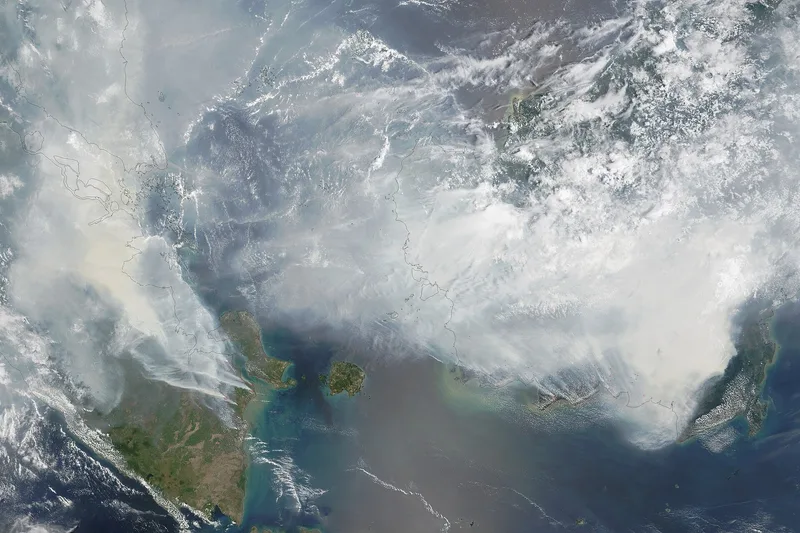
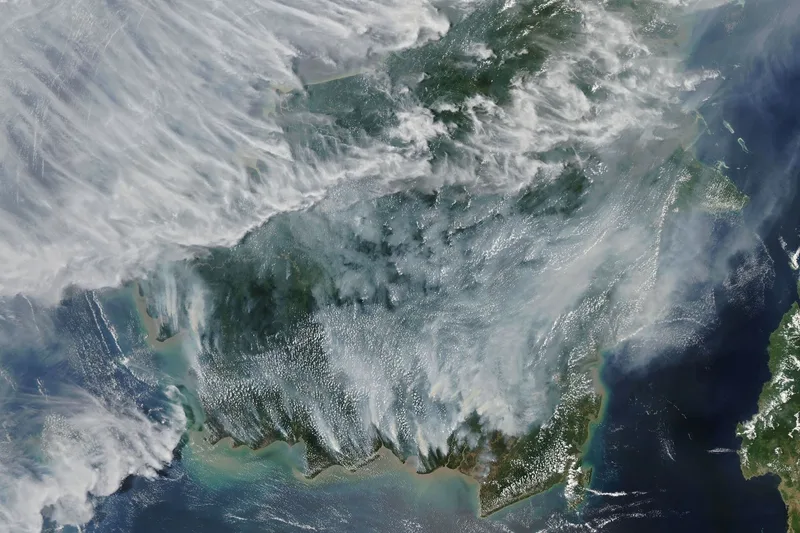
In 2026, affected countries face worse-than-usual conditions because two climate phenomena, both of which climate change may be influencing, are occurring at the same time.
A “Godzilla-level” El Niño
As defined by the World Meteorological Organization (WMO), El Niño is characterised by unusually warm ocean surface temperatures in the central and eastern Pacific. This leaves Indonesia and much of the western Pacific drier than usual. Dry seasons that coincided with El Niño exacerbated the haze crises originating from Indonesian fires in the years 1997, 2015, and 2023.
The media have informally termed this year’s exceptionally powerful El Niño event “Godzilla-level,” and WMO’s latest data and forecasts show why. In its October press release, WMO Secretary-General Celeste Saulo said, “El Niño is firmly established and strengthening rapidly.” WMO forecast a peak in December and a near-certain likelihood of persisting through February 2027.
The Niño 3.4 index, which tracks sea surface temperatures in the central-eastern equatorial Pacific, rose from an average of 1.6 °C above normal in June to 2.5 °C above normal in August. For October to December, it is forecast to average about 3.7 °C above normal, which would be the highest since observations began.
A positive Indian Ocean Dipole
The Indian Ocean Dipole (IOD) – El Niño’s counterpart in the Indian Ocean – is in a positive phase this year.This means that the western part of the Indian Ocean has warmer sea temperatures while it’s cooler in the east. Because rainfall tends to move with warm waters, this tends to bring drought to Indonesia and Australia. WMO expects the positive IOD to peak in October, with an October to December anomaly at about +0.5 °C.
The IOD’s influence has been documented in a study titled Asymmetric carbon response to the 2019 extreme positive Indian Ocean Dipole. Researchers linked that year’s positive IOD to severe drought conditions that helped forest fires spread widely across Indonesia.
Together, these hotter and drier conditions let fires spread more easily and make them harder to control, resulting in severe wildfires and the persistence of haze.
Can rain really wash haze away?
Since hot and dry environments make fires easier to spread, rain seems like the obvious remedy to stop the burning and to clean smoke out of the air.
Rain can end the fires that produce the smoke, and this is how haze seasons can actually end. In the case of the Indonesian fires, however, peat proves to be an exception as it burns deep underground and takes longer to rewet. This makes peatland fires and the haze they produce linger even after the rains arrive.
Until prolonged rain arrives, people still hope for rain to clean smoke out of the air, and scientists refer to a process called wet scavenging that can potentially wash haze away. This happens when raindrops collect the airborne particles and carry them toward the ground. A few studies suggest that rain does clean the air, but how much it removes and for how long depend on four things:
- how hard it rains,
- how big the particles are,
- how much smoke is in the air,
- and how quickly winds bring the smoke back.
The first three factors come from studies that examined US wildfire smoke and Chinese air pollution, while the fourth comes from what meteorologists have observed in the current transboundary haze as we will discuss below. As the studies did not cover Southeast Asian peat fires and haze, the exact figures may not apply in this region, but they still show how rain and haze generally interact.
1. Heavier rain removes more, but with diminishing returns
A study done by researchers at the Virginia Climate Center at George Mason University (GMU) showed that a heavier rainstorm generally works better in removing more pollution in total, but it only removes a fraction of it. They wrote, “At rainfall rates near 15 millimeters per hour, estimated reductions reached about 18% for PM2.5 and 25% for PM10.” In other words, even a heavy downpour removed less than a fifth of fine particles that make up haze. The study also found that rain at around 1 to 3 millimetres per hour has the highest removal per additional millimetre of rain, while each extra millimetre beyond this range did less.
A study done across three typical regions in China reached a similar conclusion: heavier rain resulted in a stronger removal effect. The researchers wrote, “With the increase of precipitation intensity, the removal effect of precipitation on PM2.5 changed from negative to positive values gradually.”
2. Rain removes bigger particles more easily
A study conducted in Lanzhou, China found that rain cleans different air pollutants at different rates. It ranked pollutants by how easily rain washes them away in this order:
- SO2 (Sulphur dioxide)
- PM10 (Particulate Matter 10, coarse particles)
- NO2 (Nitrogen dioxide)
- O3 (Ozone)
- PM2.5 (Particulate Matter 2.5, fine pollution particles)
- CO (Carbon monoxide)
The differences can be attributed to the composition, solubility, and size of each pollutant. SO2 dissolves very easily in water, while CO barely dissolves. PM10 is big and heavy enough for raindrops to collide with, while PM2.5 is too small, making it much harder for falling drops to capture. This matches the GMU figures above, where rain removed more PM10 than PM2.5.
3. Smoke makes rain less effective
The same team from GMU found that rain removed less particle pollution as wildfire smoke became denser. The researchers explained, “Previous research suggests that large concentrations of smoke particles can produce more numerous but smaller cloud droplets, which can reduce the collision processes that help form larger droplets and precipitation.”
The researchers stressed that while their results cannot confirm a single mechanism, they show that during a smoke episode, the atmosphere does not respond to rainfall the way it does under ordinary conditions.
4. The smoke comes back
Even when rain does clear the air, the effect is brief. Its cleaning action is limited to the rainfall process, and the concentration of pollutants increases again soon after the rain is over.
Scale makes lasting relief even harder to achieve. In the case of the persistent forest fires in Indonesia and the resulting transboundary haze, Professor Datuk Dr Azizan Abu Samah, a meteorologist from Universiti Malaya, explained that rain-producing measures such as the cloud seeding done in Malaysia do not completely address the problem.
He said in an interview with Asia News Network, “The smoke plume from the burning in Sumatra is more than 300 km long. Even if rain temporarily washed haze particles out of the atmosphere, prevailing winds could bring the smoke back within hours.
“So let’s say it rained in Ipoh [city in Malaysia] and the haze concentration cleared a bit due to washout by the rain cloud, which may affect around 50km, which is the normal thunderstorm size; it will last maybe one to two hours before the prevailing wind brings the haze smoke back.”
Cloud seeding also faces another limit as it needs suitable clouds already in the sky, which are scarce during an El Niño-driven drought.
Considering all four factors together, rainfall can only offer temporary relief, not a solution.
Why this matters beyond a single case of transboundary haze
Understanding how haze and rain interact is important beyond the current fire events in Indonesia and the haze experienced by its neighbouring countries. Haze is a global pattern, it is far more costly to manage than to prevent, and tackling it requires coordinated action at every level.
1. Fires, dry seasons, and winds ignore borders.
Wildfire and transboundary haze events are not unique to Southeast Asia. They are a recurring concern in other parts of the world, too. The fuels and conditions may differ, but the pattern of fires producing smoke that crosses borders is the same.
In 2023, Canada experienced a massive wildfire season that burned about 5% of its forests, with historic fires in Quebec, Alberta, British Columbia, and Nova Scotia. According to Grist, a media organisation focused on climate change and environmental justice, the smoke made air quality worse in the United States, despite the country’s substantial improvements in the past years.
Canada had another wildfire season in 2026. While it primarily affected Northwestern Ontario and the Northwest Territories, it produced plumes that reached major parts of the US, with the Great Lakes and Midwest bearing the brunt on both occasions.
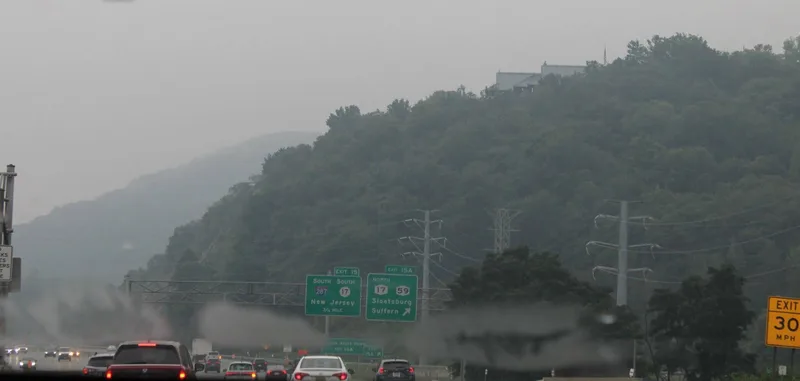
Human-caused climate change has played a role in the last three fire seasons in Canada, and an international team of scientists from Canada, the US, the Netherlands, and the United Kingdom warned that it will remain a major driver of these increasingly intensifying wildfires.
2. Waiting for relief costs more than preventing the fires.
The drivers of a persistent problem like Southeast Asia’s haze, including the seasonal monsoon, El Niño, and the IOD, can be forecast in advance, yet the response is usually reactive. Relying on reactive fixes and damage control places a much heavier burden on us.
CNA reported that the World Bank estimated the economic cost of Indonesia’s fires at US$16.1 billion in 2015 and another US$5.2 billion in 2019. By contrast, the study “Assessing costs of Indonesian fires and the benefits of restoring peatland” estimated the cost of restoring 2.5 million hectares of degraded peatland at around US$3.2 to US$7 billion. It also estimated that peatland restoration could have a potential benefit of US$8.4 billion between 2004 and 2015. The authors described it as “a cost-effective strategy for reducing the impact of peatland fires to the environment, climate, and human health.”
Beyond the economic impact, the Indonesian fires and transboundary haze are also taking a compounding toll on health and the environment. As haze’s primary pollutant PM2.5 harms our health, haze is linked to higher rates of acute respiratory infection, with the BBC reporting more than 170,000 cases in Indonesia alone between August and September 2026. The fires are also releasing long-stored carbon from peatlands, with Mongabay reporting 19.7 million tonnes of emissions from September 1 to 7, which feeds the same climate change that makes fires and haze more likely.
3. Lasting solutions need action at every level.
Transboundary haze is as much a regional issue as a national concern. Addressing it demands international cooperation and coordination from the regional level down to individuals.
Regional level
ASEAN has already established several frameworks as early as 1997 to combat transboundary haze, yet they struggle to be effective due to enforcement limitations and political tensions between member states. To address this, the academic research study, titled The politics of environmental policy: haze pollution, ASEAN, and the way forward, recommends establishing an ASEAN code of conduct. This would elevate the urgency of domestic legal responses while respecting each member’s legal and political system, and aligning regional goals without violating principles of sovereignty and non-interference.
National level
Because the main cause of ignition of recurring fires and haze in Indonesia is the deliberate burning of peatlands to clear land for palm oil and timber plantations, proactive prevention must be the Indonesian government’s top priority. This includes sustainable peatland management and strict enforcement of environmental laws. Responsibility must also be shared widely, though not necessarily equally, among stakeholders: regional and local plantation companies, smallholders, and the consumers buying the resulting products.
Governments must strengthen prevention on the ground, protect and rewet peatland ecosystems, ensure companies are accountable for their concessions and supply chains, and enforce the law without favour against individuals and corporations proven to have caused or allowed fires to occur.
Community and individual level
Communities and individuals cannot stop the fires, but they can take measures to protect themselves. One way of doing this is to monitor real-time air quality during the burning and haze season.
Real-time air quality monitoring catches when smoke returns after rain brings a brief dip in pollution. It also provides information faster than a 24-hour PSI, for example. Air quality data shows when to adjust outdoor activities, when to wear a well-fitted mask, when to run an air purifier and keep windows closed, and whether the air indoors is still healthy enough to shelter in. The same data also helps the most vulnerable, including children, older adults, and people with respiratory conditions, and it also gives people evidence to ask for cleaner air and hold others accountable. Setting up air quality monitoring also means decisions are made on data rather than guesswork.
Don’t wait for the rain or for any reactive fix
Transboundary haze is too complex to be explained by a single cause or solved by a single measure.
A rainy day does not mean the air is safer. Rain has the potential to wash some haze out of the air – but only a modest share, briefly, and if it falls heavily enough. Lasting relief comes when sustained rain extinguishes the fires, not simply when a downpour appears to clear the sky.
Haze may be seasonal, but its effects last longer than the presence of smoke and affect our everyday lives. The weather isn’t ours to control, but there are other actions we can take to keep ourselves protected, and in the future, hopefully prevent the same events from recurring and escalating. A more resilient approach combines accountability, coordinated action at every level, and the shared responsibility for clean air.
The risk is not over. While we wait for governments and companies to do their part or for atmospheric conditions to change, it makes sense for everyone affected to build air quality monitoring into their routines, plans, and policies. We need preparation and prevention, rather than a reactive response each time a wildfire or transboundary haze event occurs.