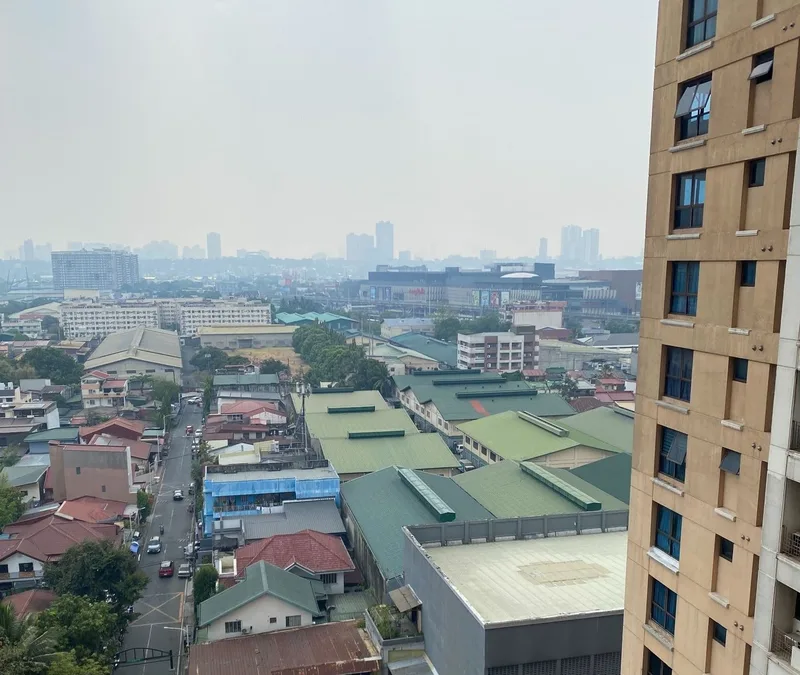
On April 11, when I looked out of my window, I noticed there was a bit of a haze over the skyline, which is quite unusual where I live. I’m not dismissing air pollution in the cities of Metro Manila, as I’ve written a number of times regarding my frustrations about it, but what was unusual this time was that it pretty much blanketed everything in sight. For the first time in a while, I could actually see the pollution in a way that was different from its usual form – localized spots of smoke belching vehicles and smoke from local street food vendors.
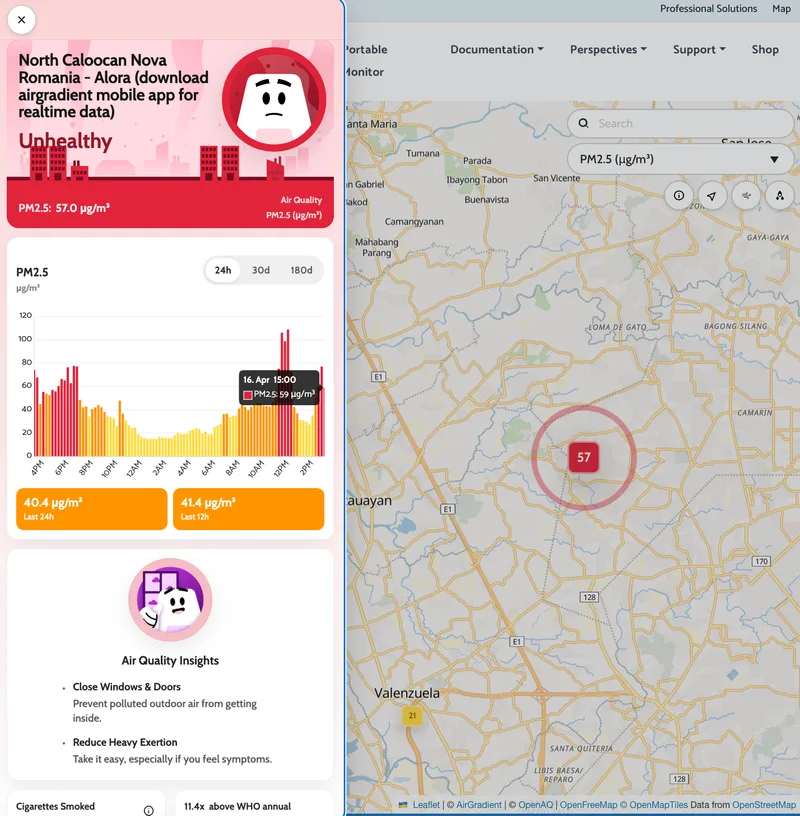
To give a bit of context about how rare this sight is, a dense haze like this is usually only experienced when a volcanic eruption happens nearby. I decided to check the AirGradient map to see how widespread it was, and to my surprise, saw that the PM₂.₅ levels across five different locations in Metro Manila were all elevated to unhealthy levels.
I noticed that the haze lingered for days, and that people were suddenly reposting air quality alerts on social media, which I’m not used to seeing on my personal feeds. So what was the cause of this “sudden” haze?
An island, a landfill, and weeks of smoke
On the evening of April 10, a fire broke out at the Navotas Sanitary Landfill, a 40-hectare closed facility sitting on an island in Navotas city. The landfill had already been non-operational since August 2025, after its operator withdrew before completing the required closure and rehabilitation procedures. What was left behind – a multi-story accumulation of largely unsegregated household waste, which under enough heat, generates methane gas – ended up catching on fire.
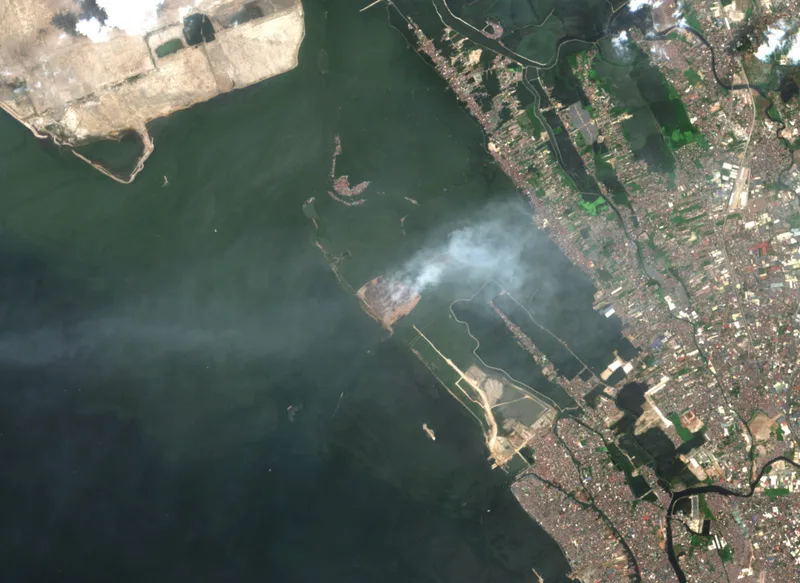
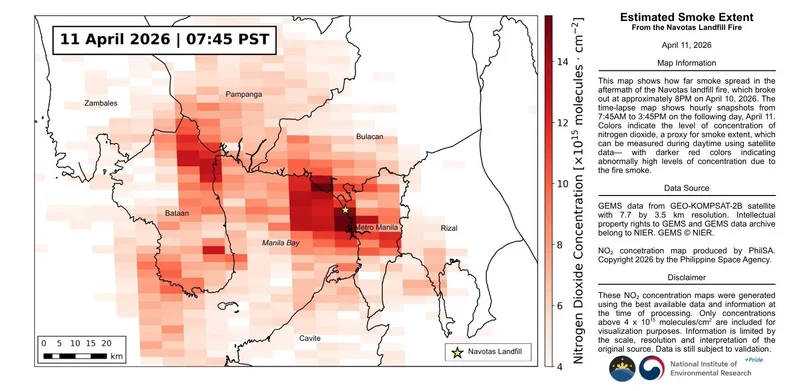
Once the fire started, it didn’t stay contained. Shifting wind directions carried the smoke far beyond Navotas, spreading it across multiple cities in Metro Manila and surrounding areas. Satellite data from the Philippine Space Agency showed elevated nitrogen dioxide levels reaching as far as Bataan. What began as a localized fire quickly became a regional air quality issue.
As the smoke spread, so did its impact on people’s health. In Obando, Bulacan, over 300 residents had to evacuate, and after more than a week of exposure, some began experiencing coughs, colds, and aggravated asthma.
I haven’t had asthma for a long time, but because of the smoke, it recently got triggered.
A week after the fire began, an analysis by the Ateneo School of Medicine and Public Health and the Breathe Metro Manila network found that some parts of northern Metro Manila were recording their highest PM2.5 levels since the fire started, even surpassing the peak of the blaze itself.
Given how widespread and prolonged these effects were, the question becomes obvious: why hasn’t the fire been fully extinguished yet?
The answer lies in the nature of the fire itself. The facility is only reachable by barge, which delayed first responders due to low tide conditions in the early hours. By the time fire boats were deployed, the fire had already taken hold deep within the waste layers – a deep-seated, smoldering burn that is difficult to extinguish because the heat source is buried and insulated under tons of garbage. Fires like these persist underneath, making them harder to access and fully put out.
While these immediate conditions explain the difficulty of controlling this particular fire, they also reflect a broader pattern in how air quality crises are handled in the Philippines.
The system behind the crisis
These events don’t appear out of nowhere, but emerge predictably from the conditions and systems that allow air quality to deteriorate in the first place. And as long as those systems remain unchanged, there is little reason to expect they won’t happen again.
Responses are often triggered only after air quality has already worsened, rather than focused on preventing the conditions that lead to deterioration in the first place. In this kind of system, air quality is repeatedly managed in episodes and addressed after it has deteriorated, rather than safeguarded in advance.
This approach is reflected in how institutions respond after major incidents. In the weeks following the spike in air pollution, the Department of Environment and Natural Resources ordered operators to submit contingency plans outlining how they would respond to fires, gas buildup, and other emergencies. On paper, this signals greater structure and preparedness, but in practice, it still assumes that the primary task is to respond once thresholds have already been crossed.
The problem with this kind of reactive framework is that it does not guarantee prevention. It can improve coordination during emergencies, but it does not necessarily reduce the likelihood of those emergencies occurring in the first place. Without stronger measures that address the underlying conditions, these responses risk functioning as temporary fixes rather than long-term solutions. And as long as that remains the dominant approach, episodes like this will not feel exceptional for long, and will simply become part of a recurring pattern of deterioration, response, and recovery.
Sources
Breathe Metro Manila, Ateneo Center for Research and Innovation, & Ateneo School of Medicine and Public Health. (2026). Post-Incident Air Quality Monitoring Reporting Navotas Sanitary Landfill Fire (10–17 April 2026). https://www.ateneo.edu/sites/default/files/2026-04/Breathe_Metro_Manila_Air_Quality_Situation_Report_18_April_2026.pdf
GMA News. (2026, April 18). Evacuees fall ill as Navotas landfill smoke worsens Metro Manila
air quality. GMA News Online. https://www.gmanetwork.com/news/topstories/metro/984469/evacuees-fall-ill-as-navotas-landfill-smoke-worsens-metro-manila-air-quality/story/
Orcio, F. (2026, April 27). Navotas landfill fire enters third week as responders race against toxic threats; Japanese experts join response | ABS-CBN News. ABS-CBN. https://www.abs-cbn.com/news/nation/2026/4/27/navotas-landfill-fire-enters-third-week-as-responders-race-against-toxic-threats-1654
Villanueva, G. (2026, April 26). DENR orders landfill operators to submit emergency response plan. Inquirer. https://newsinfo.inquirer.net/2218718/denr-orders-landfill-operators-to-submit-emergency-response-plans