First, sorry for the lack of updates over the last two months. The last weeks have been full of development work, hardware iterations, firmware testing, mobile app integration, battery measurements, drop tests, production discussions, and quite a few conferences.
Building a new portable air quality monitor is very different from building a stationary indoor or outdoor monitor. A stationary monitor mostly lives in one place, plugged into power, connected to Wi-Fi, and protected from the small accidents of daily life. A portable monitor needs to be carried, dropped, charged, bumped, attached to bags, used outside, used inside, and still give meaningful data without becoming a burden. That is the challenge we took on with the AirGradient Go.
For the ones who are not yet familiar with our new monitor, the AirGradient Go measures PM2.5, CO2, TVOC, NOx, temperature, humidity, and atmospheric pressure. It has a built-in e-ink display, GPS, local storage, BLE, and Wi-Fi. It can be used as a standalone portable device, as a route-based exposure monitor, or as a small stationary monitor when you want to observe one location for a longer period. You can explore the current product direction on the AirGradient Go product page and also try the AirGradient Go UI simulator.
Here are some of the newest developments.
A small buzzer that makes the device more alive
One of the new features we implemented is a buzzer. At first glance this sounds like a tiny hardware addition, but it opens up a useful new interaction layer.
The obvious use case is an audio notification when air quality crosses a certain threshold. For example, if PM2.5 suddenly increases while you are walking along a road, or if CO2 rises in a meeting room, the device can alert you without requiring you to constantly look at the display or open the phone app. That matters for a portable monitor because your attention is often elsewhere.
Of course, once we had a buzzer, we also had to test what else it could do. So we made a fun little video with the AirGradient Go playing the Tetris song. This will obviously not be the default air quality alarm, but it was a fun to showcase this feature this way.
A cleaner front PCB with printed icons
We also redesigned the front PCB. The buttons now have icons printed directly on the PCB, which gives the front a much cleaner and more intentional look.
The AirGradient Go has to be understandable without a manual. When you pick it up, the buttons, display, LEDs, and enclosure should all feel like one coherent product. Printing the icons directly onto the PCB reduces visual clutter and makes the device feel more finished.
White PCBs for better RGB LED reflection
We also switched the PCBs to white. The main reason is the RGB LEDs. On darker PCBs, some of the light is absorbed, and the color effect can look less clean. With white PCBs, the light reflects much better inside the device, which makes the LED colors more visible and more pleasant.
A dedicated battery gauge for more accurate battery levels
Battery indication is another area where we decided not to rely on rough estimates.
The AirGradient Go now has a dedicated battery gauge component. This allows the device to report battery levels much more accurately during both operation and charging.
Battery testing and the simulator
A portable monitor always involves trade-offs. Frequent sensor readings give richer data but consume more power. GPS is incredibly useful for route tracking, but it is also one of the hungrier components. The PM sensor, display refreshes, Wi-Fi uploads, BLE, TVOC measurements, and sleep behavior all matter.
To make these trade-offs more transparent, we built the AirGradient Go Battery Life Simulator. It lets you test different usage patterns, sensor intervals, connectivity settings, and daily routines to see how they affect estimated runtime.
Over the last weeks, we also tested different energy-saving settings on real hardware. The encouraging result is that the simulator appears to be relatively accurate in predicting runtime under different conditions.
Strengthening the enclosure after drop testing
As we shared in our recent drop-test article, portable devices need to survive real life. They fall from tables. They slip out of hands. They get knocked off shelves. They bounce around in bags. Early drop testing showed us a few weaker areas, and we used that feedback to improve the enclosure and internal support structures.
These changes are not dramatic from the outside, and most users may never notice them. But they matter. A small rib, a slightly stronger support area, a different internal tolerance, or a better way to hold a component can be the difference between a device that survives a drop and one that does not.
A custom handmade bag for every unit
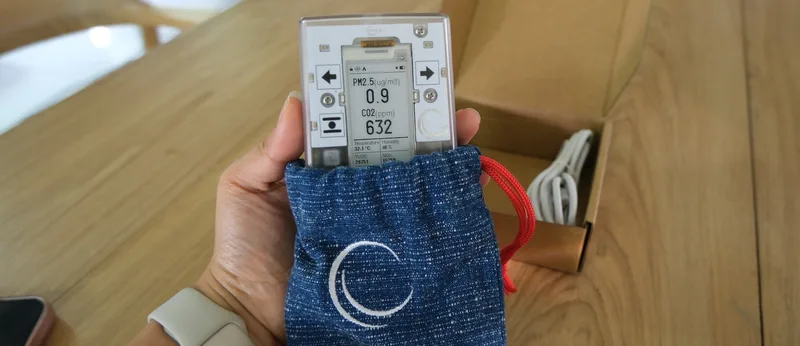
We will also provide each AirGradient Go with a custom handmade bag produced locally here in Chiang Mai using Thai traditional fabric.
This is something I personally like a lot. The Go is a device you should want to take with you. The bag makes it easier to attach the monitor to a backpack, carry it during walks, or bring it along on a commute. Importantly, the bag has openings at the bottom so the device can operate while it remains inside.
BLE, route tracking, and the mobile apps
A lot of work also went into the mobile apps. The AirGradient Go is designed to work independently. It has its own display, GPS, and local storage. You do not need to keep your phone open for it to be useful. But a phone is still the best place to review routes, see maps, inspect exposure patterns, and understand what happened during a walk, commute, or field measurement.
We have now improved the Android and iOS apps and integrated BLE and route tracking so that data can be transferred easily from the Go and viewed on your phone. This is a major part of the overall experience. The device captures the data. The app helps you understand the journey.
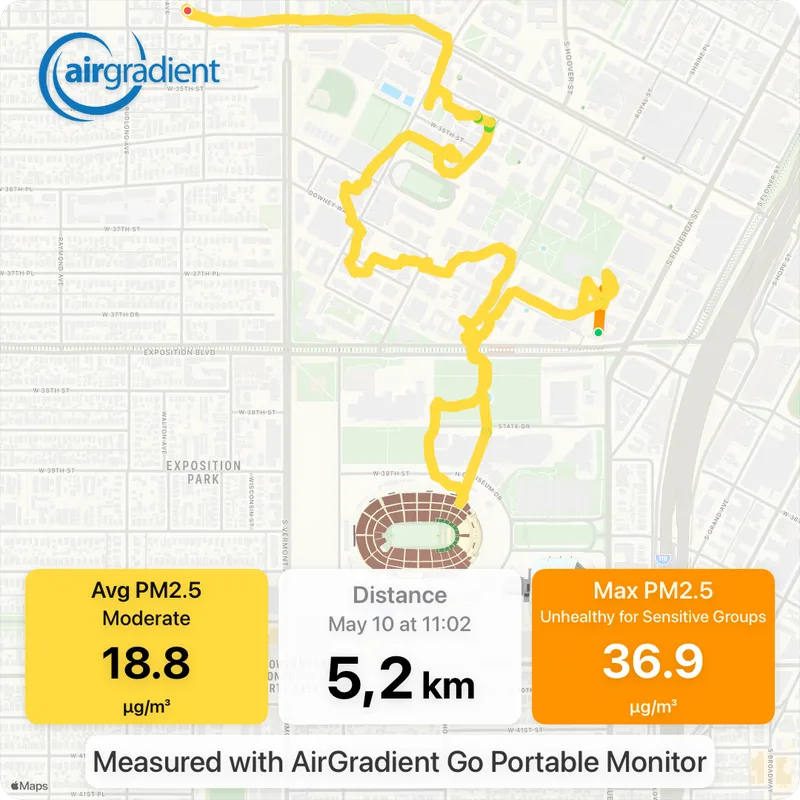
The new app versions are expected to be released in the next few weeks.
Shipping timeline
It currently looks like we are on track to ship the first units end of next month.
There are always risks in the final stretch of a hardware product. Small production issues can still appear. A supplier can be late. A tolerance can be slightly off. Firmware can reveal a last-minute edge case. We are being careful because we would rather fix important issues now than send out something that does not meet our expectations.
A personal note
On a personal note, I think the AirGradient Go is one of the best products we have ever made.
The whole AirGradient team has poured so much heart and passion into this device. The engineers, firmware developers, app developers, designers, production team, and everyone testing and giving feedback have all shaped it. It has been one of those products where every small decision feels meaningful because the final device will go into people’s hands, bags, schools, workplaces, commutes, research projects, and communities.
I believe the AirGradient Go will be a great device for personal exposure tracking and awareness raising. It can help people see what they are actually breathing, where exposure changes, and how small choices in daily life can sometimes make a real difference.
We are getting close now. Thank you for your patience, your encouragement, and your feedback while we build this openly.