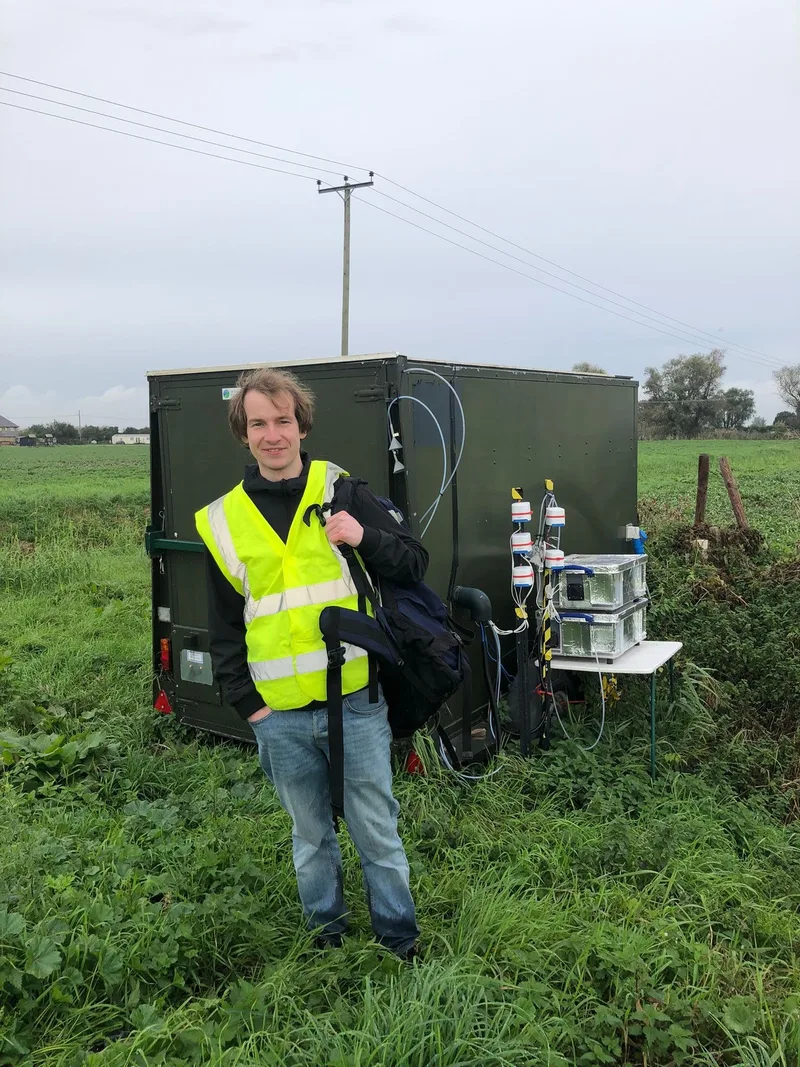
Siriel Saladin, one of our AirGradient colleagues, never planned on being an air pollution researcher. Initially, he was just planning to move abroad to the UK, improve his English and do some hands-on university work. Five years later, he’s still at Cambridge, pursuing a PhD in non-exhaust air pollutants. This topic is particularly interesting for us at AirGradient, as Siriel’s insights to the air pollution side of academia, as well as his own lab work with pollutants, give us a scientific perspective, important to understand the dynamics and developments of the field. In this blogpost, Siriel will dive into his research journey, his experiences and opinions.
Pursuing a doctorate in air pollution
How did you first get interested in air pollution research, was there a moment or person that set you on this path?
I never planned to go into air pollution research. I just wanted to go abroad, improve my English, and do something more hands-on than classroom-based study. That led me to Cambridge for a one-year Master’s by research in analytical chemistry, working on plant surface chemistry.
The key person was my professor, who supervised me during my Master’s and later also offered me the PhD opportunity. I had actually already planned to leave after the Master’s and was about to return home when she told me about a PhD project on airborne tire and brake particles that needed a student. It was very last-minute, basically an overnight decision.
I liked the project and decided to take the chance, so what was meant to be a one-year experience abroad turned into a five-year research journey.
So, you didn’t really choose your topic of interest?
Exactly, the topic chose me.
What did you expect PhD research to feel like versus what it actually is day-to-day?
I expected it to be faster. What surprised me most was how slow academic research is. A lot of time is spent not just doing experiments, but thinking through every step carefully. From reading the literature and designing experiments, to interpreting results, comparing them critically, and translating all of that into a coherent story in a paper. I learned that one well-designed experiment can be enough to make major progress, but designing that experiment often takes far longer than running it. When you're working on something that has never been done before, there isn't a textbook you can consult to check whether you're on the right path.
The limiting factor wasn't how fast I could run experiments, but how quickly I could understand a problem, challenge existing assumptions, and arrive at a conclusion I was confident in. My own capacity to think became a bottleneck, which was a completely new experience for me.
Was there a specific paper, finding, or experiment early on that made you think "this is the right problem to work on"?
Actually, it was the opposite. Early in my PhD, I was studying airborne particles from tires and found surprisingly low emissions in my experiments. That made me question whether I was working on the right problem.
I then went back to the literature and found that many studies reported a similar picture: tires generate a lot of wear particles, but most of the emitted mass is in relatively large particles that do not remain airborne for long.
As a PhD student, you have the freedom (and the responsibility) to follow where the evidence leads. So I shifted my focus towards brake wear emissions. What immediately caught my attention was that brake wear produces large numbers of particles in the 1–5 micrometre range, which falls directly within the PM2.5 and PM10 size fractions that are central to air quality regulation and health studies.
In hindsight, that period taught me something important: sometimes the most valuable result is the one that makes you rethink your research question.
Siriel’s Research
How would you summarize your research?
My research focuses on characterising non-exhaust vehicle emissions, particularly from tires and brakes, and assessing their relevance for human health. As exhaust emissions have decreased due to regulation, these sources have become an increasing share of traffic-related particulate matter.
I study how these particles are generated, what size ranges they span, and what they are composed of. In addition, I work with collaborators to study their potential biological effects in humans.
The aim is to provide evidence that helps place non-exhaust emissions in context in terms of exposure and health relevance, and to support evidence-based assessment of whether any mitigation is warranted and, if so, what form it should take.
What does a typical week actually look like for you?
In a typical week, I spend most of my time at my desk rather than in the lab. A large part of the work is planning and coordination. Writing emails, having meetings, preparing experiments, making decisions, developing strategies, analysing data, supervising undergraduate students, reading papers, and writing manuscripts or presentations.
Lab work tends to come in more intensive phases rather than being evenly distributed. When I am in the lab, the weeks can look very different depending on the experiment.
One example was a collaborative study on the toxicity of airborne brake particles, where we used our brake particle generator together with specialised equipment from collaborators abroad. Because everything and everyone was available at the same time, we compressed a lot of work into a short period to make the most of the setup. I was in the lab for 12 to 14 hours a day, including weekends.
So overall, it’s a mix of largely desk-based scientific work and intermittent, highly focused experimental phases.
How do you deal with the slow pace of science when the problems you're studying feel urgent?
I see it as a question of evidence and interpretation.
In my field, the evidence base for non-exhaust emissions and their health relevance is still developing, while interest and policy discussions are often moving faster than the underlying science. I understand the motivation for early action, but from a scientific perspective it’s important to be clear about what is well established and what is still uncertain.
For me, the key role of the research is to strengthen that evidence base so that decisions (whether and how urgently to act) can be made on robust data.
What's the most unglamorous but essential part of what you do?
Endless emails and meetings.
What are some limitations or obstacles you find challenging in the field or in your research specifically?
One challenge I find is recognising and controlling for human bias, both my own and the field’s. Even in experimental science, interpretation is subjective, so it is important to keep questioning whether conclusions are driven by evidence or narratives.
Air pollution research as a field
How much do scientists actually agree on the health risks of non-exhaust particles, is there consensus or still a lot of debate?
There is broad concern about non-exhaust particles, and some evidence of biological effects. However, unlike exhaust emissions, there is still no evidence base that clearly shows that non-exhaust air pollution causes health damage in humans.
Where do you think the field will be in 10 years, what's the work that still needs doing?
I hope that in 10 years we will have a clear answer on the health relevance of air pollution from tires and brakes, and a better quantitative understanding of its contribution to overall health burden.
If you could change one thing about how air pollution science is funded or communicated, what would it be?
I would like to see more emphasis in communication not only on what results might suggest, but also on what they do not support. In a field like air pollution, where evidence is often partial and evolving, that context is important to avoid over-interpretation and to keep conclusions properly anchored in the data.
Was your research ever misinterpreted?
Yes. When I observed low air pollution from tires, my colleagues and I published a paper. Our conclusion: air pollution from tires is currently overestimated and needs revision. However, time and time again, that paper is misquoted and misinterpreted, used as a source to support the relevance of air pollution from tires. This interpretation opposes our work.
There is an irony in this: our study highlights how the current narrative is based on repeated misquotations, yet the study itself has become part of that same citation chain, unintentionally contributing to the spread of the very narrative it questions.
What do you do when something like this happens with your research?
Sometimes I reach out to the authors to correct their mistakes but often, once a paper is published there is very little one can do.
So what happens then?
Misquotations propagate through citation chains, where an incorrect or overstated claim is repeatedly referenced without returning to the original source. Over time, this can create a self-reinforcing narrative that becomes increasingly detached from the underlying evidence. In my case, the chain of misquotations dates back to 1995.
I believe my case is unusual, more an exception than the rule. Fortunately, there are mechanisms to correct the record once such issues are identified. Based on my work, officials associated with the European Environment Agency have acknowledged that current estimates of tire PM2.5 and PM10 are overestimated and require revision. However, it may take several years before updated values are implemented, during which time the chain of misquotations is likely to continue growing.
Okay, one last question. Do you use AI for your PhD?
Yes, I do. During my experiments, I interpret my observations and draw conclusions. I share these observations with AI to explore alternative interpretations and conclusions. If they align with mine, that is reassuring; if not, I investigate the discrepancy further. In some cases the AI provides unconvincing answers, while in others it helps me recognise assumptions or details I have missed.
Do you also use it for lab work?
Yes. I outline my experimental plan and ask for tips, corrections and limitations. Then, I obviously verify if its recommendations are reasonable. So far, the outputs from AI were surprisingly accurate and helpful. While always staying on top of it, I use AI as a tool to maximise my thinking capacity.
Research is so efficient with AI, it’s like talking with a hundred scientists at the same time.