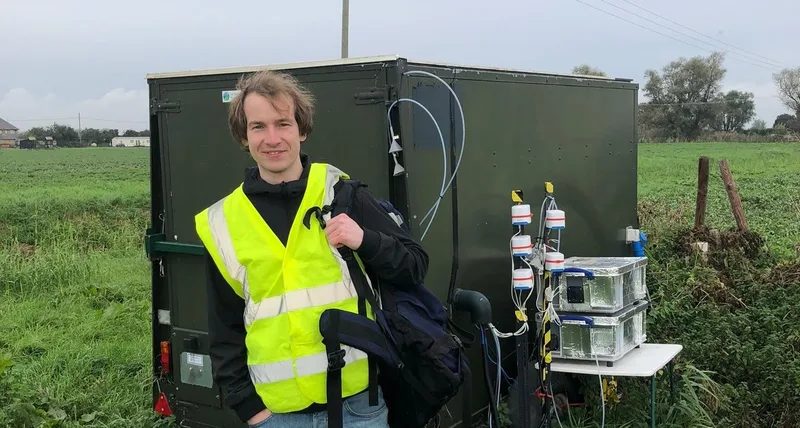
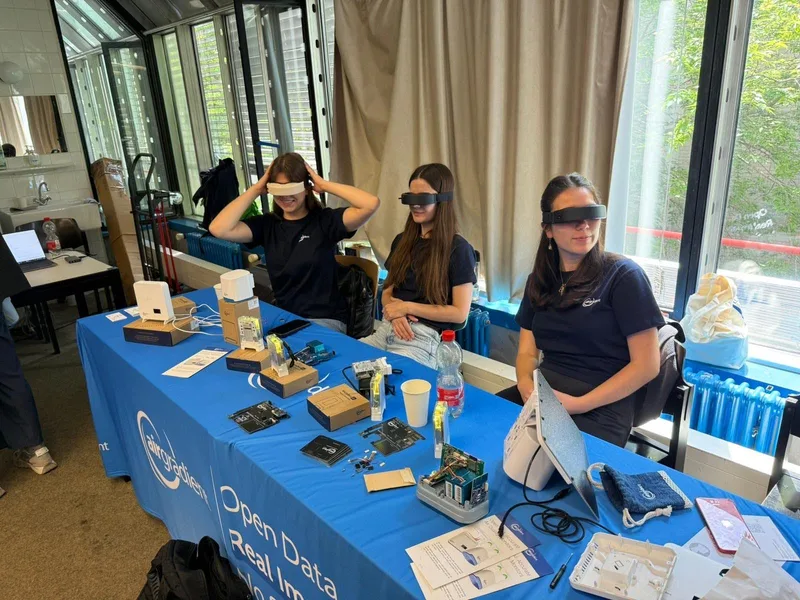
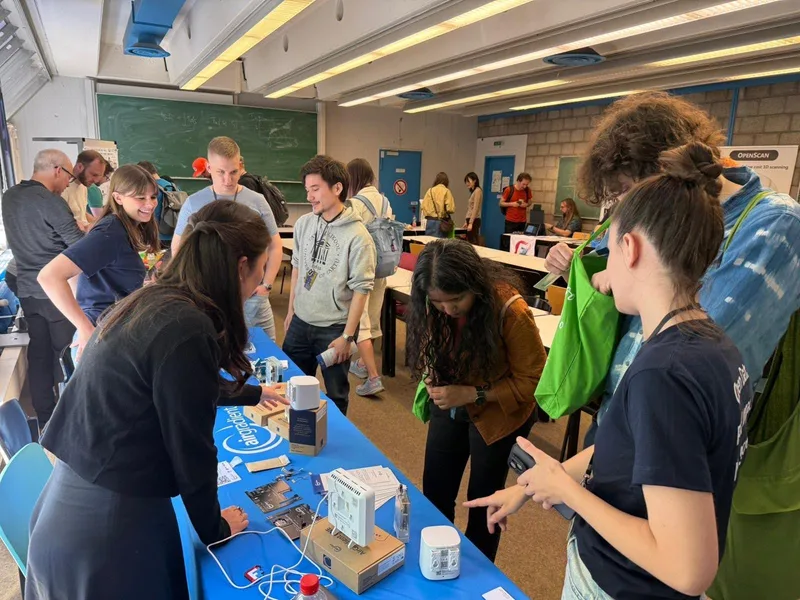
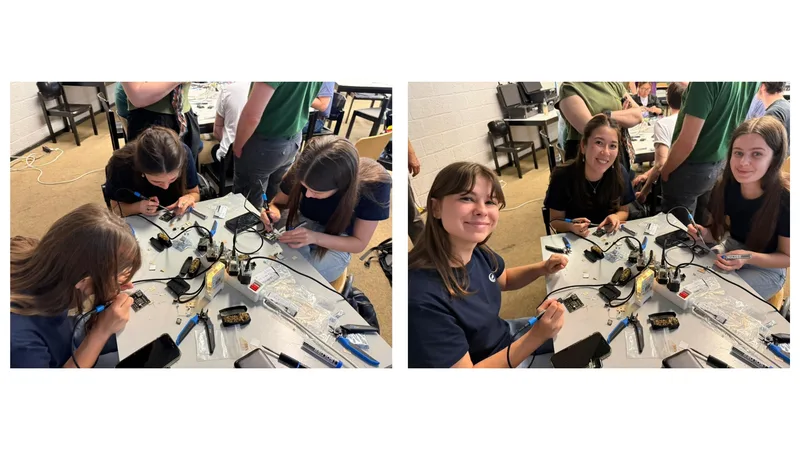
Wow, what a weekend. Last Saturday and Sunday, our team set up a booth at the Open Source Hardware Summit 2026 in Berlin, Germany. The conference was full of interesting talks and fascinating workshops, where we learned how to solder and make shiny jewelry from just a battery, wire and a couple of LEDs. The summit featured many small and medium size manufacturers of open source hardware products ranging from a fully wooden percussion set to hand-made running shoes and sneaky TV-B-Gone remote controls that can turn off any TV from as far as 50m away.
Our own booth was also quite popular. People would come up to us to ask questions about parts, calibration, shipping, and manufacturing, but the most recurring question was: How do you make an open source business successful?
The summit’s participants were eager to hear our “success story,” which is why in his presentation Achim highlighted 5 main advantages of an open source business model which worked for AirGradient.
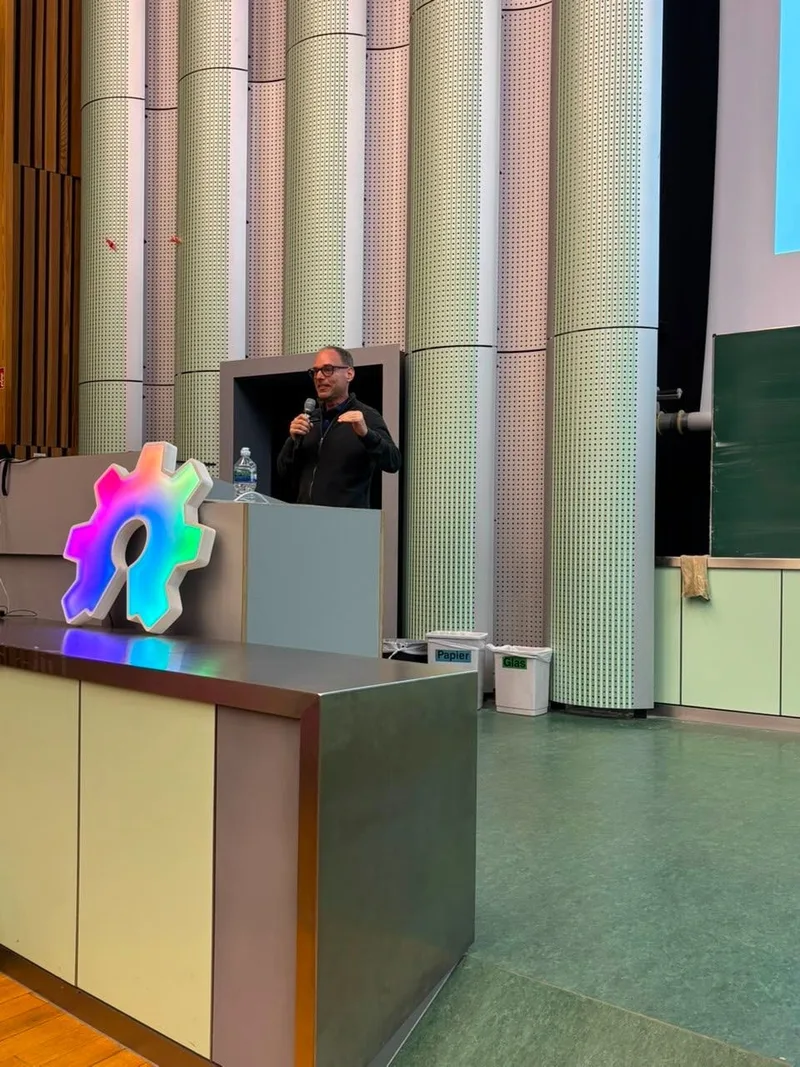
Accelerates Innovation and Builds Community
Open source practices allow for input and help from all around. AirGradient managed to integrate its sensors into the Homey smart home system in just 3 weeks, relying on the help of a couple of developers found on an online forum. When your data and processes are public, and you can just send over information about your product without any constraints, people from all over the world can support you in any developments, improvements and innovations you might need – even suggesting what features might be missing. In the end, your project or product will be well-rounded and feature-filled, and you will have a community of supporters to advise and help you achieve remarkably rapid changes and speedy development.
At the conference, we saw this in real-time. Everyone was giving each other advice. One man came up to us and tested his glasses, which flash lights and induce meditative effects. We gave him advice about how his design could be more comfortable. Another attendee actually came up to our booth and started giving us ideas about whether we can integrate the reductions wearing a mask would cause to the cigarette-formula we have in our app (iOS and Android).
All the while, Achim was giving advice to vacuum clean designers about how to reconcile a 3D printing design with large-scale production methods that use molds. Overall, by being completely open about every detail of manufacturing, you give the community around you the ability to help you accelerate your own innovation.
Opens Powerful Partnerships
As AirGradient, we’ve had a couple of partnerships with powerful organizations. Our work with UNDP and UNICEF, or esteemed universities such as Cambridge and Imperial College are some examples. Often, these organizations specifically require partners to exhibit transparency and openness. In the context of deploying a network in a country, an organization’s ideal partner is someone who has skills they are willing to actually transfer to people, so that this skill can be replicated. The open source mindset allows for exactly this, which is why these powerful and often “big players” actually prefer to work with open source companies for their projects. We understand that powerful partnerships also come from having visibility as an open source business. By contributing to sponsoring the Open Source Hardware Summit, we also want to hopefully support the next open source business.
Maximizing Impact
By sharing your process and your product at every stage, you open yourself up to feedback from people who might offer indispensable insights. Open source lets you move from a top-down approach of product development to an integrative one. By asking for feedback all throughout the process, you create something actually useful. At AirGradient we collaborate with community members asking them how we could improve our products to make them more efficient, effective and empowering. Recently, we even had a meeting session with some of our partners on how we can improve our mobile app.
At the conference we met people from Maker Emergency Kits, who are making emergency kits for people in crisis environments. They emphasized their devotion to fostering continuous conversation and feedback exchange with everyone around to provide tools that are actually useful to those impacted, and not just sensible to someone on the outside. They said that their work is focused around workshops with students, scientists, and local community leaders, brainstorming improvements and additions to their product. Open source creates a space of communicating and learning from each other, maximizing impact of the product.
Capacity building
Additionally, with open source, anyone can replicate your product, improve it and thus make your mission or goal more attainable. At AirGradient we are very aware that we cannot improve air quality around the world just by ourselves, it needs to be a joint effort, which is why we share our resources and hope that people will join in.
Additionally, all of our additional resources: workshop presentations, blog posts, and educational materials are all available for community members to use, replicate and reshare. Partners are encouraged to draw on resources such as the Open Source Air Quality Monitoring Toolkit in their own events and workshops and pass them along to anyone who could benefit.
Keeping Us Competitive
As a last parting point, Achim stressed that being open source forces us to stay competitive. We must be “one step ahead of the cloners” in terms of cost-position and innovation. What does this mean in practice? Anyone could copy our designs and manufacture them at a large scale; in fact, we are comfortable with that idea because we know that the state of air quality monitoring is not solvable by one company. This possibility pushes us to constantly reflect on what we, as AirGradient, bring to the table. Our large science team and their creative approaches to optimizing our monitor design, is one thing that sets us apart from a company that might use our design in a purely profit-driven way.
The act of sharing your designs initially puts you in a vulnerable position against proprietary competitors. But if you accept this vulnerability and use it as a tool to force you to innovate constantly, this vulnerability becomes a strength.
Conclusion
Overall, what this presentation stressed, and what was proven true by attending the conference, is that the community around the open source mindset or philosophy is something unique, strong, beautiful, and future-oriented in a sustainable way. In contrast, most of the world is becoming increasingly individualistic, proprietary, and continues to exploit depleted resources. We hope that this open source mindset and its amazing community grows stronger, and our commitment to staying open source has only grown.
Last but not least, some highlights of our trip
- We learned how to solder TV-B-Gone remotes!
Anastasiia had her first proper, Berlin Gemüsedöner.
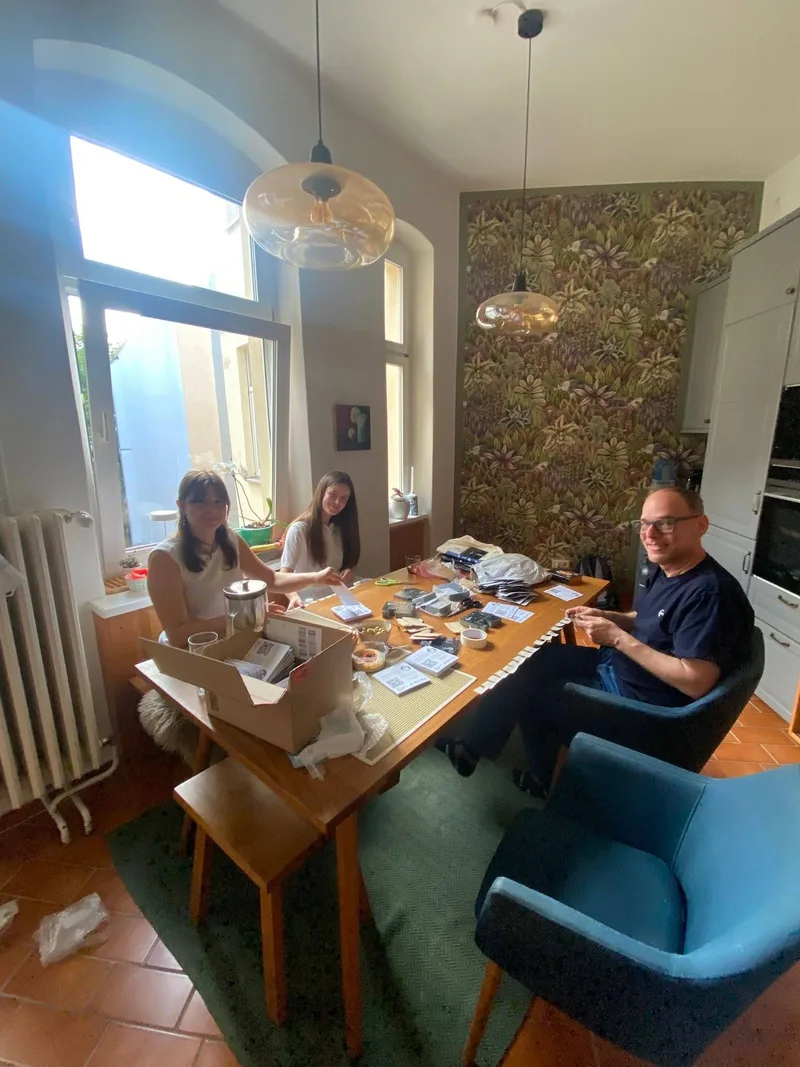
We spent Friday evening in Emilia’s flat, taping together 300 PCB kits as take-home presents for conference attendees.