During the keynote address of the Indoor Air 2026 conference we attended yesterday, the keynote speaker Lidia Morowska used slides in her presentation from 2000.
Why did she use such outdated slides? Because since she used those same slides 26 years ago, little has changed in policy attitudes toward indoor air quality. As a research field, indoor air quality has been around for a long time. The knowledge that indoor air pollution is a health risk, contributes to disease and has a heavy economic cost has been there for decades, but only recently, thanks to a small event you might know as Covid-19, has it become a point of interest for people beyond the air quality and public health space. Only now are we making strides towards prioritizing indoor air pollution and not just assuming that indoor spaces protect us against ambient pollution. However, Dr. Morowska stressed that universal standards for indoor air quality are still needed, similar to the national ambient pollution standards that are used almost universally.
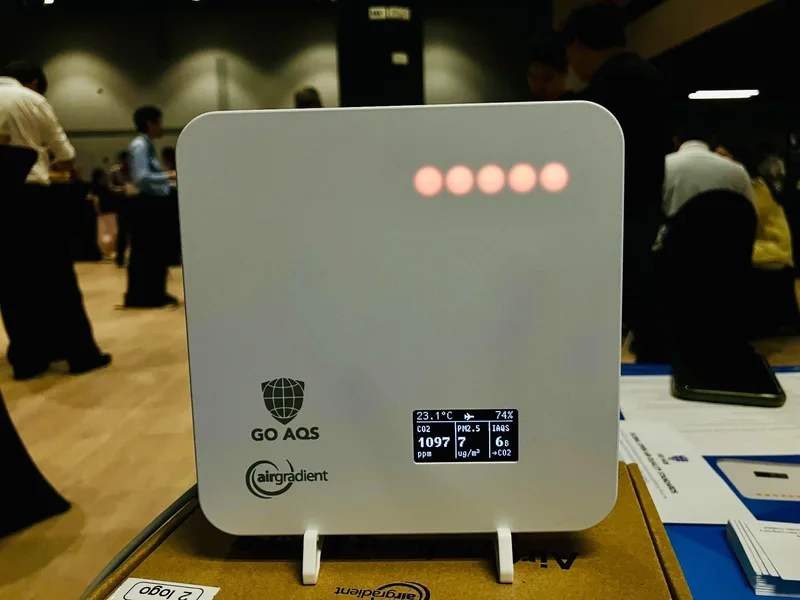
This remark was quite fitting, as we displayed the AirGradient ONE monitors at our booth that we configured to show the new Global Open Indoor Air Quality Standard (GO IAQS). We made these monitors for Sotirios Papathanasiou, the founder of GO AQS, a science and policy initiative aimed at standardising how we measure indoor air quality. These sensors now show a grade from 0-10, of which 10 is the worst score, and this numeric scale is divided into 3 parts A, B and Z, which translate to Good, Moderate and Unhealthy. So now, the ONE with the GO AQS standard could show a score of 6B, meaning the air is moderate. Most helpful with the GO AQS standard fitted into the ONE is that under the score, the main pollutant contributing to the score is shown. This way, you can more easily tell whether it’s PM2.5 or CO2 that is causing pollution and can adjust your environment accordingly. Here’s how we integrated it into our system.This new feature directly corresponds to Dr. Morawska’s address - we need standardization in indoor air quality to have a common global foundation in understanding and tackling it.
Another highlight of the conference was a poster made by an 11-year old girl from Qatar. She developed a low-cost filter for airborne micro-plastics, which costs about 20$ and is made from household items. She first developed an innovative, low-cost air filter during her Grade 5 school exhibition, using a simple tiffin lunch box, a car AC filter, and a small DC fan. She was then mentored by Dr Asit Kumar Misra from University College Cork, and converted her school project into a full research paper, that she presented as a poster yesterday. Here is a newspaper article about her project and her father’s blog about her time at Indoor Air 2026.
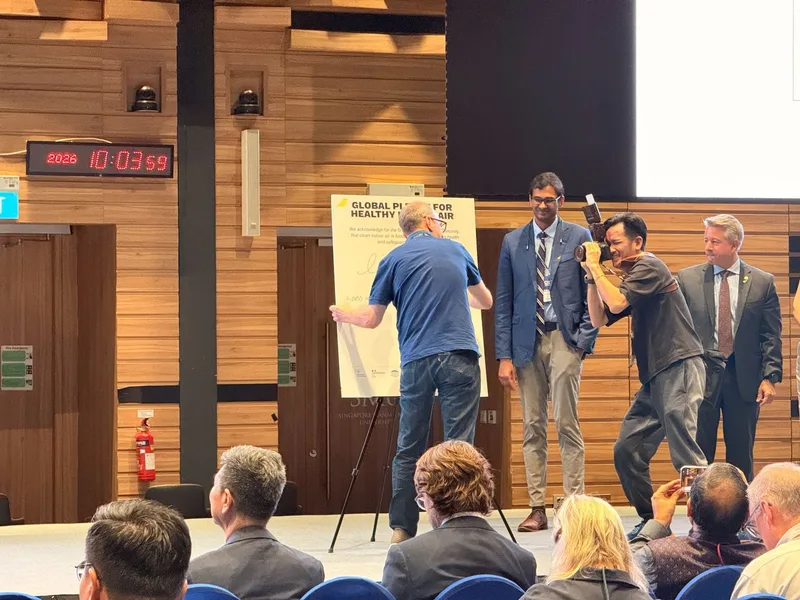
Lastly, as AirGradient, Achim signed the Global Pledge for Healthy Indoor Air, joining the global movement that recognizes the fundamental importance of indoor air quality. Here’s a photo of his pledge ceremony.
Overall, we enjoyed the Indoor Air 2026 conference, and felt that our booth was quite popular. The AirGradient Go received lots of interest overall and also excitement from people who have already pre-ordered and are patiently waiting for us to ship them out. Our new poster of Breezy was also a hit!

Last but not least, being in Singapore was also lots of fun. We visited some hawker centers, had sesame almond icecream, and walked along Marina Bay. Here are some team photos from our trip!