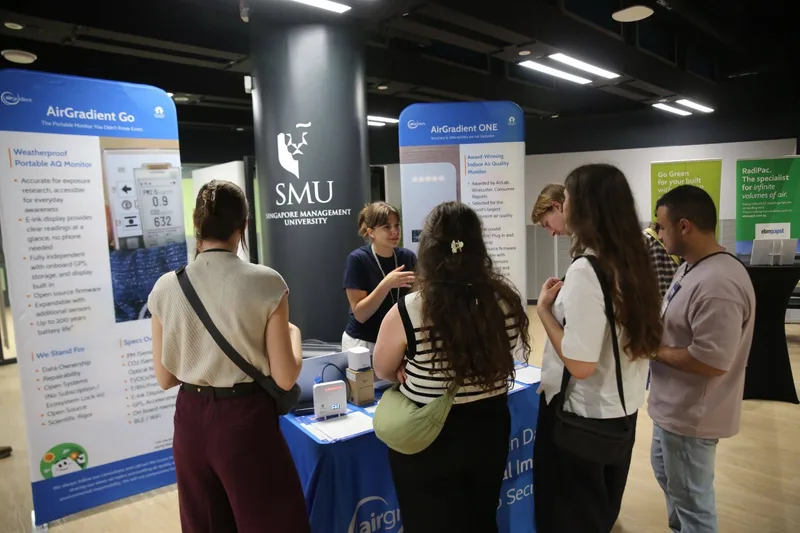
Earlier this month, members of the AirGradient team were in Australia. I attended the CASANZ Clean Air and Odour Conference in Cairns before visiting Queensland University of Technology (QUT), where I delivered a lecture on our open-source business model and met with researchers working on indoor air quality.
Across both visits, one question stayed with me. How can we make openness the standard across the air-quality monitoring sector?
What Stood Out to Me at CASANZ
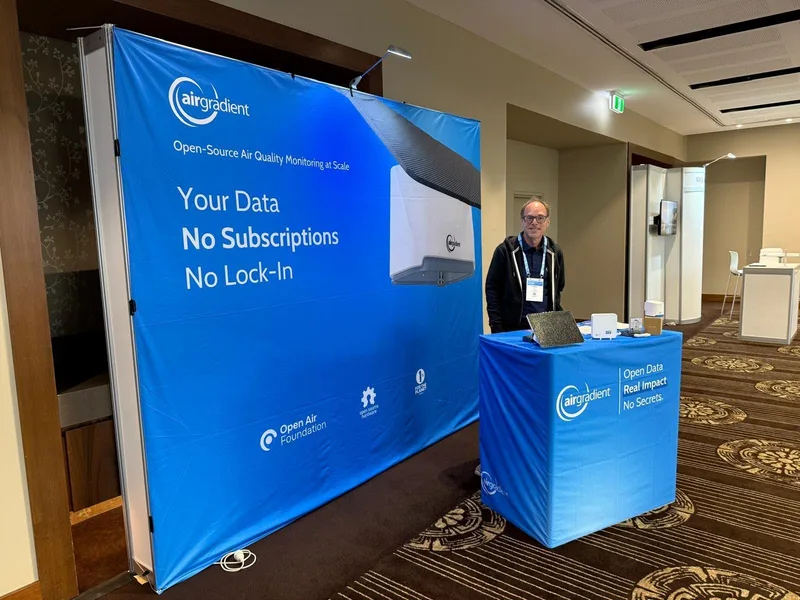
One thing that stood out from our conversations at CASANZ was how much interest there was in AirGradient’s open-source model, particularly among academics, government officials, and people working in the public sector. They valued the fact that we at Air Gradient avoid vendor lock-in and subscriptions, give users ownership and control of their data, and publish our schematics so monitors can be repaired or serviced locally.
This felt particularly relevant at a conference where many of the sessions focused on scaling low-cost sensor networks, assessing their performance under real-world conditions, and making monitoring data useful for communities and decision-makers. Open source does not remove the need for careful calibration and data interpretation, but it gives public institutions greater visibility into how their monitoring systems work and more freedom to evaluate, adapt, and maintain them over time. It can help turn a one-off equipment purchase into long-term monitoring capacity that does not depend on a single company or procurement cycle.
Something else that stood out was the strong presence of traditional air-quality monitoring firms. If we want to measure air quality at greater scale without compromising accuracy or durability, we cannot continue relying on business models built around selling high-cost sensors in low volumes. The sector needs to focus more on making monitoring technology clearer, more accessible, transparent, repairable, and sustainable over the long term.
My Reflections from QUT
At QUT, I had the opportunity to meet with the THRIVE team, led by Distinguished Professor Lidia Morawska. THRIVE, formally known as the ARC Training Centre for Advanced Building Systems Against Airborne Infection Transmission, is an interdisciplinary research centre funded by the Australian Research Council and hosted by QUT. It brings researchers and industry partners together to develop building systems that improve indoor air quality, reduce airborne infection risks, and inform future policy and operational guidelines.
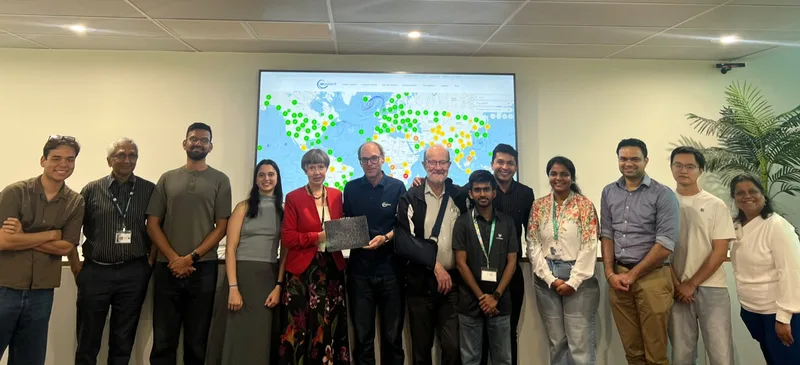
The team is putting this mission into practice through the landmark refurbishment of P Block. The three-year project aims to turn QUT’s Science and Engineering Building into a living laboratory, demonstrating how existing buildings can meet proposed indoor air-quality standards. More than 200 monitors will feed real-time data into an AI-enabled building management system.
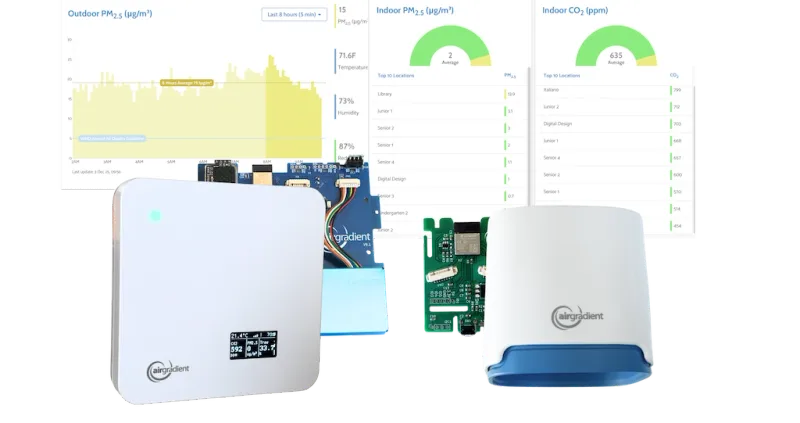
The AirGradient ONE was selected following five months of monitor scoping, protocol development, testing, and data analysis. Four shortlisted monitors were tested in the laboratory and under real-world conditions, with their readings compared against reference instruments and international guidelines. Performance was considered alongside technology, data security, connectivity, maintenance requirements, and cost.
While all four monitors performed well, the AirGradient ONE was selected as the best overall fit for the project. For me, this selection is especially meaningful because it validates the hard work our team has put into improving sensor performance over the years and building a monitor that is accurate, reliable, and practical to deploy at scale
Our conversation then moved beyond the P Block deployment. During the meeting, I also demonstrated the new public platform for indoor air-quality data that we recently launched. Our goal is to build the world’s largest open indoor air-quality dataset, and so far, 1,900 people have opted in to share their data. Over time, this could support research into mold risk, thermal comfort, indoor pollution sources, mitigation strategies, and the relationship between indoor and outdoor air quality.
The QUT researchers responded warmly to the platform while also raising important questions. How do we account for selection bias if people with better indoor air quality are more likely to share their data? How much can we learn without more context about the homes being monitored, such as how well sealed they are or whether sensors are located in kitchens, bedrooms, or other spaces? These questions do not weaken the case for open data. They show why openness must be accompanied by an honest discussion of both a dataset’s potential and its limitations.
That exchange was one of several moments that showed how much we have in common beyond the P Block project. The THRIVE team shares our commitment to open data, transparent technology, and monitoring systems that can be deployed at scale. We also discussed how these principles could support capacity-building and projects with a wider social impact, including in Pacific Island communities close to Australia. Together, these conversations made me feel that our relationship with THRIVE could become much more than a single sensor deployment.
I left Australia encouraged by how strongly our approach resonated with practitioners and researchers alike. My conversations at CASANZ and QUT opened the door to new collaborations and reinforced my belief that accurate monitoring must also be open, accessible, and practical at scale. I look forward to seeing where these relationships lead.