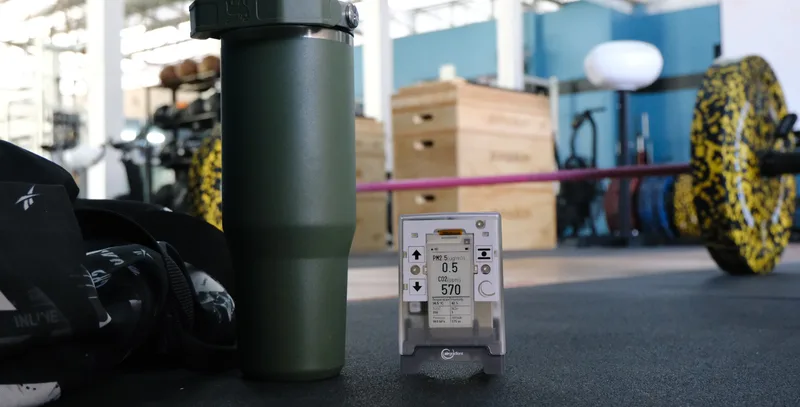
In 2023, a team of economists went looking for the effects of air pollution in an unusual place: professional chess tournaments. They linked readings from air quality monitors inside the tournament halls to more than 30,000 moves across three tournaments, with every move graded by a chess engine (in this case, Stockfish, a program which plays far beyond the level of any human). When the PM2.5 concentration in the room rose by 10 µg/m³, players became 26.3% more likely to make a meaningful mistake - and the damage grew as the timer was running out.
Keep in mind that these were expert players, performing a task that many of them had trained their whole lives for, indoors, at concentrations between 14 and 70 µg/m³ - the kind of air millions of students sit in every day. If fine particles can quickly push a tournament player into blunders, it’s pretty easy to guess what they do to a student mid-exam.
I first wrote about air pollution and its relation to studying and exam scores back in 2020 on my personal blog, when I was a university student myself. The summary of the research at the time was 'this probably matters, but we can't say exactly how, or how much'. Six years later, that answer has changed. We now have studies following cognitive function in office workers across six countries, natural experiments from wildfire smoke drifting over schools, and intervention studies measuring what happens to test scores when a classroom's air is actually cleaned.
So, in this article, I want to finally revisit the topic with everything that has been learned since, focusing on where it matters most: schools. The evidence now runs all the way from smoke days to exam halls to what students earn years later. It also points at a dilemma nearly every school faces, because the obvious fix for outdoor pollution - closing the windows - creates a second, equally problematic issue indoors. But more on that soon!
What Does Air Pollution Do to School Results?
While I found the introductory example quite telling, it’s important to note that chess players are adults who chose to be in the room. Students don't get that choice. School is compulsory, it happens indoors, and it happens while their lungs and brains are still developing. So my first question is whether the effect we discussed at the chessboard shows up in classrooms at schools - and thanks to an unfortunate natural experiment, we now know it does.
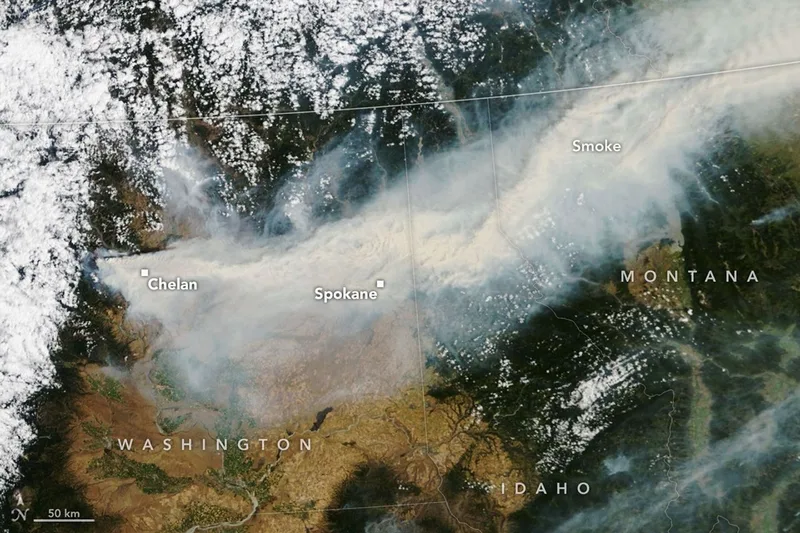
Between 2009 and 2016, researchers at Stanford tracked standardised test results across almost 11,700 US school districts and matched them against satellite estimates of wildfire smoke. Scores in both maths and English fell measurably in smokier school years, with the impact concentrated in primary school students (grades 3 to 5), while students in grades 6 to 8 showed no clear effect. As you can probably predict, the impact was far worse (nearly doubled) when the smoke arrived on school days rather than weekends.
Of course, most schools will never (or very rarely) sit under wildfire smoke, so I went searching for other studies and found one about something far more ordinary: traffic. By following students who changed schools, researchers compared those who moved to a school downwind of a major highway against those who moved to an upwind school the same distance from the same kind of road. The downwind students' test scores fell, while their absences and behavioural incidents rose - despite the only meaningful difference being which way pollution from traffic was being carried. In other words, it’s not just severe pollution events that impact students, but normal, everyday pollution.
An earlier Israeli study (and one that I remember reading when I wrote my initial article), went so far as to link PM2.5 concentrations to future earnings. Israeli students sit the Bagrut, a series of high-stakes exit exams that largely decide university admission and are required to graduate high school. Because each student sits several exams, researchers could compare the same student on cleaner and dirtier days - and on polluted exam days, scores dropped. Since a worse Bagrut result increases the difficulty of university admission (and can limit which universities will accept the student), a decade later, students who happened to sit their exams in bad air were earning around 30 USD a month less than their peers who sat the exams on days with lower PM2.5 concentrations.
So, while PM2.5 has been linked to cognitive performance many times in the past, it’s becoming increasingly clear that fine particles are also costing students marks, and marks compound into futures.
So Schools Should Just Close the Windows, Right?
If PM2.5 - primarily entering from outdoors - costs students marks, the instinct is obvious: keep them out. All we need to do is shut the windows and seal the gaps, right? Well, to be fair, on a smoke day, closing the windows is the right call.
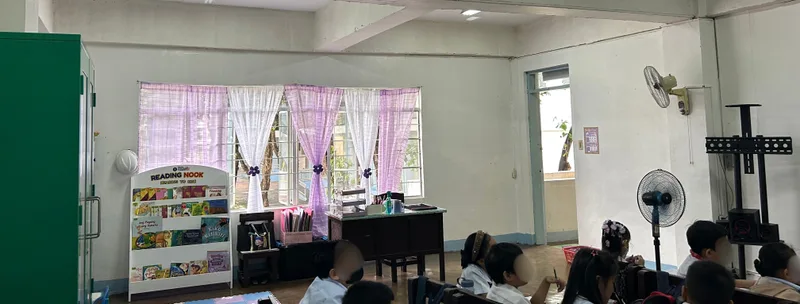
However, classrooms also have a property that makes 'sealed' a trap, and that is density. A typical classroom puts 25 to 30 people in a single room for hours at a time (a crowding level that very few other things in ordinary life match) and every one of the students and teachers is exhaling CO₂ into the shared air. Ventilation surveys across multiple countries repeatedly find classrooms falling short of what standards call for, with typical rates of just 3 to 5 litres per second per person, and peak CO₂ during lessons routinely passing 2,000 parts per million - with maximum readings between 3,000 and 6,000 ppm. If you've ever walked into a classroom at the end of a lesson, you’ve very likely experienced a ‘stuffy’ feeling. That stuffiness is the carbon dioxide concentration.
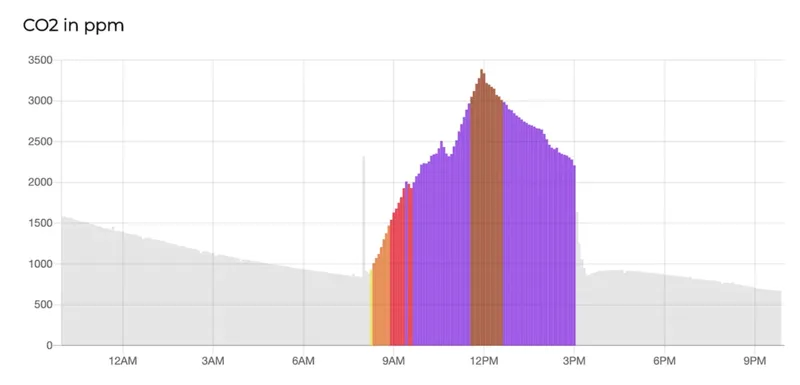
Why does that matter for studying? The study that first put this question on the map came from Harvard in 2016: office workers spent their days in a controlled environment while researchers quietly changed the air, and on days when CO₂ was raised to 1,400 ppm (a level the average classroom passes quite quickly) their scores on a cognitive test battery came out roughly half of what they managed on the cleanest-air days. That result came from just 24 people in a chamber, and later research testing CO₂ on its own has found smaller and less consistent effects, so it’s important not to hang the whole argument on this figure. However, a six-country follow-up in real offices pointed the same direction: as ventilation fell (with CO₂ as the marker), workers' response times slowed and their accuracy dropped - on top of the separate damage from PM2.5. While these studies were done on office workers, no one can argue that a drop in cognitive performance helps students.
So here is the dilemma in full. Most classrooms worldwide use natural ventilation which means the window is the extent of the ventilation system. Open it, and on a polluted day you let outdoor PM2.5 in. Close it, and within a short amount of time the room fills with what thirty people have breathed out. In the end, teachers end up choosing between pollutants, usually without any way to tell which is the bigger issue.
How Do Schools Fix Both Problems at Once?
In 2015, the largest gas leak in US history happened at Aliso Canyon in Los Angeles, and the gas company responded by installing air filters in every classroom within five miles of the leak. By comparing schools just inside that boundary against near-identical schools just outside it, one researcher found that the filters lifted maths scores by 0.20 standard deviations - roughly three months of extra learning - and English scores by 0.18. Interestingly, no gas was ever detected inside the schools. The filters were simply removing everyday urban pollution that nobody had considered a problem previously. Keep in mind, this is in an area with generally quite good air quality.
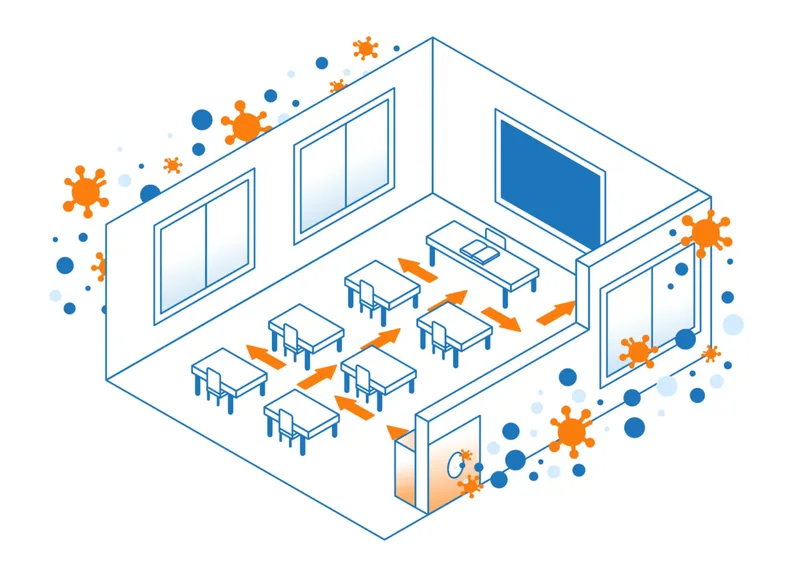
However, filters alone only answer half of our dilemma. While a good purifier will remove the PM2.5 from a room, it recirculates the same air while it does it, and that means it does nothing about CO₂. Thirty students in a sealed classroom with a purifier will enjoy clean particle readings while the CO₂ is still climbing past 2,000 ppm. A purifier solves the pollutant you can filter but it cannot solve the pollutant you exhale.
This is where positive pressure systems come in, and it's why we think they deserve far more attention in schools. Where a purifier cleans the air already in the room, a positive pressure system takes outdoor air, pushes it through a filter, and blows it into the classroom, keeping the room at slightly higher pressure than the outside. This one change does three jobs at once. The incoming outdoor air dilutes the CO₂ that the students and teachers produce, the filter reduces the particles on the way in, and because the room is pressurised, air leaks flow outward through every crack and gap - so unfiltered air can't seep in around the edges like is usually would.
While proper ducted mechanical ventilation is the textbook answer to the window dilemma, retrofitting it through a school is expensive, disruptive and, for many older buildings, simply not going to happen. A positive pressure system is an addition rather than a rebuild: a unit, a filter, and a reasonably well-sealed room.
If you can run one, the window dilemma becomes a non-issue. The windows stay shut, the particles stay out, and the CO₂ stays down. The teacher no longer has to choose between pollutants.
That being said, a PPS assumes a classroom you can seal, and plenty of schools - especially under-resourced ones in developing countries - teach in open-air or semi-open classrooms, where sealing the room isn’t possible. These classrooms have typically already solved the CO₂ half of the dilemma, but they're fully exposed to the PM half. For these schools, the realistic option is a clean room: take one space that can be reasonably sealed - a library, an office, or otherwise - filter it, and treat it as a refuge for the worst pollution days. It isn't a whole-school but one room of clean air during a smoke episode beats zero.
Conclusion
When I wrote about this topic in 2020, I ended by saying that air pollution 'needs more awareness'. Six years on, I think we can do better than awareness. The evidence has moved from 'this probably matters' to numbers you can take into a budget meeting: 26.3% more blunders at the chessboard, three months of extra maths learning, and 30 USD a month still missing from payslips ten years after one polluted exam morning.
For schools, the practical picture is now reasonably clear too. On a smoke day, closing the windows is right - as long as something else does the ventilating. A purifier handles the particles but not the CO₂. A positive pressure system handles both, without rebuilding the school. Where that is out of reach, a single sealed and filtered clean room is the place to start.